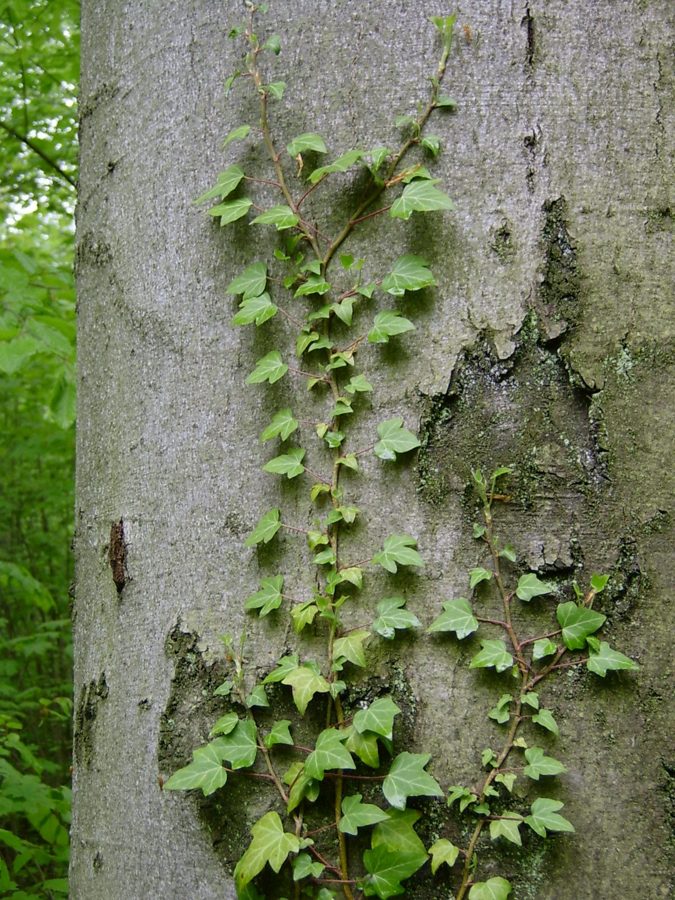
Ivy (Staszek99 (Wikimedia Commons))
References
- Greek κισσός kissos: 2 MAC 6:7
- Greek κισσόφυλλον kissofullon: 3 MAC 2:29
Discussion
Some readers may not think of Ivy Hedera helix as a “tree,” but we include it here because, like “proper trees” it has a thick, woody stem. People in cities, who only see it climbing the walls of buildings, need to be reminded that it also grows in forests. The two references in Scripture are in the Deuterocanon, where we read of ivy wreaths being worn by those in the procession for Dionusos (Dionysus), the Greek god of fruitfulness and vegetation, and of people being branded with an ivy-leaf symbol of Dionusos.
Translation
Since 2 MAC 6:7 refers to a wreath or crown made of ivy, some translators may prefer to use a generic description that does not include the species. If the species name is to be included, as it might be in a study Bible, a transliteration of ivy from a major language is recommended together with a classifier identifying the transliteration as a climbing plant, if such is available. If not, the word for “shrub” or “tree” can be used as a classifier together with a transliteration such as kisos (Greek), hedera (Latin), or one from a major local language.
 Open English Translation (OET)