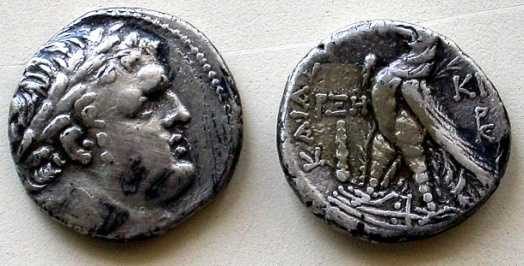
A half-shekel from Tsor (Tyre) (© Kwo-Wei Peng by United Bible Societies)
References
- Greek δίδραχμον didrachmon: MAT 17:24
G04001702400018 G04001702400018: Here the Greek word didrachma (rendered “the half-shekel tax” in RSV) refers to the tax which, according to H00203001301000, was required of every male Yehudi (Jew) from the age of twenty onward.
It is not the amount of the half-shekel tax that is really important in this verse, but rather the nature of it, as seen in GNT, which says “the Temple tax.” Translators can say “the tax all the men [or, all Jewish men] paid for the Temple expenses” or “the tax paid to support the Temple.”
Some translators have wanted to give some indication of the amount of money here and have said “the tax of money of half a shekel” or even “the money called a half-shekel that people had to pay to the Temple.” It is also possible to indicate in a footnote that this was about half the wages a laborer would earn in a day. But this is marginal information and does not need to be specified in the text. Another rendering some have used is “the small amount of money people had to pay to support the Temple.” But translators should be careful not to make the expression too cumbersome. Nor should they give more emphasis to the amount of money than to its function. The Temple tax was paid once a year.
 Open English Translation (OET)