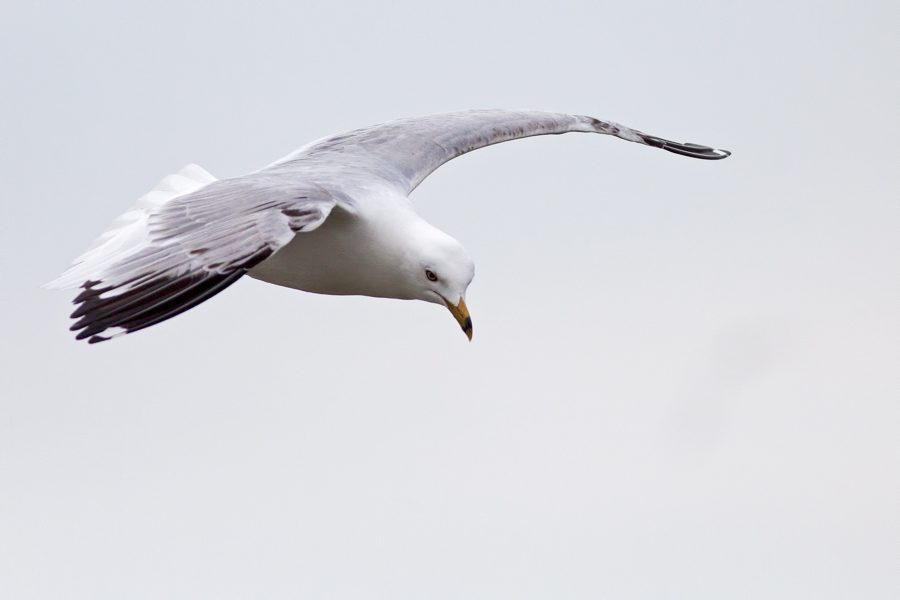
Seagull (Pixabay)
References
- Hebrew שַׁחַף shachaf: LEV 11:16, DEUT 14:15
Discussion
All modern English translations, except NEB and REB (which follow Driver’s suggestion), render shachaf as “seagull” or “gull", and this reflects the overwhelming consensus among scholars. This is also the meaning in modern Hebrew, while the tern (a relative of the gull) is called shechafit ("little gull").
It is likely that in biblical times this word referred to all seabirds with long narrow wings, including gulls, terns, skuas, coursers, shearwaters, and others. There are at least twelve common species of this family of birds found in Yisrael (Israel), along the coastal areas and on Lake Galil (Galilee). The most common are the Black-headed Gull Larus ridibundus, the Herring Gull Larus argentatus, the Common Tern Sterna hirundo, and the Little Tern Sterna albifrons.
Description
Seagulls, as their name suggests, are seabirds, living on the coasts of seas and lakes. Some of their relatives, the terns and skimmers, are also found on the great rivers of the world, such as the Amazon, Nile, Zambezi, Ganges, Brahmaputra, Mekong, Murray, and Mississippi. Some are even found on smaller rivers and ponds. Gulls are bigger than terns and have heavier beaks, with some species having a noticeable hook at the tip.
Most of the birds in this family are white with gray or black backs and upper wing surfaces. They have long flexible wings. They feed on fish or plankton, usually settling on the water to feed. Some dive into the water for their food, and many are also shoreline scavengers, eating dead fish, crabs, and shellfish. They typically follow fishing boats to eat scraps or discarded fish.
Special significance or symbolism
They are listed among the unclean birds.
Translation
Since gulls and terns are found worldwide near the sea or any other significant body of water, a local name will not be difficult to find in such areas. Both of the terns mentioned above occur worldwide, migrating from one hemisphere to the other. The black-headed gull is found in Europe and Africa. In drier or mountainous inland parts of the world where neither gulls or terns are known, a phrase such as “seabird” can be used.
 Open English Translation (OET)