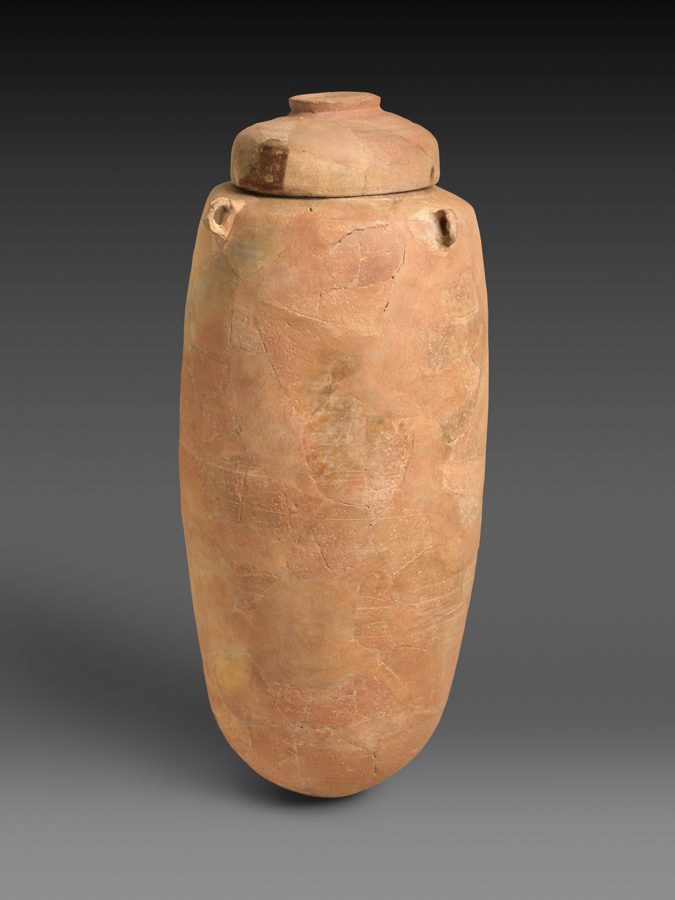
Storage jar with lid (Metropolitan Museum of Art, CC0, MMA)
Reference
Description
The lid was a cover made to fit tightly over the opening of a pot or jar. In some cases the lid was secured by tying it to the container.
———
Translation
The Hebrew word tsamid normally means a kind of bracelet worn as jewelry (see 10.5.2 Bracelet, armlet, anklet<REALIA:10.5.2>). In NUM 19:15, however, it indicates the way a jar was covered. The translation of this verse should convey the idea that the vessel is not closed or covered and so foreign objects might fall into it. Possible models are GNT “Every jar and pot in the tent that has no lid on it also becomes unclean” and NCV “And every open jar or pot without a cover becomes unclean.” In this verse the Hebrew word pathil, which describes the situation of the lid relative to the vessel, is expressed by some translations as “tied” (NASB, REB, Luther, ITCL). Others choose a more general term, such as “fastened” (RSV, NRSV, NIV). Another model for the whole verse is “Any jar or pot that is not closed tightly becomes unclean.”
 Open English Translation (OET)