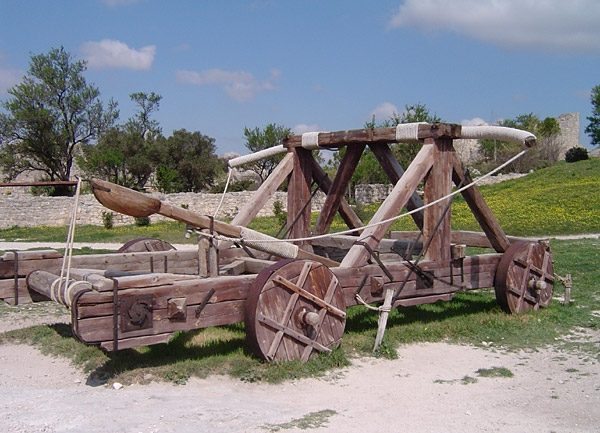
Modern copy of a catapult (© ChrisO, CC BY-SA 3.0, via Wikimedia Commons)
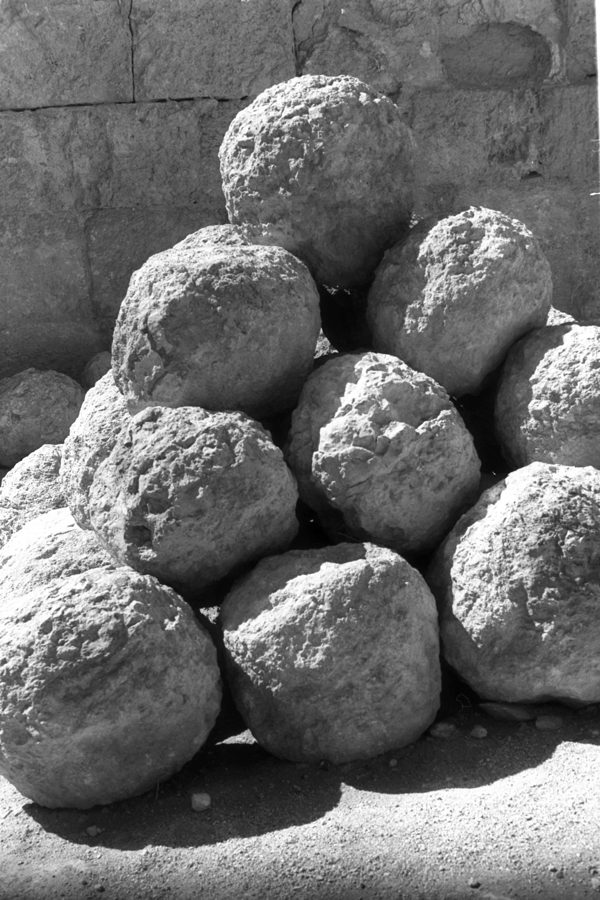
Ballista stones for use in a catapult (Herodion fortress in the Yehudi (Judean) desert) (© Moshe Milner, Israel Government Press Office)
References
- Hebrew חִשָּׁבוֹן chishvon: 2 CHR 26:15
- Greek λιθοβόλον lithobolon: 1 MAC 6:51
- Greek πετροβόλος petrobolos: WIS 5:22
- Greek σκορπίδιον skorpidion: 1 MAC 6:51
Description and usage
The catapult was a device constructed of wood and ropes or leather cords and used in the siege of a city. It consisted of a base to which was attached a long wooden arm. At one end of the arm was an open bowl-like container that held the object to be projected, usually a heavy stone. The arm was forced down by mechanical means, bending the wood into a tense bow. When released, the arm snapped back into place, hurling the stone in the direction of the besieged city. The size of the stones varied widely according to the size of the catapult.
———
Translation
2 CHR 26:15 seems to describe a kind of catapult “to shoot arrows and hurl large stones” (NIV), and most translations follow this pattern. However, this seems to be an anachronism. De Vaux and Yadin suggest that the Hebrew word chishvon in this context refers to projections or frames (which were possibly made of stone, but were more likely wooden frames covered with shields that were erected when attack was imminent) that protected the defenders on the walls of the city as they shot arrows or slung rocks at the attackers below. This is reflected in NJB ’s rendering of 2 CHR 26:15 a, which reads “He also erected expertly contrived devices for the towers and angles of Yerushalem (Jerusalem) from which to shoot arrows and drop large stones.” NJB also adds the following footnote: “Defensive screens projecting from the stonework, not platforms for catapults which were still unknown at that epoch.”
While the Greek text of 1 MAC 6:51 uses three words for instruments to propel objects (see 2.19.5 Fire thrower<REALIA:2.19.5>), some translators may want to combine the three words in a more general phrase, for example, “weapons [or, machines] that threw fire and spears and rocks.” GNT provides a good model: “catapults for throwing fire and stones, and other weapons to throw spears and rocks.”
 Open English Translation (OET)