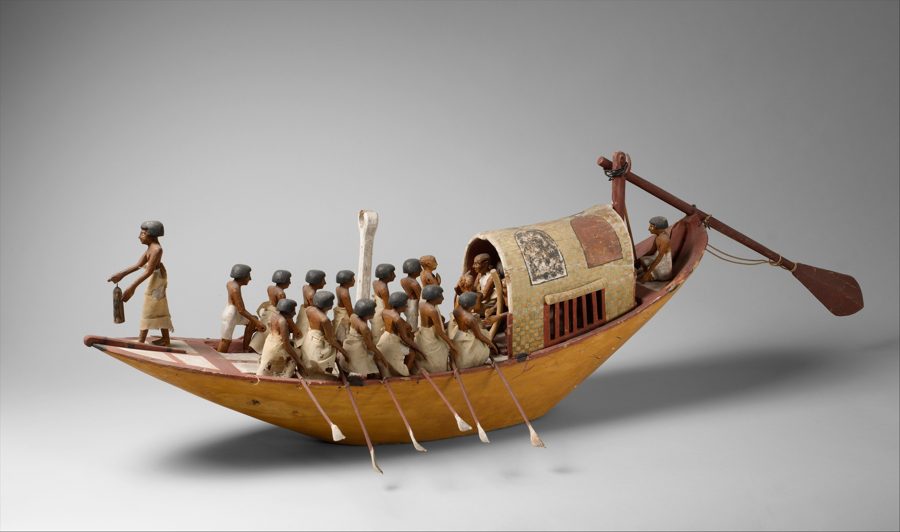
Boat propelled and steered by oars (Mitsri (Egyptian), ca. 1981–1975 BCE) (Metropolitan Museum of Art, Public domain, MMA)
References
- Greek οἴαξ oiax: 4 MAC 7:3
- Greek πηδάλιον pēdalion: ACTs 27:40, YAC 3:4
Description and usage
The rudder was a large plank at the stern of a ship used to direct its course. This could also take the form of two long oars, one extending from each side either behind the ship or in front of it. By moving the rudder or steering oars from side to side, it was possible to control the direction of the ship.
———
Translation
Ancient ships had “steering oars,” one on each side sticking out toward the back or toward the front. In some languages “steering oars” may be rendered “rudders” or “oars that served like rudders.” In other languages translators must use a descriptive phrase, such as “large oars that the boat used for steering.” For languages in which there is no regular term for “oar” or “rudder,” you may even use an expression such as “large pieces of wood at the back of the boat used to steer it.” Also possible is “instrument for steering the ship” or “instrument for making the ship go the way one wants it to go.”
Even though the rudder could be a large wooden plank, it was small in relation to the size of the whole ship. This is the point in YAC 3:4: a relatively small plank can change the direction of a large ship.
 Open English Translation (OET)