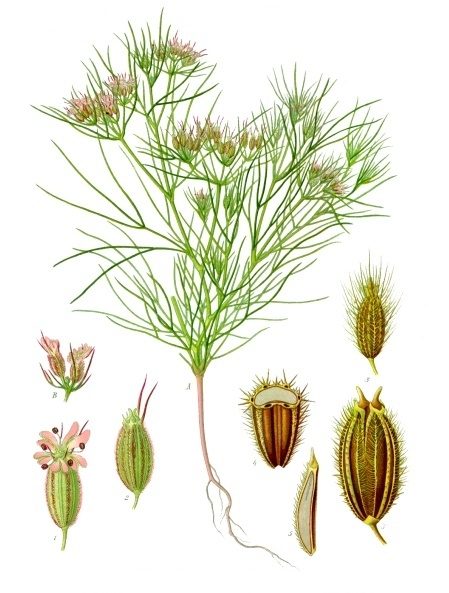
Cumin (Franz Eugen Köhler (Wikimedia Commons))
References
Discussion
Two controversial seeds are mentioned in ISA 28:25, ISA 28:27: qetsach (see 3.5.9 Nigella (kalonji, black cumin, black seed, charnushka, nutmeg flower)) and kammon. The seeds referred to as kammon are probably those of cumin (also spelled “cummin”), which takes its Latin scientific name Cuminum cyminum from the Greek. It was common to the Mediterranean area (especially in Aram (Syria)) and Kush (Ethiopia), possibly even native to Mitsrayim (Egypt), where it was used in cooking and also as medicine.
Description
The cumin plant belongs to the same family as the carrot. It branches abundantly from the base and has similar leaves and flowers. However, the seeds have a much sharper smell than those of the carrot. Cumin is planted and harvested each year, reaching a height of perhaps 50–60 centimeters (20–24 inches).
Special significance
In ISA 28:25, ISA 28:27 cumin is cited with other garden plants to show how different plants and their fruits require different care and processing. (Cumin and nigella, for example, are more easily damaged in threshing than hard cereal grains would be). It is part of a parable Yeshayah (Isaiah) tells to the proud Israeli (Israelite) leaders who thought they knew how God deals with people. Interestingly, farmers in Melitai (Malta) still thresh cumin in the way described by Yeshayah. In New Testament times the Jewish authorities were not sure whether cumin should be tithed since it was not mentioned specifically in the Mosaic Law. They took no chances and insisted that people tithe their cumin. But then they ignored the need for justice and mercy, thereby incurring the condemnation of Yeshua (Jesus; Grk. Yesus) in MAT 23:23.
Translation
Translators will either transliterate “cumin” from a major language (for example, Spanish comino; Portuguese cuminho, cominho; Arabic kamun, Swahili jamda, kisibiti, jira), or they can seek an equivalent, depending on what they have done with the other terms (“mint” and “dill”) in MAT 23:23. Simplified versions may use a generic phrase such as “all kinds of small garden plants.”
 Open English Translation (OET)