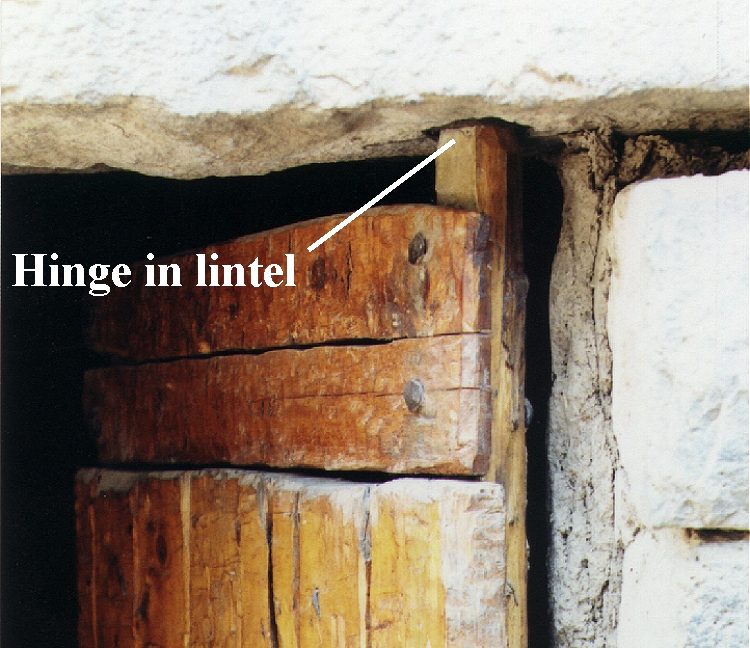
A wooden socket hinge on a door (© Ray Pritz by United Bible Societies)
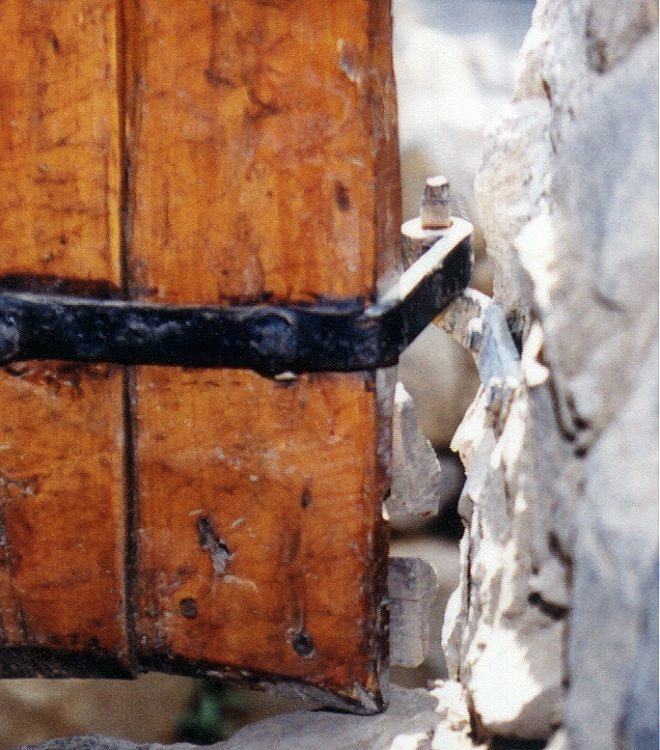
A metal hinge on a door or gate (© Ray Pritz by United Bible Societies)
References
- Hebrew גָּלִיל galil: 1 KI 6:34
- Hebrew פֹּת poth: 1 KI 7:50
- Hebrew צִיר tsir: PROV 26:14
Description and usage
The hinge was a device for attaching two things in a way that they were free to swing relative to each other. On a door the hinge was the point at which the door was attached at the top (the lintel) and at the base (the threshold) or to the doorpost (if there was one), allowing the door to swing open or closed. Hinges for doors of simple dwellings were often just extensions of the wooden door that stood in indentations or sockets in the stone lintel and threshold of the doorway. Hinges for larger doors were made of metal. A metal hinge consisted of three parts: two leaves, one attached to the door and one to the wall or doorpost, and a metal pin that held them together.
Translation
The exact meaning of the Hebrew word galil in 1 KI 6:34 is uncertain. REB takes the word (which is related to a Hebrew verb meaning “to rotate”) to be a “swivel-pin,” that is, a kind of “hinge.” Many translations render this difficult verse in a way that makes it unnecessary to identify the specific object intended by galil; for example, GNT renders the whole verse as “There were two folding doors made of pine.”
 Open English Translation (OET)