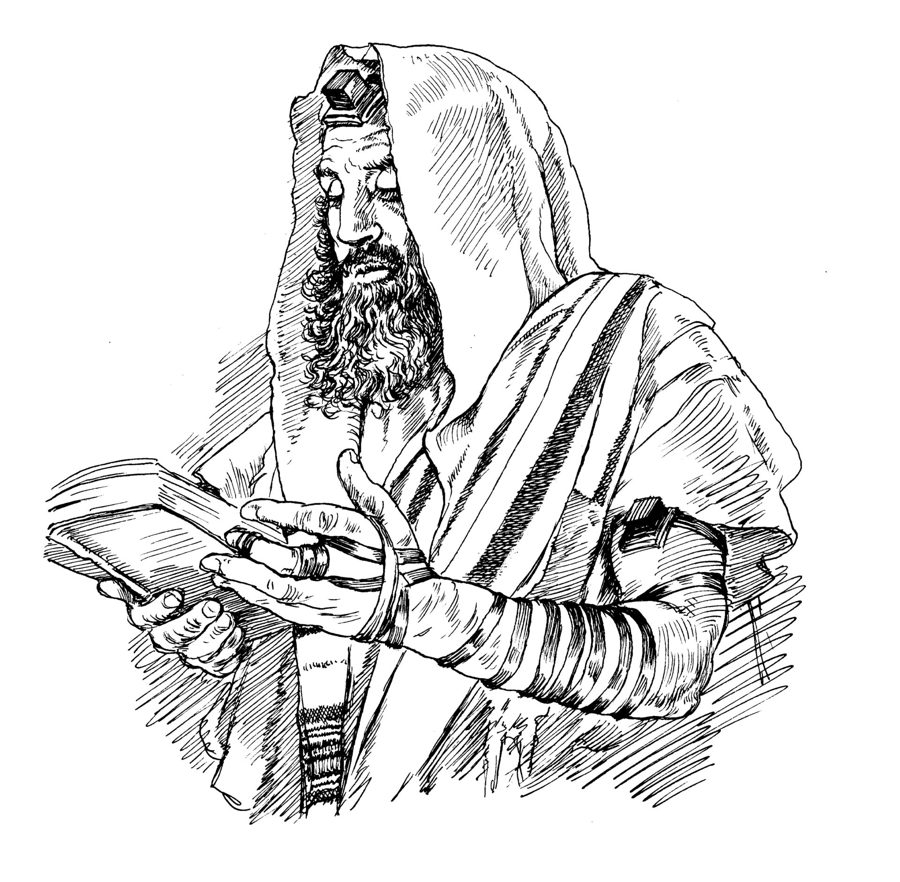
Man with phylacteries on his forehead and arm (© Deutsche Bibelgesellschaft, Stuttgart by United Bible Societies)
Reference
- Greek φυλακτήριον fulaktērion: MAT 23:5
Description
The phylactery was a small leather box containing Old Testament verses.
———
Usage
When Jewish men prayed, they tied these small containers to the forehead and upper left arm near the heart. They did this in obedience to a literal interpretation of EXO 13:9; DEUT 6:8; DEUT 11:18.
———
Translation
MAT 23:5: In this verse the word “phylacteries” (so RSV and most other English translations) is a technical religious term that will not be understood by most readers. GNT handles the specialized term with the explanatory phrase “straps with scripture verses on them which they wear on their foreheads and arms.” Several translations retain the traditional rendering and provide a footnote to help the reader. Brc (“prayer-boxes”) and GECL (“prayer straps”) attempt dynamic equivalent translations. There is no good reason to retain the word “phylacteries,” and most translators will use an explanatory phrase like that in GNT. However, the GNT expression is rather long, and some restructuring may be required to combine it well with the verb “make … broad” (RSV); for example, “the leather boxes with scripture verses in them that these people wear [on their foreheads and arms] are very big,” “they make sure that the boxes with scripture verses that they wear are really big,” and “see how big they make those little boxes with scripture verses in them, the ones they wear on their foreheads and arms.”
 Open English Translation (OET)