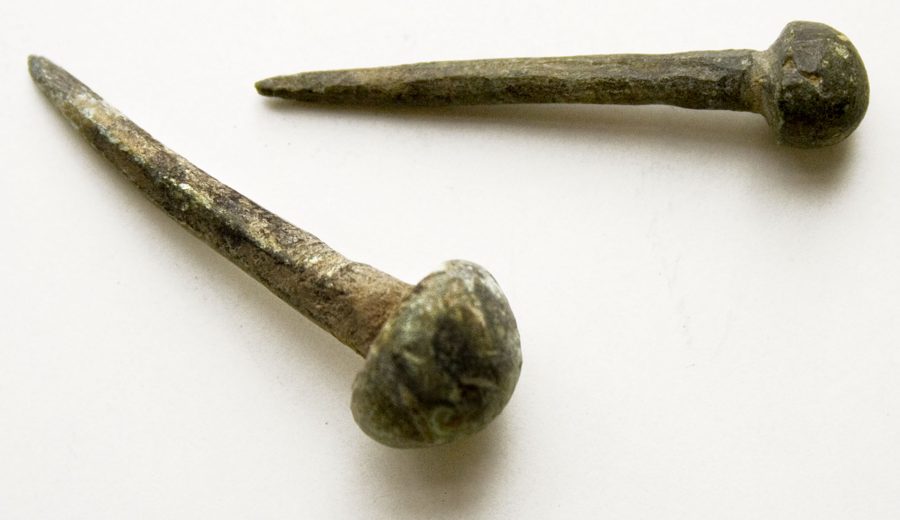
Roman-era rought iron nails (© Takkk, CC BY-SA 3.0, via Wikimedia Commons)
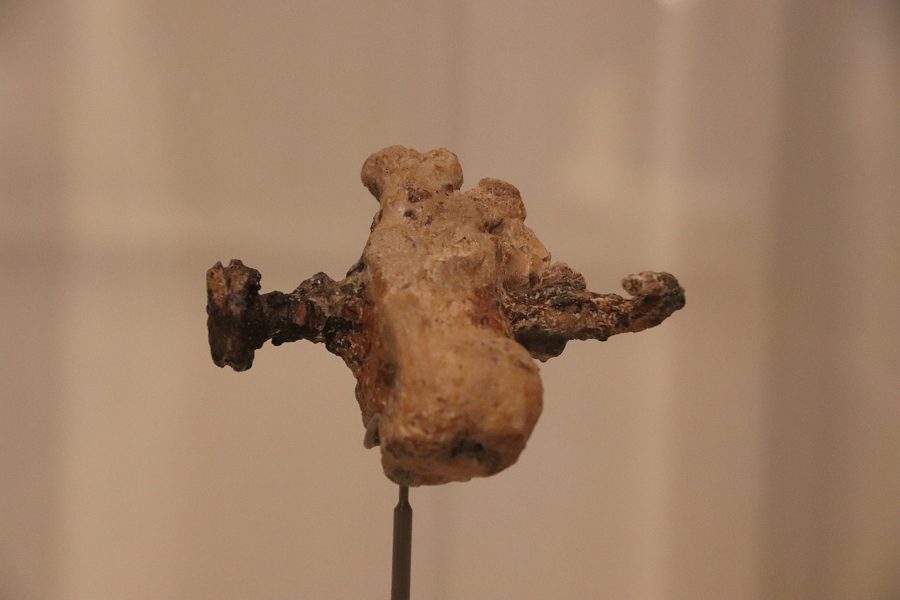
Spike in an anklebone (Gary Todd, Israel Museum, CC0, via Wikimedia Commons)
References
Description
The nail was a thin piece of metal (usually iron) sharpened on one end. It served much the same purpose as a modern nail, attaching pieces of wood to each other or to the floor.
The spike for crucifixion was a fairly thick, pointed piece of iron. It was roughly 20 centimeters (8 inches) long and about the thickness of a man’s finger. Archaeological excavations in 1968 uncovered the remains of a crucified man. A metal spike was still lodged in an anklebone, passing through it from the side.
———
Translation
In a number of languages a distinction is made between relatively small nails and larger spikes. The latter would be appropriate when speaking of crucifixion and probably for the spikes used in gate construction in 1 CHR 22:3. The word chosen should indicate a spike strong enough that two or three of them would have held the weight of a man.
The nails mentioned in 2 CHR 3:9 were made of gold and varied widely in size.
 Open English Translation (OET)