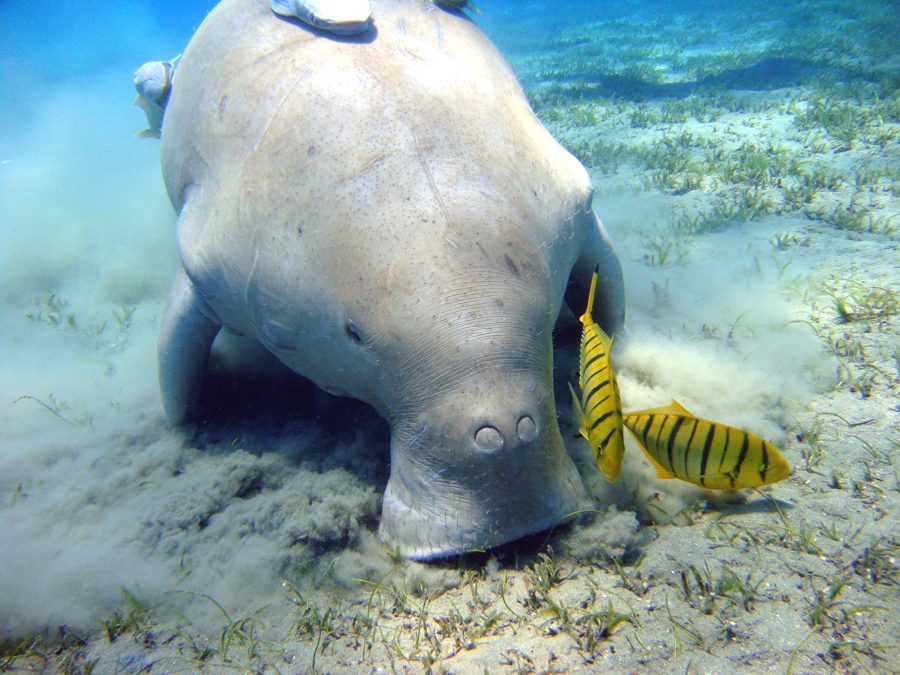
A dugong (Dugong dugon), in the same order as the manatee (© Julien Willem, CC BY-SA 3.0, via Wikimedia Commons)
References
Description
Above the two inner layers that covered the Tabernacle there were two more layers. They are mentioned only briefly and not really described. We are not sure if they only covered the top of the Tabernacle or hung down to the ground on the sides like the goat hair cloth. These two covers were made of two different animal skins. The first layer was made of rams’ skins dyed red (or, tanned rams’ skins; see 1.13 Leather<REALIA:1.13>). The second layer was made of the skin of a sea mammal.
———
Translation
EXO 26:14: The name of the mammal from which the outermost cover was made presents a difficulty for the translator. Translations include the skins of the “badger” (KJV), “seal,” and “dugong” (REB), or the somewhat more inclusive “sea cow” (NIV), “dolphin” (NJPSV), “porpoise” (NEB), and “goat” (RSV). Most of these possibilities indicate a skin that was rare and thus very special. Perhaps for this reason, the trend among more recent common-language translations is to render the Hebrew word tachash as “fine leather” (GNT, CEV, NCV, NJB) without specifying which animal it came from. If a language must specify what animal the skin came from, then “sea cow” or “porpoise” would be best.
 Open English Translation (OET)