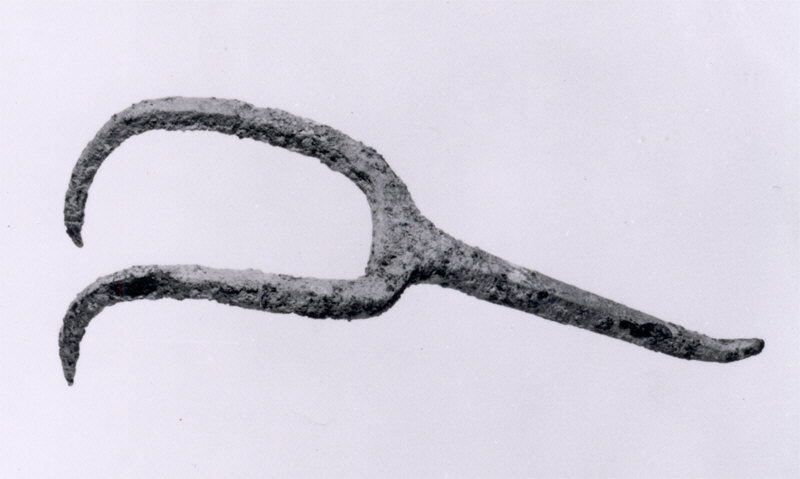
Copper alloy fork, late 3rd–early 2nd millennium BCE, central Asia (Metropolitan Museum of Art, CC0, via Wikimedia Commons)
References
- Hebrew מַזְלֵג mazleg: 1 SAM 2:13, 1 SAM 2:14
- Hebrew מַזְלֵג mizlgoth: EXO 27:3, EXO 38:3, NUM 4:14, 1 CHR 28:17, 2 CHR 4:16
Description and usage
The fork was used in the Tabernacle and Temple to turn sacrificial victims on the altar or to remove them. Its exact form is unknown, but it may have resembled a hook or a kind of two-pronged fork.
———
Translation
For the Hebrew word mizlgoth, some translations (RSV, REB) have “forks,” while GNT says “hooks.” However, a more descriptive expression is recommended, such as “meat forks” (NIV, CEV, FRCL).
The Hebrew word mazleg for fork used to describe the actions of the sons of Eli in 1 SAM 2:13, 1 SAM 2:14 differs slightly from the word mizlgoth. It is reasonable to assume that they used something ready at hand, probably the same fork used at the altar. Translators are advised to use the same word. In many languages the word used for both of these will be the same as the word for a common fork, used as an item of table cutlery.
 Open English Translation (OET)