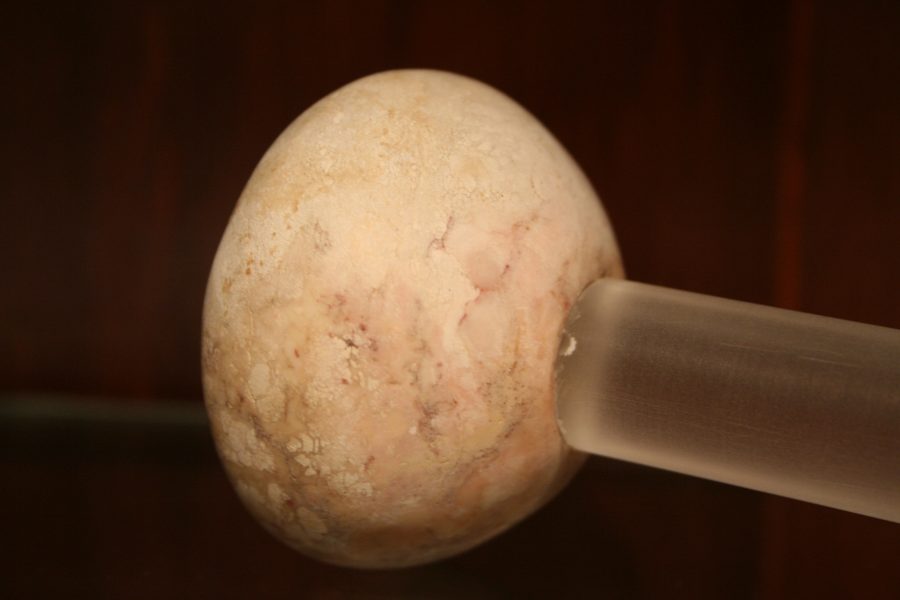
Mitsri (Egyptian) mace head, Ägyptisches Museum der Universität Leipzig (© Einsamer Schütze, via Wikimedia Commons)
References
- Hebrew כְּלִי, מַפָּץ kli mapats: EZEK 9:2
- Hebrew מַפֵּץ mapets: YIR 51:20
- Hebrew מַקֵּל, יָד maqel yad: EZEK 39:9
- Hebrew תּוֹתָח tothach: JOB 41:29
- Greek ξύλον xulos: MAT 26:47, MAT 26:55, MARK 14:43, MARK 14:48, LUKE 22:52
- Greek ράβδος rhabdos: BEL 1:25
Description
The war club was a short wooden rod used for striking the enemy in hand-to-hand combat. It could be held with one hand and was used to strike the enemy on all parts of his body, particularly where he was unprotected by armor. The mace was normally fitted with a heavy head made of stone or metal. This head was wedged over the end of the stick and secured by tying or by the tapered shape of the stick. The handle too could be tapered wider in order to give a better grip. The handle was sometimes curved.
———
Translation
The Hebrew word tothach appears only in JOB 41:29. Most scholars agree that it means “club,” although it has also been suggested that it refers to the shafts of arrows. However, no translation consulted reflects this latter possibility.
Since the main point in EZEK 9:2 is the fearfulness of the weapon, some translations focus on this element rather than attempt to find an exact implement in the receptor language. So CEV has “deadly weapon,” NCV “powerful weapon,” and FRCL “destructive weapon.”
EZEK 39:9: While many translations have “clubs” (GNT) or “war clubs” (NCV) here for the Hebrew phrase maqel yad (literally “hand staff” or “handstick”), there are other possibilities. Some have “spears” (GECL) or “javelins” (SPCL). G. Baez-Camargo suggests that it was a kind of boomerang (compare REB “throwing-sticks,” which could have several meanings). Since the point of the passage is that abandoned wooden weapons will be in abundance and will be burned instead of firewood, it may be possible to combine several of the weapons listed in this verse under a more general heading; for example, ITCL has combined maqel yad and “spears” under “lances,” and CEV combines the two types of shields under the collective “shields.”
The Greek word xulos in MAT 26:47, MAT 26:55, MARK 14:43, MARK 14:48; and LUKE 22:52 is literally “wood,” which could be understood simply as “sticks” in this context of a lynch mob. However, all translations consulted have “clubs” or an equivalent word.
 Open English Translation (OET)