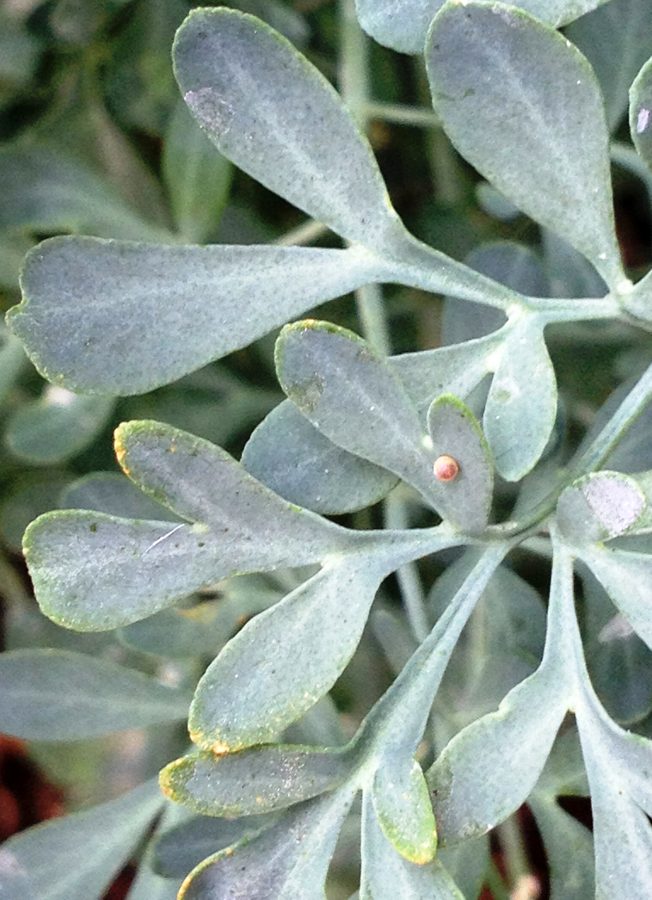
Wormwood (איתמר יפעת (Wikimedia Commons))
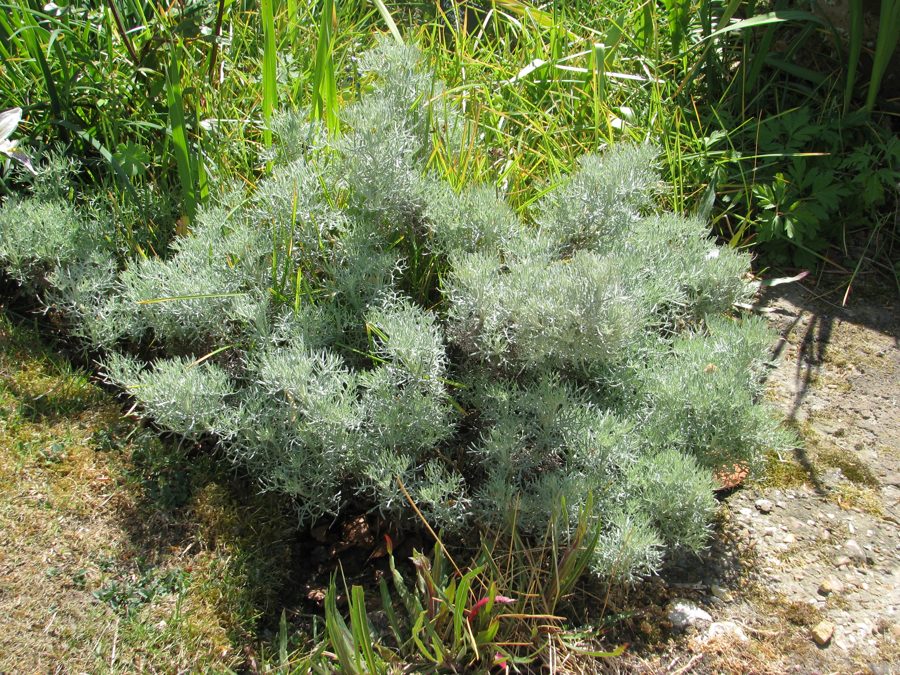
White wormwood (Steve Law (Wikimedia Commons))
References
Discussion
The Hebrew word la‘anah refers literally to a plant, but it is only used figuratively in the Old Testament, as something representing intense bitterness. Despite very little evidence, commentators and botanists have agreed that this word may refer to a substance derived from the white wormwood bush, which is found abundantly in the the deserts of the Holy Land.
Description
White Wormwood Artemisia herba-alba is a bush less than half a meter (18 inches) high, with finely divided fuzzy leaves. These leaves drop at the end of the cool rainy season of Yisrael (Israel) and are replaced with something like scales in the hot season. The flowers appear in clusters of two to four around September/October and mature into small, hairy fruits. When the plant matures, the leaves and flowers are dried to make a very bitter tea, or ground into powder, paste, or oil that is used in medicine.
Special significance
Most of the references to wormwood in the Old Testament are paired with the Hebrew word for “poison/gall” (ro’sh) and are used metaphorically to represent painful experience and sorrow (see 5.2.5 Poison hemlock (black henbane, gall)). In REV 8:11 a star named Wormwood (apsinthos in Greek) makes a third of the water on earth bitter and poisonous. The leaves of wormwood have a very bitter taste. In small quantities it was used as an anesthetic, and Europeans use it in concocting alcoholic drinks (absinthe, vermouth). It is also used to repel moths and fleas, and as an intestinal worm expeller.
Translation
The white wormwood of the Holy Land is found throughout the Middle East, North Africa (Mitsrayim (Egypt), Morocco) and Southwest Europe, but there are at least 300 species of Artemisia throughout the world, usually in dry areas. A Chinese type (huang huahaosu) is used as medicine against malaria. Artemisia cina and Artemisia maritima are found in Eurasia, where they produce santonica, an anti-worm medicine. Artemisia tilesii is used by the Inuits like codeine. The sagebrush plants of the American West also belong to this genus and were used by Native Americans for various conditions.
Most languages have words for plants that have bitter leaves and/or roots. Since all of the references to wormwood in the Old Testament are metaphorical, these plants can be used to convey the essential component of the passages. As noted above, most of the references to la‘anah are coupled with ro’sh, so the two must be dealt with together in those passages. If particular plants are not available, phrases such as “bitter fruit,” “bitter spice,” or “bitter thing” can be used. If needed, transliterations for wormwood could be based on French absinthe, Portuguese absinto, losna; and Spanish absintio, ajenjo.
 Open English Translation (OET)