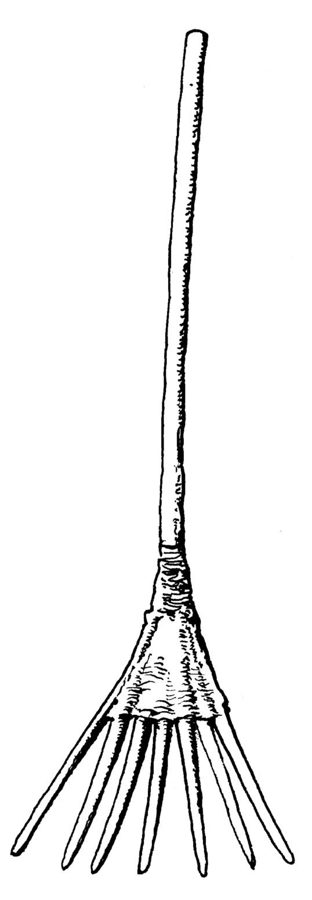
A winnowing fork is used in separating grain from chaff (© Deutsche Bibelgesellschaft, Stuttgart by United Bible Societies)
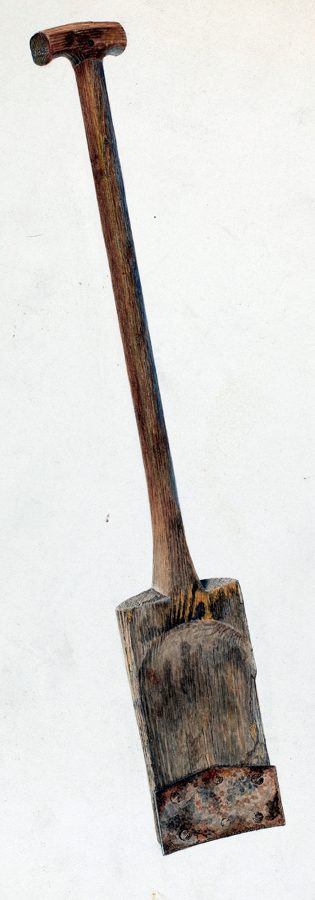
Wooden Spade, possibly used in winnowing (watercolor and graphite on paper, Archie Thompson, 1938) (National Gallery of Art, CC0, via Wikimedia Commons)
References
Description
The winnowing fork was a wooden fork-like implement, with five to seven prongs, for throwing threshed grain into the air so that the wind might separate the straw and chaff from the grain.
———
Usage
See 1.1.8 Threshing and winnowing<REALIA:1.1.8>.
———
Translation
Where there is no receptor-language term for a winnowing fork, translators may choose a descriptive phrase, for example, “a tool for throwing threshed grain into the air in order to let the chaff blow away.”
The Hebrew verb zarah means literally “to scatter.” It refers to a variety of operations in Scripture, including the process of winnowing.
The Hebrew word rachath appears only once in Scripture at ISA 30:24, where its meaning is uncertain. It probably refers to a wooden implement with a long, flat blade attached to a long handle, similar to a spade but made of wood. The verse names two objects for performing the different stages of winnowing. The point of the verse is that even the food given to the animals will have been thoroughly prepared. Some translations eliminate the need to translate an implement by following the Septuagint; for example, CEV has “Even the oxen and donkeys that plow your fields will be fed the finest grain.”
In SIR 5:9 the activity of winnowing is used in a proverb. The literal text of the New Revised Standard Version (NRSV) says “Do not winnow in every wind, or follow every path,” but GNT restructures (and reverses the order of) verses 9 and 10 to give the meaning of the proverb: “Don’t try to please everyone or agree with everything people say.”
 Open English Translation (OET)