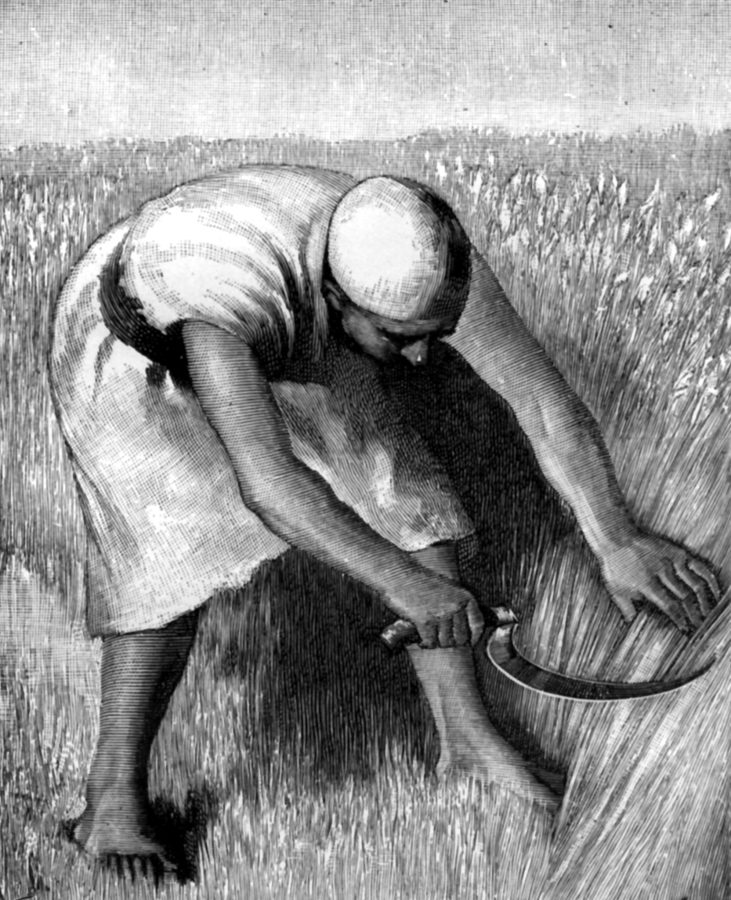
Man cutting grain with a sickle (The Pictorial New Testament, The Religious Tract Society 1881, Public domain)
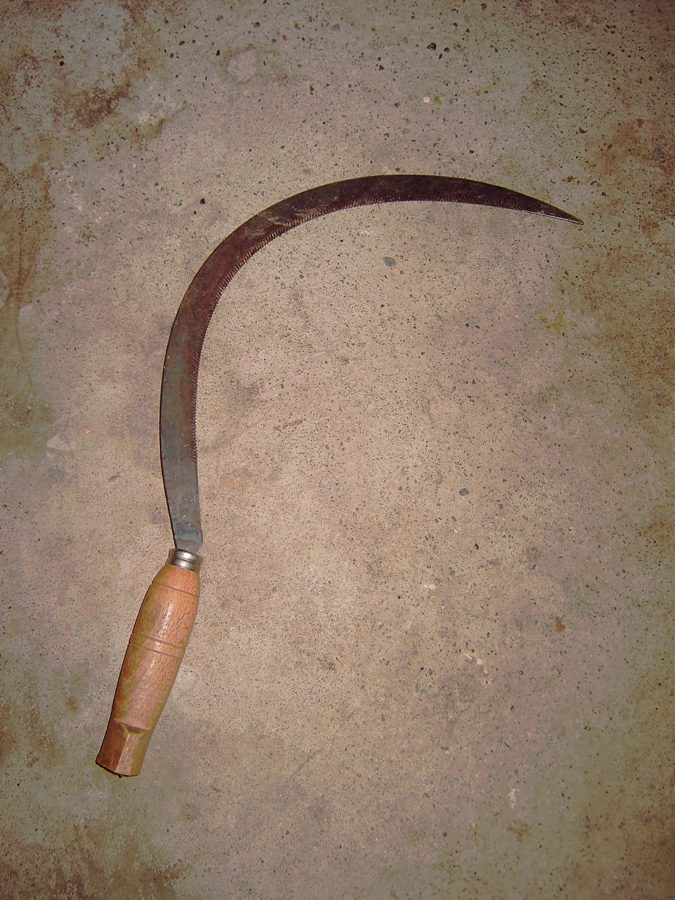
Sickle (© Juan R. Lascorz, CC BY-SA 3.0, via Wikimedia Commons)
References
Description
The sickle was a large, curved knife used for cutting ripe grain. It had a short wooden handle (15-20 centimeters, 6-8 inches).
———
Usage
The implement was swung in a circular motion close to the ground, cutting off the grass or grain. Using the sickle required bending over in order to cut close to the ground, while the longer handle of the scythe allowed the worker to stand erect (see also 2.15.1 Scythe (chariot weapon)<REALIA:2.15.1>).
———
Translation
Where there is no receptor-language term for “sickle,” translators may often use a descriptive phrase, such as “curved knife for cutting grain,” “reaping hook,” or “machete for reaping.” In REV 14 the word sickle is used in idiomatic expressions that could be confusing to the reader. For example, in REV 14:15, rather than the literal “Put in your sickle, and reap” (RSV), it may be clearer to say “Use your sickle and reap the harvest” (GNT). The long-handled scythe was unknown in ancient Yisrael (Israel). Where a translator must choose between a short-handled implement and a long-handled one, the former will be more accurate.
 Open English Translation (OET)