Open Bible Data Home  About  News  OET Key

OET OET-RV OET-LV GHT ULT UST BSB MSB BLB AICNT OEB WEBBE WMBB NET LSV FBV TCNT T4T LEB BBE Moff JPS Wymth ASV DRA YLT Drby RV SLT Wbstr KJB-1769 KJB-1611 Bshps Gnva Cvdl TNT Wycl SR-GNT UHB BrLXX BrTr Related Parallel Simple Interlinear Topics Reference Dictionary Search

A B C D E F G H I J K L M N O P Q R S T U V W XY Z

Tyndale Open Bible Dictionary

Intro ← Index → ©

GOLGOTHA

Place where Jesus and two thieves were crucified, in the vicinity of Jerusalem. The term appears in the NT only in the accounts of the Crucifixion. Three of the Gospels use the Hebrew-Aramaic term, “Golgotha” (Mt 27:33; Mk 15:22; Jn 19:17), while one uses the Latin equivalent, “Calvary,” meaning “skull or cranium” (Lk 23:33).

Show passage in OET: MAT 27:33

OET-RV MAT 27:33

33 When they arrived at the place called Golgotha (which means ‘Place of the skull’),

OET-LV MAT 27:33

33 And having_come to a_place being_called Golgotha/(Gulgolet), which is being_called place Of_the_skull,
Show passage in OET: MRK 15:22

OET-RV MRK 15:22

22 and so they all arrived at Golgotha (which means ‘Place of the skull’).

OET-LV MRK 15:22

22 And they_are_bringing him to the Golgotha/(Gulgolet), place which is being_translated:
place Of_the_skull.
Show passage in OET: JHN 19:17

OET-RV JHN 19:17

17 Carrying the pole himself, Yeshua (Jesus; Grk. Yesus) arrived at the Place of the Skull (called Golgotha in Hebrew) just out of the city

OET-LV JHN 19:17

17 And bearing the stake to_himself, he_came_out to the place being_called:
place Of_the_skull, which is_being_called In_Hebraios, Golgotha/(Gulgolet),
Show passage in OET: LUK 23:33

OET-RV LUK 23:33

33 When they got to the place named ‘The Skull’, they attached Yeshua onto a post and the same for the two criminals, one on each side of him,

OET-LV LUK 23:33

33 And when they_came to the place which being_called the_skull, there they_executed_on_a_stake him and the criminals, one on_one_hand on the_right, one on_the_other_hand on the_left.

Jump to OET MAT 27:33 section.

Jump to OET MRK 15:22 section.

Jump to OET JHN 19:17 section.

Jump to OET LUK 23:33 section.

The reason why this place was called “the skull” is unknown, although several explanations have been offered. An early tradition, apparently originating with Jerome (AD 346–420), asserted that it was a common place of execution and that the skulls of many who had been executed were strewn around the site. No first-century evidence has been found to substantiate this viewpoint. Some suggest that it was a place of execution and that “skull” was used figuratively, simply as a symbol of death. Origen (AD 185–253) mentioned an early, pre-Christian tradition that the skull of Adam was buried in that place. This is probably the oldest explanation of the name, and is referred to by several writers after Origen. Others have said that the name resulted from the fact that the place of the Crucifixion was a hill that had the natural shape of a skull. No early evidence from any sources has been found to substantiate this view, and the NT accounts do not refer to the place as a hill.

The location of the site is disputed. The biblical references give us only general indications. It was outside the city proper (Jn 19:20; Heb 13:12). It may have been on an elevated site, since it could be seen from a distance (Mk 15:40). It was perhaps near a road since “passersby” are mentioned (Mt 27:39; Mk 15:29). John’s account places it near a garden that contained the tomb in which Jesus was buried (Jn 19:41). The use of the definite article, “the place of the skull,” would indicate that it was a well-known place.

Show passage in OET: JHN 19:20

OET-RV JHN 19:20

20 Many Yehudim read this title because the place where Yeshua was executed was near the city, and it had been written in Hebrew, Latin, and Greek.

OET-LV JHN 19:20

20 Therefore this the title many of_the Youdaiōns read, because the place was near of_the city, where the Yaʸsous/(Yəhōshūˊa) was_executed_on_a_stake, and it_was having_been_written In_Hebraios, In_Latin, In_Hellaʸn.
Show passage in OET: HEB 13:12

OET-RV HEB 13:12

12 So too, Yeshua also suffered outside the city gate so that he could declare the people innocent by means of the price of his own blood,

OET-LV HEB 13:12

12 Therefore also Yaʸsous, in_order_that he_may_sanctify by his own blood the people, outside the gate suffered.
Show passage in OET: MRK 15:40

OET-RV MRK 15:40

40 Further back, there was also a group of women observing everything. They included Miryam (Grk. Maria/Mariam) from Magdala, Miryam the mother of young Ya’akov (James; Grk. Yakobos) and Yoseh, and Salome,

OET-LV MRK 15:40

40 And were also women observing from afar, among whom both Maria/(Miryām) the from_Magdala, and Maria the mother of_Yakōbos/(Yaˊₐqoⱱ) the little and of_Yōsaʸs/(Yōşēf?
), and Salōmaʸ,
Show passage in OET: MAT 27:39

OET-RV MAT 27:39

39 Many of the people passing by bad-mouthed him, shaking their heads

OET-LV MAT 27:39

39 And the ones passing_through were_slandering him, shaking the heads of_them
Show passage in OET: MRK 15:29

OET-RV MRK 15:29

29 As people passed by on that path, they insulted Yeshua, shaking their heads and shouting, “Hoy there! You who reckoned you could demolish the temple and rebuild it in three days,

OET-LV MRK 15:29

29 And the ones passing_through were_slandering him, shaking the heads of_them, and saying:
Aha, you tearing_down the temple and building it in three days,
Show passage in OET: JHN 19:41

OET-RV JHN 19:41

41 There was a garden out at the place where Yeshua had been executed, and in the garden there was a new tomb that hadn’t been used yet.

OET-LV JHN 19:41

41 And there_was a_garden in the place where he_was_executed_on_a_stake, and in the garden a_ new _tomb, in which not_yet no_one was having_been_laid.

Jump to OET JHN 19:20 section.

Jump to OET HEB 13:12 section.

Jump to OET MRK 15:40 section.

Jump to OET MAT 27:39 section.

Jump to OET MRK 15:29 section.

Jump to OET JHN 19:41 section.

There seems to have been little interest in the site of Golgotha until the early part of the fourth century. Eusebius, who lived in Jerusalem for several years, said that Constantine the emperor instructed Bishop Macarius to find the site of the Crucifixion and burial. Later accounts said that the bishop was guided to the site by a vision of the Queen Mother Helena. The site that he settled on contained a Hadrianic temple of Aphrodite, which Constantine destroyed. There, tradition says, he found fragments of the cross of Christ. On that site he built two churches, and this is the site of the modern Church of the Holy Sepulcher. Although destroyed and rebuilt several times, this has remained a fixed site since the time of Constantine.

In 1842 Otto Thenius contended that Golgotha was a rocky hill about 250 yards (228.5 meters) northeast of the Damascus Gate. He based his contention on the assertions that it had been a Jewish place of stoning, lay outside the city wall, and was shaped like a skull. Later General Charles Gordon also advocated this spot, and it has come to be known as “Gordon’s Calvary.”

See also Crucifixion.
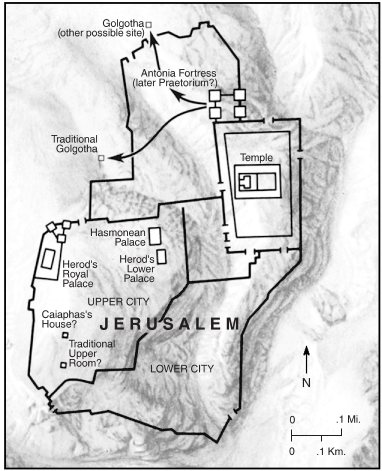
Two Possible Sites for Golgotha

This map shows the boundaries of Jerusalem in Jesus’ day. Two possible sites for Golgotha (meaning “the place of the skull”) are shown—one to the north of the city, outside the Fish Gate; and one to the west of the city, nearer to Herod’s palace.