OET OET-RV OET-LV GHT ULT UST BSB MSB BLB AICNT OEB WEBBE WMBB NET LSV FBV TCNT T4T LEB BBE Moff JPS Wymth ASV DRA YLT Drby RV SLT Wbstr KJB-1769 KJB-1611 Bshps Gnva Cvdl TNT Wycl SR-GNT UHB BrLXX BrTr Related Parallel Simple Interlinear Topics Reference Dictionary Search
ParallelVerse GEN EXO LEV NUM DEU JOB JOS JDG RUTH 1 SAM 2 SAM PSA AMOS HOS 1 KI 2 KI 1 CHR 2 CHR PROV ECC SNG JOEL MIC ISA ZEP HAB JER LAM YNA (JNA) NAH OBA DAN EZE EZRA EST NEH HAG ZEC MAL LAO GES LES ESG DNG 2 PS TOB JDT ESA WIS SIR BAR LJE PAZ SUS BEL MAN 1 MAC 2 MAC 3 MAC 4 MAC YHN (JHN) MARK MAT LUKE ACTs YAC (JAM) GAL 1 TH 2 TH 1 COR 2 COR ROM COL PHM EPH PHP 1 TIM TIT 1 PET 2 PET 2 TIM HEB YUD (JUD) 1 YHN (1 JHN) 2 YHN (2 JHN) 3 YHN (3 JHN) REV
Mark Intro C1 C2 C3 C4 C5 C6 C7 C8 C9 C10 C11 C12 C13 C14 C16
Mark 15 V1 V3 V5 V7 V9 V11 V13 V15 V17 V19 V21 V23 V25 V27 V31 V33 V35 V37 V39 V41 V43 V45 V47
Note: This view shows ‘verses’ which are not necessarily natural language units and hence sometimes only part of a sentence will be visible—click on any Bible version abbreviation down the left-hand side to see the verse in more of its context. Normally the OET discourages the reading of individual ‘verses’, but this view is only designed as a tool for Bible-translators and others doing comparisons of different translations—the older translations are further down the page (so you can read up from the bottom to trace the English translation history). The OET segments on this page are still early looks into the drafted texts of the Open English Translation of the Bible—please double-check these texts in advance before using in public.
B I ◄ ← Mark 15:29 ↓ → ► ≡ ═ ©
Text critical issues=small word differences Clarity of original=clear Importance to us=normal Speaker(s)=Narrator (All still tentative.)
OET (OET-RV) As people passed by on the path, they insulted Yeshua, shaking their heads[ref] and shouting, “Hoy there! You who reckoned you could demolish the temple and rebuild it in three days,[ref]
OET-LV And the ones passing_through were_slandering him, shaking the heads of_them, and saying:
Aha, you tearing_down the temple and building it in three days,
SR-GNT Καὶ οἱ παραπορευόμενοι ἐβλασφήμουν αὐτὸν, κινοῦντες τὰς κεφαλὰς αὐτῶν, καὶ λέγοντες, “Οὐὰ, ὁ καταλύων τὸν ναὸν καὶ οἰκοδομῶν ἐν τρισὶν ἡμέραις, ‡
(Kai hoi paraporeuomenoi eblasfaʸmoun auton, kinountes tas kefalas autōn, kai legontes, “Oua, ho kataluōn ton naon kai oikodomōn en trisin haʸmerais,)
Key: khaki:verbs, light-green:nominative/subject, orange:accusative/object, pink:genitive/possessor, cyan:dative/indirect object, magenta:vocative.
Note: Automatic aligning of the OET-RV to the LV is done by some temporary software, hence the RV alignments are incomplete (and may occasionally be wrong).
GHT and the[plural] being-gone-aside have-been-asserting-evil [toward] same, moving the heads of {same} and saying, "Ah, the loosing-down the temple and in to {three days} house-building,
ULT And the ones passing by were blaspheming him, wagging their heads and saying, “Aha! The one destroying the temple and rebuilding, it in three days,
UST The people who walked past Jesus insulted him by shaking their heads at him. They said to him, “Ha! You said that you could tear down God’s temple and construct it again within three days.
BSB & MSB And those who passed by heaped abuse on Him, shaking their heads and saying, “Aha! You who are going to destroy the temple and rebuild [it] in three days,
BLB And those passing by were railing at Him, shaking their heads and saying, "Aha! The One destroying the temple and building it in three days,
AICNT And those passing by were blaspheming[fn] him, shaking their heads and saying, “Aha! You who destroy the temple and build it in three days,
15:29, blaspheming: The Greek word for blasphemed is defined by BDAG as: to speak in a disrespectful way that demeans, denigrates, maligns (BDAG, βλασφημέω).
OEB The passers-by railed at him, shaking their heads, as they said, ‘Ah! You who would destroy the Temple and build one in three days,
WEBBE & WMBB Those who passed by blasphemed him, wagging their heads and saying, “Ha! You who destroy the temple and build it in three days,
NET Those who passed by defamed him, shaking their heads and saying, “Aha! You who can destroy the temple and rebuild it in three days,
LSV And those passing by were slandering Him, shaking their heads, and saying, “Ha! The [One] throwing down the temple, and building [it] in three days!
FBV People passing by shouted insults at him, shaking their heads, and saying. “Aha! You who claimed you were going to destroy the Temple and rebuild it in three days;
TCNT Those who passed by reviled him, shaking their heads and saying, “Ha! Yoʋ who would destroy the temple and build it in three days,
T4T The people who were passing by insulted him by shaking their heads as if here were an evil man. They said, “Aha! You said that you would destroy the Temple and then you would build it again within three days.
LEB And those who passed by reviled him, shaking their heads and saying, “Aha! The one who would destroy the temple and rebuild it[fn] in three days,
15:29 *Here the direct object is supplied from context in the English translation
BBE And those who went by made sport of him, shaking their heads, and saying, Ha! you who give the Temple to destruction, and put it up again in three days,
Moff Those who passed by scoffed at him, nodding at him in derision and calling, "Ha! You were to destroy the temple and build it in three days!
Wymth And all the passers-by reviled Him. They shook their heads at Him and said, "Ah! you who were for destroying the Sanctuary and building a new one in three days,
ASV And they that passed by railed on him, wagging their heads, and saying, Ha! thou that destroyest the temple, and buildest it in three days,
DRA And they that passed by blasphemed him, wagging their heads, and saying: Vah, thou that destroyest the temple of God, and in three days buildest it up again;
YLT And those passing by were speaking evil of him, shaking their heads, and saying, 'Ah, the thrower down of the sanctuary, and in three days the builder!
Drby And they that passed by reviled him, shaking their heads, and saying, Aha, thou that destroyest the temple and buildest it in three days,
RV And they that passed by railed on him, wagging their heads, and saying, Ha! thou that destroyest the temple, and buildest it in three days,
(And they that passed by insulted/jeered at him, wagging their heads, and saying, Ha! thou/you that destroyest/destroy the temple, and buildest/build it in three days,)
SLT And they going by blasphemed him, shaking their heads, and saying, Ah, thou loosing the temple, and building in three days,
Wbstr And they that passed by, railed on him, wagging their heads, and saying, Ah, thou that destroyest the temple, and buildest it in three days,
KJB-1769 And they that passed by railed on him, wagging their heads, and saying, Ah, thou that destroyest the temple, and buildest it in three days,
(And they that passed by insulted/jeered at him, wagging their heads, and saying, Ah, thou/you that destroyest/destroy the temple, and buildest/build it in three days,)
KJB-1611 And they that passed by, railed on him, wagging their heads, and saying, Ah thou that destroyest the Temple, and buildest it in three dayes,
(Modernised spelling is same as from KJB-1769 above, apart from capitalisation and punctuation)
Bshps And they that went by, rayled on him, wagging their heades, and saying: A wretche, thou that destroyest the temple, and buildest it in three dayes,
(And they that went by, insulted/jeered at him, wagging their heads, and saying: A wretch, thou/you that destroyest/destroy the temple, and buildest/build it in three days,)
Gnva And they that went by, railed on him, wagging their heads, and saying, Hey, thou that destroyest the Temple, and buildest it in three dayes,
(And they that went by, insulted/jeered at him, wagging their heads, and saying, Hey, thou/you that destroyest/destroy the Temple, and buildest/build it in three days,)
Cvdl And they that wete by, reuyled him, and wagged their heades, and sayde: Fye vpon the, how goodly breakest thou downe ye teple, & buyldest it agayne in thre dayes?
(And they that went by, reviled him, and wagged their heads, and said: Shame upon them, how goodly breakest thou/you down ye/you_all temple, and buildest/build it again in three days?)
TNT And they that went by rayled on him: waggynge their heedes and sayinge: A wretche that destroyest the temple and byldest it in thre dayes:
(And they that went by insulted/jeered at him: wagging their heads and saying: A wretch that destroyest/destroy the temple and buildest/build it in three days:)
Wycl And as thei passiden forth, thei blasfemyden hym, mouynge her heedis, and seiynge, Vath! thou that distriest the temple of God, and in `thre daies bildist it ayen;
(And as they passed forth, they blasphemed him, moving her heads, and saying, Bah! thou/you that destroyest/destroy the temple of God, and in three days buildest/build it again;)
Luth Und die vorübergingen, lästerten ihn und schüttelten ihre Häupter und sprachen: Pfui dich, wie fein zerbrichst du den Tempel und bauest ihn in dreien Tagen!
(And the passed_by, blasphemed/slandered him/it and shook their/her heads(n) and said: Pooh you/yourself, as/like fine breaks/shatters you(sg) the temple and build him/it in three days!)
ClVg Et prætereuntes blasphemabant eum, moventes capita sua, et dicentes: Vah ! qui destruis templum Dei, et in tribus diebus reædificas,[fn]
(And they_pass_byes they_blasphemed him, moving heads his_own, and saying: Wow/Woe ! who/which you_destroy the_temple/sanctuary of_God, and in/into/on tribe days you_rebuild,)
15.29 Moventes capita. HIER. Emittitur mors iniquorum quando excitantur vincula inferni usque ad cervicem, quæ est cervix humani generis.
15.29 Moving heads. HIER. Sent death of_the_wicked when they_are_excited chains hell until to neck, which it_is neck human kind.
UGNT καὶ οἱ παραπορευόμενοι ἐβλασφήμουν αὐτὸν, κινοῦντες τὰς κεφαλὰς αὐτῶν, καὶ λέγοντες, οὐὰ, ὁ καταλύων τὸν ναὸν καὶ οἰκοδομῶν ἐν τρισὶν ἡμέραις,
(kai hoi paraporeuomenoi eblasfaʸmoun auton, kinountes tas kefalas autōn, kai legontes, oua, ho kataluōn ton naon kai oikodomōn en trisin haʸmerais,)
SBL-GNT Καὶ οἱ παραπορευόμενοι ἐβλασφήμουν αὐτὸν κινοῦντες τὰς κεφαλὰς αὐτῶν καὶ λέγοντες· Οὐὰ ὁ καταλύων τὸν ναὸν καὶ ⸂οἰκοδομῶν ἐν τρισὶν ἡμέραις⸃,
(Kai hoi paraporeuomenoi eblasfaʸmoun auton kinountes tas kefalas autōn kai legontes; Oua ho kataluōn ton naon kai ⸂oikodomōn en trisin haʸmerais⸃,)
RP-GNT Καὶ οἱ παραπορευόμενοι ἐβλασφήμουν αὐτόν, κινοῦντες τὰς κεφαλὰς αὐτῶν, καὶ λέγοντες, Οὐά, ὁ καταλύων τὸν ναὸν καὶ ἐν τρισὶν ἡμέραις οἰκοδομῶν,
(Kai hoi paraporeuomenoi eblasfaʸmoun auton, kinountes tas kefalas autōn, kai legontes, Oua, ho kataluōn ton naon kai en trisin haʸmerais oikodomōn,)
TC-GNT καὶ οἱ παραπορευόμενοι ἐβλασφήμουν αὐτὸν [fn]κινοῦντες τὰς κεφαλὰς αὐτῶν καὶ λέγοντες, Οὐά, ὁ καταλύων τὸν ναὸν καὶ [fn]ἐν τρισὶν ἡμέραις οἰκοδομῶν,
(kai hoi paraporeuomenoi eblasfaʸmoun auton kinountes tas kefalas autōn kai legontes, Oua, ho kataluōn ton naon kai en trisin haʸmerais oikodomōn,)
Key for above GNTs: yellow:punctuation differs, red:words differ (from our SR-GNT base).
In this section, Jesus was crucified. This is the climax of the book of Mark. Three times Jesus had predicted these events (8:31, 9:31, and 10:33–34). Now they really happened. Mark has presented Jesus as the Messiah and King who the prophets in the Old Testament predicted would come. By dying on the cross, Jesus did what the Messiah had to do to save his people.
Here are some other possible headings for this section:
The soldiers fastened Jesus to a cross to kill him
Jesus was executed on a cross
The crucifixion of Jesus
There are parallel passages for this section in Matthew 27:32–44, Luke 23:26–43, and John 19:17–27.
And those who passed by heaped abuse on Him,
Those who passed/walked by were insulting Jesus
Those who by chance walked past/near the place said insulting/bad/terrible things about him/Jesus.
And those who passed by: The clause those who passed by refers to people who by chance were walking by the place where Jesus was crucified. They did not come to watch the crucifixion on purpose.
Here are some other ways to translate this clause:
people who walked by
those who happened to pass/walk by the cross at that moment
heaped abuse on Him: The Greek verb that the BSB translates as the English idiom heaped abuse on Him means “to speak evil of him.” (This verb often refers to speaking against God, but can also refer to speaking against a person.The Greek word is βλασφημέω and is primarily used in Scripture of speech against God. Some commentators (Edwards page 473, for example) see divine overtones here.) An example of the words these people spoke against Jesus are given in 15:29c–30.
Here are some other ways to translate this:
insulted him (GW)
said terrible things about Jesus (CEV)
The form of the Greek verb for heaped abuse indicates that this action was repeated many times. Many people who walked by insulted Jesus. Consider using a verb form or another way in your language to indicate this. For example:
were insulting him
repeatedly insulted him
shaking their heads and saying,
by shaking their heads and saying,
They shook their heads in mockery and said,
shaking their heads and saying: The phrase shaking their heads describes a gesture that indicates that the people were insulting Jesus. When Jews shook their heads, they showed that they did not respect the person whom they were looking at or talking to.
If people in your culture will not understand the meaning of this gesture, you could:
Translate it literally and include a footnote to explain the meaning. A sample footnote could be:
Jews “shook their heads” at a person to indicate that they considered that person very low/shameful and therefore did not respect them.
Translate it in a way that makes the meaning clear. For example, the NLT says:
shaking their heads in mockery
Translate only the meaning and not the gesture. For example:
and said in mockery
and said with scorn/disrespect
It may not be necessary or natural in your language to have two verbs of speaking, such as “insulted” (15:29a) and “said” (15:29b). These could be combined into one verb. Also the action “shaking their heads” (15:29b) could be placed either before or after the verb/verbs of speaking. For example, you could say:
Those who passed by shook their heads and insulted him, “So! You who are…”
Aha! You who are going to destroy the temple and rebuild it in three days, come down from the cross and save Yourself!: The people passing by said this to mock Jesus. It is based on something that Jesus had previously said. What he said was probably misunderstood by most people (see John 2:19–22 and Mark 14:58–59). This is the sense of the mockery:
You said you can do great miracles such as destroying the temple and rebuilding it in three days.
If you can do that, then do this: come down from the cross and save yourself.
These people did not believe that Jesus could do either (a) or (b). They believed that his being on the cross was proof that he did not have power to do great miracles.
Translate this in a natural way in your language to show that they were mocking Jesus. It should be clear that the people did not believe that he could do what they were telling him to do.
“Aha! You who are going to destroy the temple
“Ha! You(sing) who said/claimed that you will destroy the temple
“If you(sing) can tear/break down the temple
“You(sing) said that you could destroy the holy building where God dwells
and rebuild it in three days,
and build it again in/within three days,
and rebuild it in just three days’ time,
and build it again in three days.
Aha!: The Greek word that the BSB translates as Aha! is an exclamation that here expresses mocking or ridicule. If you have a word or expression in your language that expresses mocking or ridicule, consider using it here. If you do not have such a word, you could leave this word untranslated.
You who are going to destroy the temple and rebuild it in three days: These words in Greek are spoken as a way to address Jesus. They are not a complete sentence in themselves but simply lead to the command to “come down….” It may be natural in your language to make this a separate sentence as a number of English versions have done. For example:
So you would destroy the Temple and rebuild it in three days! (NJB)
You were going to tear down the Temple and build it back up in three days! (GNT)
It is implied here that Jesus had said or claimed he would do this. You may want to make this explicit in your language:
You said you could destroy the Temple and build it again in three days. (NCV)
So you’re the one who claimed you could tear down the temple and build it again in three days. (CEV)
Didn’t you say that you would destroy the temple and build it in three days?
temple: The Greek word that the BSB translates as temple here refers to the main temple building. The main building was the holiest part of the temple. It was the part where God was present in a special way.
Here are some other ways to translate the word temple:
Use a descriptive phrase. For example:
house/building of God
house/place where God dwells
house/place where God is
holy/sacred house
If your language has a word for “temple,” consider using it. But you may need to modify it. For example:
temple of the Lord
Be sure to use a different term from the one you have chosen for “synagogue.” There was only one temple, but there were many synagogues throughout the land of Israel where the Jews met regularly for worship.
See how you translated this term in 14:58b, where the same word occurs. See also temple, Meaning 2, in the Glossary for more information.
rebuild it: The temple had already been built when Jesus made this statement. Here are some other ways to translate this phrase:
build it again
put it back together again
in three days: The phrase in three days refers to how much time it would take Jesus to rebuild the temple. It does not mean that he would wait three days and then begin rebuilding the temple. Nor does it mean that he would wait three days and then rebuild it in an instant. See how you translated this at 14:58c.
Note 1 topic: translate-symaction
κινοῦντες τὰς κεφαλὰς αὐτῶν
shaking (Some words not found in SR-GNT: Καί οἱ παραπορευόμενοι ἐβλασφήμουν αὐτόν κινοῦντες τάς κεφαλάς αὐτῶν καί λέγοντες Οὐά ὁ καταλύων τόν ναόν καί οἰκοδομῶν ἐν τρισίν ἡμέραις)
The people’s action of wagging their heads at Jesus showed that they felt disdain for him and that they disapproved of him. If it would be helpful in your language, you could use a gesture with a similar meaning in your culture, or you could indicate what the gesture means. Alternate translation: [showing disdain for him by wagging their heads] or [wagging their heads to mock him]
Note 2 topic: figures-of-speech / exclamations
οὐὰ
(Some words not found in SR-GNT: Καί οἱ παραπορευόμενοι ἐβλασφήμουν αὐτόν κινοῦντες τάς κεφαλάς αὐτῶν καί λέγοντες Οὐά ὁ καταλύων τόν ναόν καί οἰκοδομῶν ἐν τρισίν ἡμέραις)
Here, the word Aha expresses mock surprise. In other words, the people are pretending to be surprised that Jesus is on the cross in order to mock him. If it would be helpful in your language, you could use a word or phrase that expresses this idea in your language. Alternate translation: [Wow] or [What]
Note 3 topic: figures-of-speech / explicit
ὁ καταλύων τὸν ναὸν καὶ οἰκοδομῶν ἐν τρισὶν ἡμέραις
you tearing_down (Some words not found in SR-GNT: Καί οἱ παραπορευόμενοι ἐβλασφήμουν αὐτόν κινοῦντες τάς κεφαλάς αὐτῶν καί λέγοντες Οὐά ὁ καταλύων τόν ναόν καί οἰκοδομῶν ἐν τρισίν ἡμέραις)
Here the people refer to Jesus by what the false witnesses testified during his trial that he had said (see [14:58](../14/58.md)). If it would be helpful in your language, you could indicate more explicitly that the people are describing Jesus. Alternate translation: [You who said that you would destroy the temple and rebuild it in three days]
Note 4 topic: figures-of-speech / explicit
ἐν τρισὶν ἡμέραις
in (Some words not found in SR-GNT: Καί οἱ παραπορευόμενοι ἐβλασφήμουν αὐτόν κινοῦντες τάς κεφαλάς αὐτῶν καί λέγοντες Οὐά ὁ καταλύων τόν ναόν καί οἰκοδομῶν ἐν τρισίν ἡμέραις)
Here, the phrase in three days refers to a time period made up of three days. If it would be helpful in your language, you could make that idea more explicit. See how you translated the similar phrase in [14:58](../14/58.md). Alternate translation: [during a period of three days]
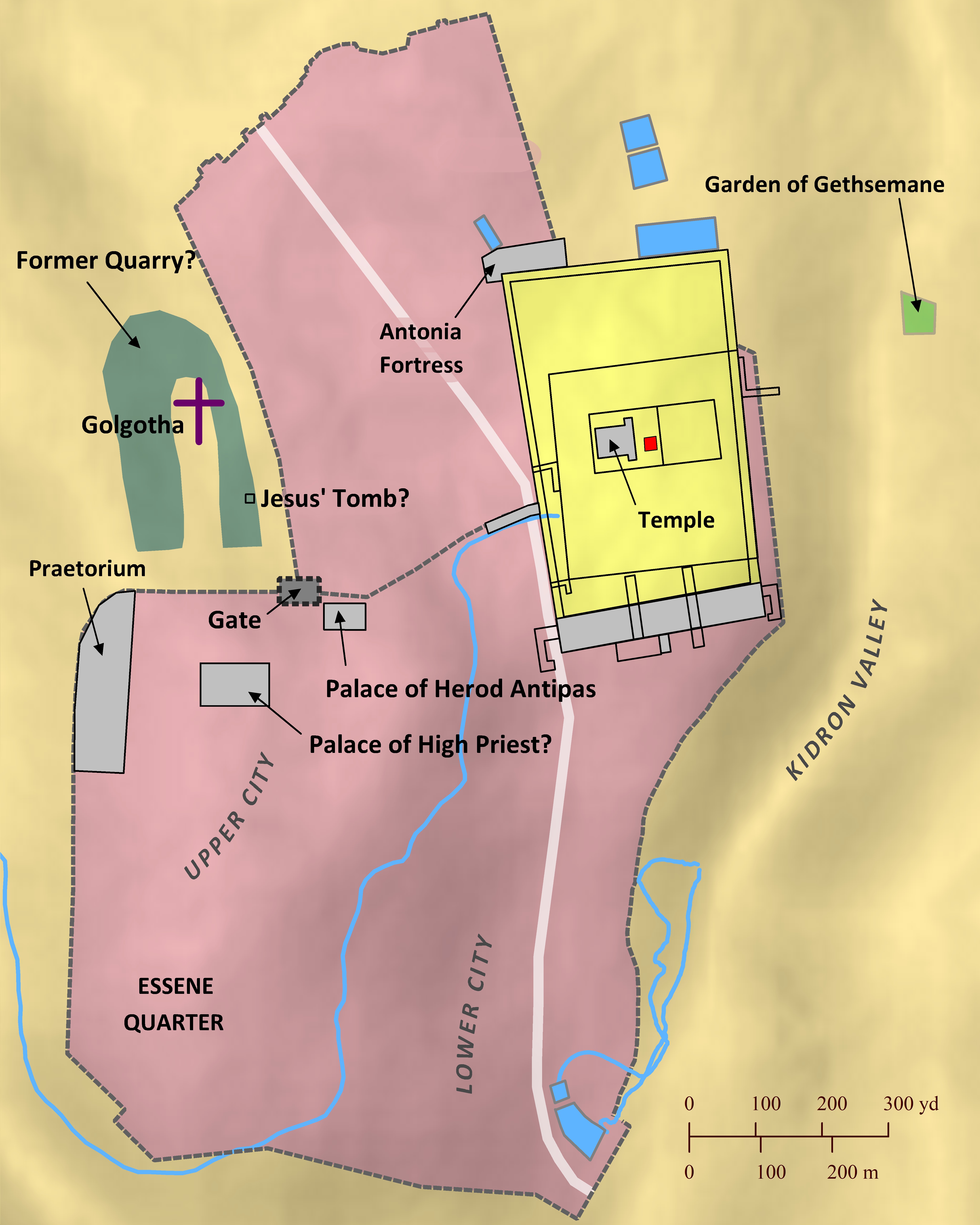
Matthew 26-27; Mark 14-15; Luke 22-23; John 13-19
On the Thursday before he was crucified, Jesus had arranged to share the Passover meal with his disciples in an upper room, traditionally thought to be located in the Essene Quarter of Jerusalem. After they finished the meal, they went to the Garden of Gethsemane, where Jesus often met with his disciples. There Judas Iscariot, one of Jesus’ own disciples, betrayed him to soldiers sent from the High Priest, and they took Jesus to the High Priest’s residence. In the morning the leading priests and teachers of the law put Jesus on trial and found him guilty of blasphemy. The council sent Jesus to stand trial for treason before the Roman governor Pontius Pilate, who resided at the Praetorium while in Jerusalem. The Praetorium was likely located at the former residence of Herod the Great, who had died over 30 years earlier. When Pilate learned that Jesus was from Galilee, he sent him to Herod Antipas, who had jurisdiction over Galilee. But when Jesus gave no answer to Herod’s many questions, Herod and his soldiers sent him back to Pilate, who conceded to the people’s demands that Jesus be crucified. Jesus was forced to carry his cross out of the city gate to Golgotha, meaning Skull Hill, referring to what may have been a small unquarried hill in the middle of an old quarry just outside the gate. After Jesus was unable to carry his cross any further, a man named Simon from Cyrene was forced to carry it for him. There at Golgotha they crucified Jesus. After Jesus died, his body was hurriedly taken down before nightfall and placed in a newly cut, rock tomb owned by Joseph of Arimathea, a member of the Jewish high council. This tomb was likely located at the perimeter of the old quarry.
Open Bible Data site copyright © 2023–2026 Freely-Given.org.
Python source code for creating these static pages is available on GitHub under an open licence.
For Bible data copyrights, see the details for each displayed Bible version.
The Open English Translation (OET) main site is at OpenEnglishTranslation.Bible or OET.Bible.