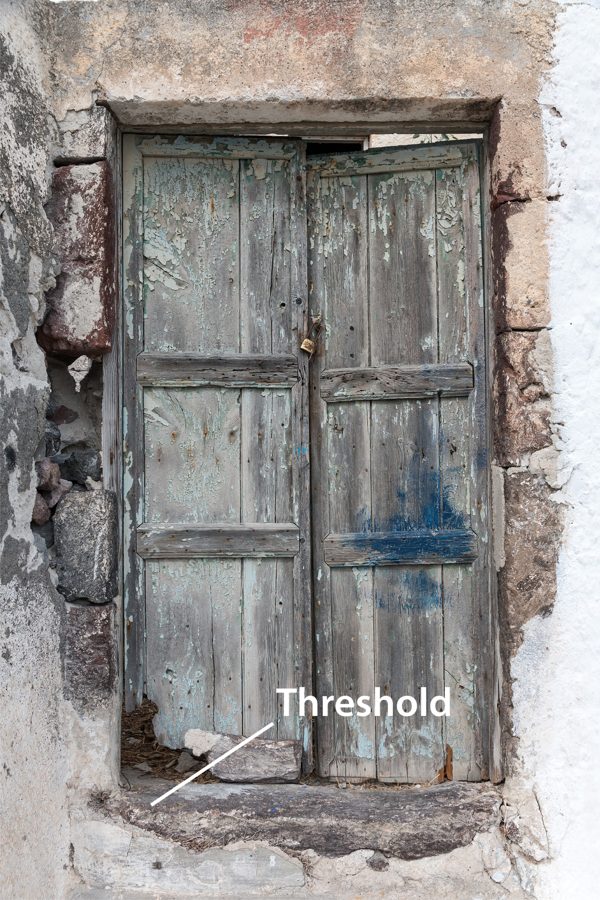
Threshold of an old doorway in Santorini (© Dietmar Rabich, CC BY-SA 4.0, via Wikimedia Commons)
References
- Hebrew סַף saf: HERO 19:27, 1 KI 14:17, EZEK 40:6, EZEK 40:7, EZEK 41:16, EZEK 43:8, ZEP 2:14
- Hebrew מִפְתָּן miftan: 1 SAM 5:4, 1 SAM 5:5, EZEK 9:3, EZEK 10:4, EZEK 10:18, EZEK 46:2, EZEK 47:1, ZEP 1:9
- Greek χελωνίς chelōnis: JDT 14:15
Description
The threshold was the bottom part of a doorframe (see 3.1.2 Door, doorway<REALIA:3.1.2>); it was the piece that sat horizontally on the ground. It was usually made of stone.
———
Translation
Where a technical term for “threshold” does not exist or would not be generally understood, it may be necessary to use a descriptive phrase; for example, in EZEK 9:3NCV has “place … where the door opened.”
ZEP 1:9: The literal phrase “all who jump over [or, on] the threshold” in this verse is obscure and has been rendered in various ways. It may refer to a Pelishti (Philistine) religious practice, the origins of which are described in 1 SAM 5:4, 1 SAM 5:5. CEV reflects this by saying “worshipers of pagan gods” and adding a footnote. NCV is more specific with “those who worship Dagon” but does not add a footnote. Also possible is the expanded translation in FRCL, which reads “all those who, like the pagans, jump over the doorsill of the temple.” FRCL also includes a footnote with the following alternate rendering: “all those who go up on the [sacred] platform.” See also the discussion in A Handbook on The Books of Nahum, Havakuk (Habakkuk), and Tsefanyah (Zephaniah), pages 152-153.
The Greek word chelōnis in JDT 14:15 is somewhat obscure. NJB has “threshold,” which is also the definition given by Liddell-Scott. In JDT 13:9 we learn that Yehudit (Judith) rolled Holofernes’ body off the bed, which means it lay on the floor. So in 14.15 many translations render chelōnis as “floor” (ITCL, NAB), and this seems preferable.
 Open English Translation (OET)