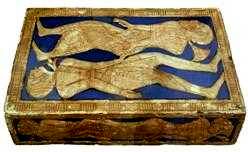
This royal footstool has images of the king's enemies where he can put his feet on them (© Ray Pritz by United Bible Societies)
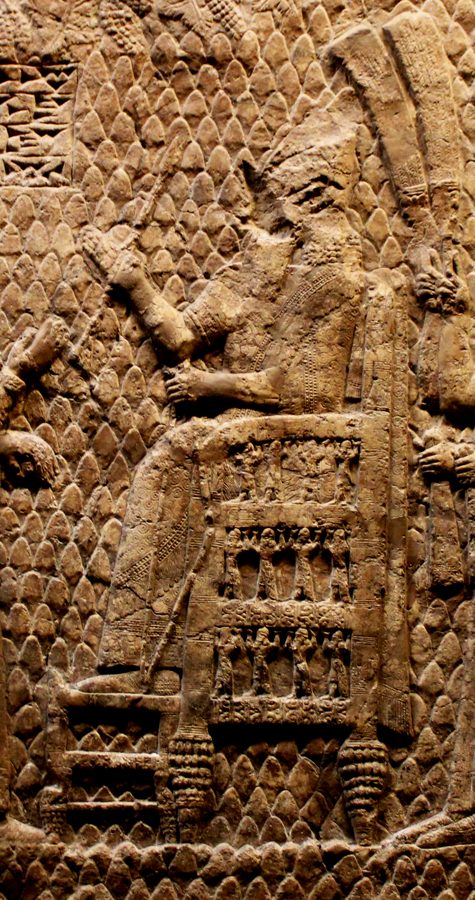
King seated with his feet on a footstool (Lakish (Lachish) relief) (© Zunkir, CC BY-SA 4.0, via Wikimedia Commons)
References
- Hebrew הֲדֹם, רֶגֶל hadom regel: 1 CHR 28:2, PSA 99:5, PSA 110:1, PSA 132:7, ISA 66:1, LAM 2:1
- Hebrew כֶּבֶשׁ kevesh: 2 CHR 9:18
- Greek ὑποπόδιον hupopodion: MAT 5:35, LUKE 20:43, ACTs 2:35, ACTs 7:49, HEB 1:13, HEB 10:13, YAC 2:3
- Latin scabillum: L ESD 6:4
Description and usage
The footstool was a piece of furniture on which a person could rest his feet. It took the form of a low stool on which the feet were placed to keep them off the ground. Mitsri (Egyptian) footstools, such as the one shown below actually depicted enemies the Mitsri king had defeated.
———
Translation
Since footstools are a common cultural feature in many parts of the world, it is may not be necessary to use a descriptive phrase. Translators can, however, use an expression such as “thing on which to rest one’s feet.” In some languages the functional equivalent of “footstool” is “footstick,” which is a stick on which a person normally places his feet in order to raise them from the relatively damp dirt floor of a typical house or hut.
Except for YAC 2:3, the Greek word hupopodion occurs only as a figure in the New Testament. As a figure, it occurs in quotations from or allusions to Old Testament verses. Most translations consulted render it literally; for example, in LUKE 20:43GNT has “until I put your enemies as a footstool under your feet.” NCV renders it nonfiguratively, saying “until I put your enemies under your control.” Similarly, at MAT 3:35 instead of the literal “or by the earth, for it is his footstool” (RSV), NCV has “using the name of the earth, because the earth belongs to God.” In YAC 2:3hupopodion refers to an actual footstool, when the host insults the poor man by telling him, “Sit under my footstool.” REB retains the reference to the footstool with “sit here on the floor by my footstool.” However, most translations choose to omit the footstool with something similar to NIV, which says “Sit on the floor by my feet.”
 Open English Translation (OET)