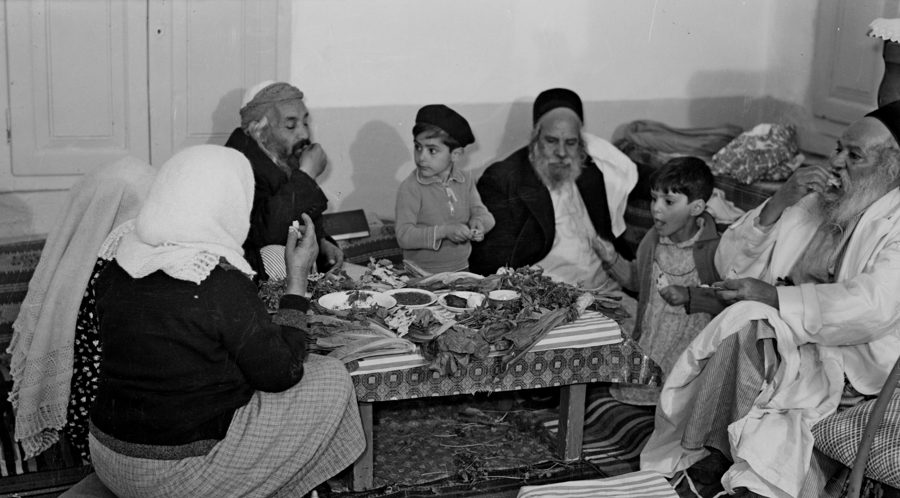
Family eating at a low table (Matson Collection, Library of Congress, Public domain)
References
- Hebrew מֵסַב mesav: SNG 1:12
- Hebrew שֻׁלְחָן shulchan: EXO 25:23, EXO 25:27, EXO 25:28, EXO 25:30, EXO 26:35, EXO 30:27, EXO 31:8, EXO 35:13
54 more references
EXO 37:10, EXO 37:14, EXO 37:15, EXO 37:16, EXO 39:36, EXO 40:4, EXO 40:22, EXO 40:24, LEV 24:6, NUM 3:31, NUM 4:7, HERO 1:7, 1 SAM 20:29, 1 SAM 20:34, 2 SAM 9:7, 2 SAM 9:10, 2 SAM 9:11, 2 SAM 9:13, 2 SAM 19:28, 1 KI 2:7, 1 KI 4:27, 1 KI 7:48, 1 KI 10:5, 1 KI 13:20, 1 KI 18:19, 2 KI 4:10, 1 CHR 28:16, 2 CHR 4:8, 2 CHR 4:19, 2 CHR 9:4, 2 CHR 13:11, 2 CHR 29:18, NEH 5:17, JOB 36:16, PSA 23:5, PSA 69:22, PSA 78:19, PSA 128:3, PROV 9:2, ISA 21:5, ISA 28:8, ISA 65:11, EZEK 23:41, EZEK 39:20, EZEK 40:39, EZEK 40:40, EZEK 40:41, EZEK 40:42, EZEK 40:43, EZEK 41:22, EZEK 44:16, DAN 11:27, MAL 1:7, MAL 1:12 - Greek κατακλίνω kataklinō (verb): LUKE 7:36, LUKE 24:30, JDT 12:15
- Greek τράπεζα trapeza: MAT 15:27, MARK 7:28, LUKE 16:21, LUKE 22:21, LUKE 22:30, ACTs 6:2, ACTs 16:34, ROM 11:9
11 more references
1 COR 10:21, ESG 4:17, SIR 6:10, SIR 14:10, SIR 29:26, SIR 31:12, SIR 40:29, BEL 1:18, 1 MAC 1:22, 1 MAC 4:49, 1 MAC 4:51 - Latin mensa: L ESD 9:19
Description and usage
Meals were eaten from a mat or low table. The mat could be made of straw or an animal skin. The low table stood only about 30 centimeters (12 inches) high.
———
Translation
The Hebrew word shulchan (literally “a thing thrown”) originally referred to a straw mat or animal skin spread on the ground. People sat on the ground or reclined on one side. By New Testament times, people ate while lying on their side next to a low table. Normally a person reclined on the left side, leaning on the left elbow and eating with the right hand. The knees were bent with the feet behind the back. While Yeshua (Jesus; Grk. Yesus) was in this position, the woman in LUKE 7:36, LUKE 7:37, LUKE 7:38 was able to perfume his feet from behind him while he was eating. This would have been an almost impossible action if he had been seated in a chair. In this passage an explanatory note may be appropriate. In most of the other passages listed above, a common word for “table” will be adequate since the exact structure will be unimportant.
A higher table, at which a person could sit in a chair, was also known in ancient times. Such tables often had three legs, two on one side and one opposite, giving the table stability on uneven surfaces. In fact, the Greek word trapeza means “three legs.” Such tables, however, were used for purposes other than eating.
For the Hebrew word shulchan used with the sense of “altar,” see 4.2.3 Temple altar<REALIA:4.2.3> and 4.2.4 Incense altar<REALIA:4.2.4>.
For the Hebrew word mesav in SNG 1:12, see the comments at 5.5 Bed, sleeping mat<REALIA:5.5> above.
In a number of New Testament passages, the word “table” is used in a phrase in which the focus is on what happens at a table rather than on the table itself. Thus, for example, “eat and drink at my table” (LUKE 22:30; RSV) may be rendered “eat and drink with me” (CEV); “to serve tables” (ACTs 6:2; RSV) may be “to assist in the distribution” (REB) or “to handle finances” (GNT); and “You cannot partake of the table of the Lord and the table of demons” (1 COR 10:21; RSV) may be “You cannot participate at the same time in the Lord’s meal and in the meals of evil spirits” (PV).
In LUKE 7:36 most English translations consulted use the word “table” in some phrase like “sat down at table.” It is possible, however, to avoid introducing the table. CEV has “got ready to eat.”
 Open English Translation (OET)