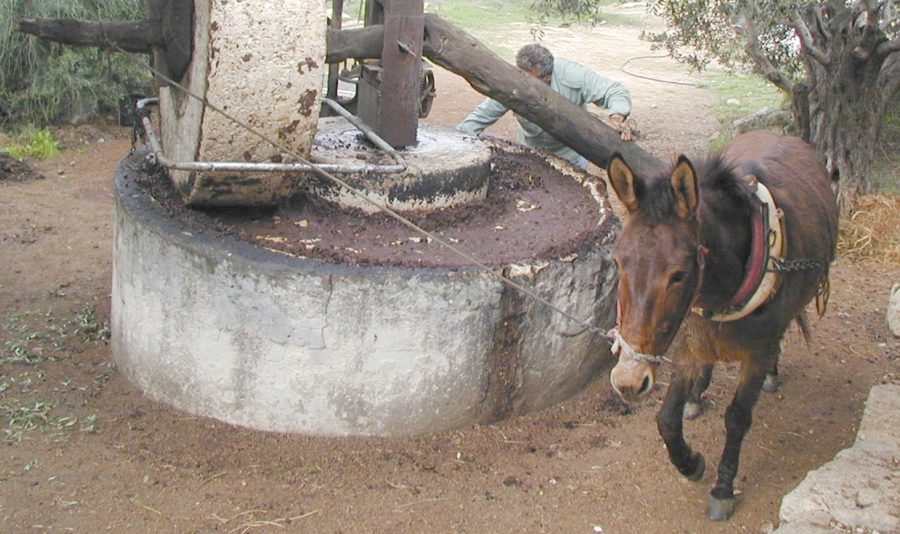
Mule turning olive press (© Ray Pritz (UBS))
References
- Hebrew פֶּרֶד pered: 2 SAM 13:29, 2 SAM 18:9, 1 KI 10:25, 1 KI 18:5, 2 KI 5:17, 1 CHR 12:40, 2 CHR 9:24, EZRA 2:66
- Hebrew פִּרְדָּה pirdah: 1 KI 1:33, 1 KI 1:38, 1 KI 1:44
- Greek ἡμίονος hēmionos: JDT 2:17, JDT 15:11, G ESD 5:42
Discussion
The word pirdah refers to the female mule while pered can refer to either the male or the female. In biblical times mules were used for riding and as pack animals while horses were mainly used to pull military chariots. They appear to have been introduced into Kena’an (Canaan) much later than horses. Mules are not mentioned in the Bible until the time of David while horses are mentioned in the Yosef (Joseph) story and in DEUT 17:16 where the king is forbidden to acquire them. Technically the owning of mules was not prohibited although the breeding of them would have fallen under the prohibition of LEV 19:19, which forbade the cross-breeding of animals. The Israelis (Israelites) thus seem to have relied on mules imported from neighboring countries.
Description
The mule is not an animal found naturally anywhere, but is the result of people breeding male donkeys with female horses. It is also possible to breed male horses with female donkeys, but the offspring, technically called “hinnies", not “mules", are usually smaller than mules. Mules are bigger and stronger than donkeys and are much more resistant to disease than either horses or donkeys. They are usually dark brown with bigger ears than the parent horse.
Although there are male and female mules they are infertile and not able to breed. This makes the stronger males much easier to handle than stallions.
Special significance or symbolism
Although the mule in English is associated with stubbornness this is not usually the case in other cultures since mules are very easy to handle if treated properly. In PSA 32:9 the mule is linked to the horse as both being animals that lack sufficient understanding and need to be guided in the right direction.
Translation
Even in languages of societies that know mules, they are often referred to as “horse-donkeys", or “donkey-horses". This seems to be a good translation solution even in languages that have no word for mule.
 Open English Translation (OET)