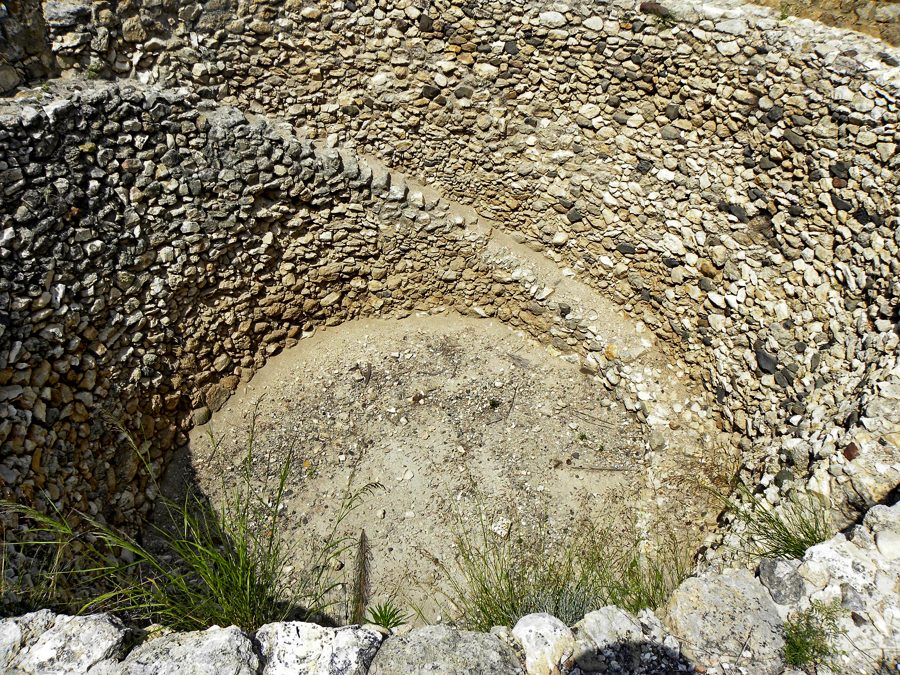
Grain-store at Megidon (Megiddo) (© Ian Scott, CC BY-SA 2.0, via Wikimedia Commons)
References
- Hebrew אָסָם ’asam: DEUT 28:8, PROV 3:10
- Hebrew אוֹצָר ’otsar: YOEL 1:17
- Hebrew מַאֲבוּס ma’avus: YIR 50:26
- Hebrew מְגוּרָה mgurah: HAG 2:19
- Hebrew מַמְּגוּרָה mamgurah: YOEL 1:17
- Hebrew מִסְכְּנוֹת misknoth: EXO 1:11, 1 KI 9:19, 2 CHR 8:4, 2 CHR 8:6, 2 CHR 16:4, 2 CHR 17:12, 2 CHR 32:28
- Greek ἀποθήκη apothēkē: MAT 3:12, MAT 6:26, MAT 13:30, LUKE 3:17, LUKE 12:18, LUKE 12:24
- Latin promptuarium: L ESD 5:9
Description and usage
The grain-store or silo was a small structure for storing agricultural produce. It normally was made of stone.
———
Translation
In a number of languages an important distinction is made between buildings used to store farm produce and those that are warehouses for other types of material. This structure was actually not a “building” in the sense that it was constructed like a house. The English word “barn” conveys the idea of a large, multi-purpose structure. Something like “grain-store,” “granary,” or “grain bin” will be preferable.
Most of the references to the Hebrew word misknoth (except 2 CHR 32:28) appear with the word for “city.” The following advice comes from of A Handbook on Exodus (page 22) at EXO 1:11: “The store-cities were special centers built as warehouses for storing grain and other supplies for the government. If such centers are unknown in the receptor culture, it is possible to translate this word as ‘cities in which to store supplies,’ or ‘cities … to serve as supply centers,’ as in TEV [that is, GNT]. In cultures where the only large human settlements are villages surrounded by fences, translators will need other more descriptive ways to translate store-cities; for example, ‘large villages with high walls [or, fences] around them, where supplies are stored’ or ‘large places with high fences around them, where they store grain and other things.’ ”
 Open English Translation (OET)