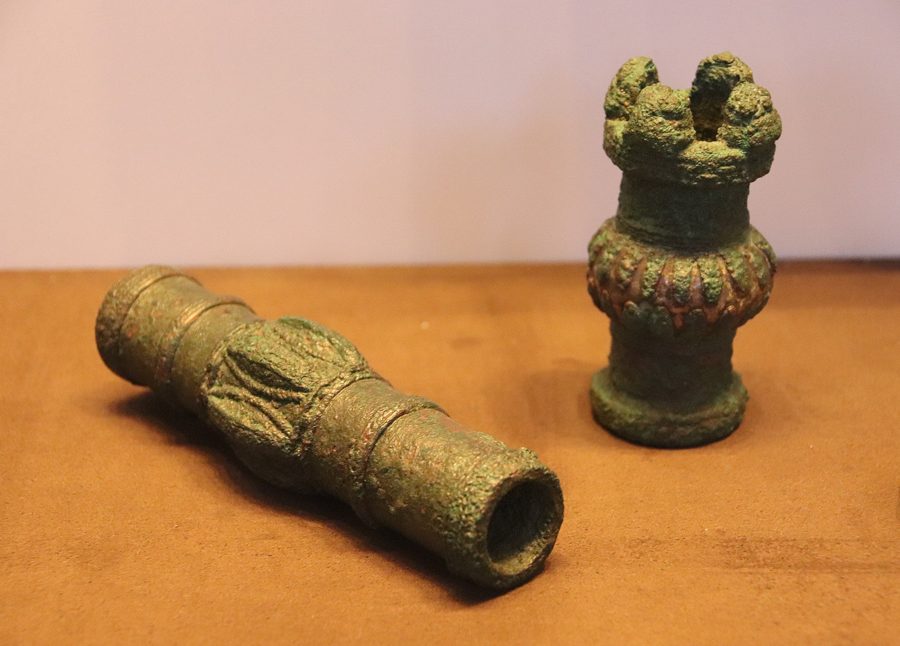
Head of a scepter (Gary Todd, Israel Museum, CC0, via Wikimedia Commons)
References
- Hebrew חקק mchoqeq: GEN 49:10, NUM 21:18, PSA 60:7, PSA 108:8
- Hebrew מַטֶּה mateh: PSA 110:2, YIR 48:17
- Hebrew מַקֵּל maqel: YIR 48:17
- Hebrew שֵׁבֶט shevet: GEN 49:10, NUM 24:17, HERO 5:14, PSA 45:6, PSA 125:3, ISA 14:5, EZEK 19:11, EZEK 19:14
- Hebrew שַׁרְבִיט sharvit: EST 4:11, EST 5:2, EST 8:4
- Greek ῥάβδος rhabdos: HEB 1:8, ESG 5:2
- Greek σκῆπτρον skēptron: ESG 4:17, WIS 6:21, WIS 7:8, WIS 10:14, SIR 35:21, L JER 1:12
Description and usage
The scepter was a decorated rod, often made at least partially of a precious metal, symbolizing the authority of the ruler. The ruler held the scepter when he was engaged in certain aspects of his office. See also 1.2.4 Rod, club, shepherd’s staff<REALIA:1.2.4>.
———
Translation
In languages where a chief’s authority is symbolized by an object associated with him (such as a cane, stool, or scepter), such symbols of authority can often be used in translation; for example, PSA 45:6 may be rendered “Your ceremonial staff shows that you rule your people fairly.”
The Hebrew words mateh and maqel are parallel to each other in YIR 48:17. It is not always necessary to reproduce the parallelism with two similar words; for example, for the last half of this verse RSV has “How the mighty scepter is broken, the glorious staff,” but GNT says “Its powerful rule has been broken; its glory and might are no more.” This passage is metaphorical, so the focus here is not on the scepter as a physical object but on authority.
 Open English Translation (OET)