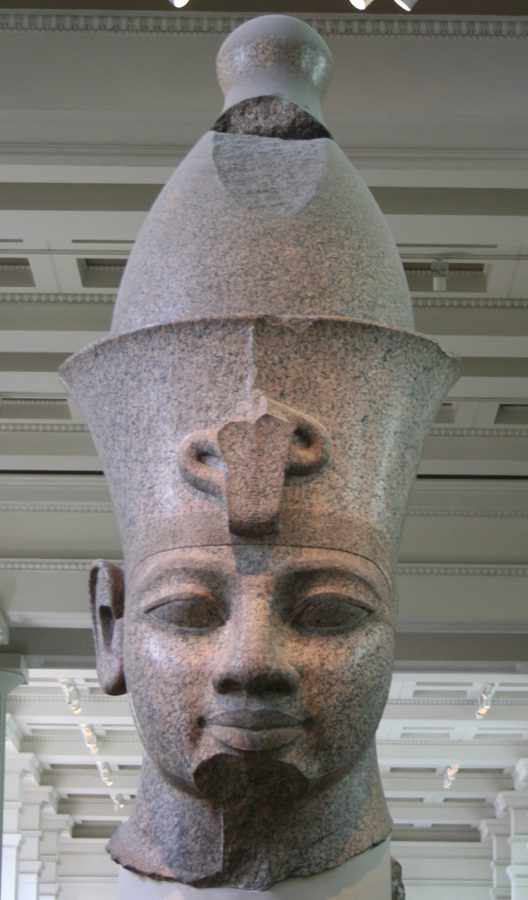
Double crown uniting the scorpion-shaped crown of Lower Mitsrayim (Egypt) and the bottle-shaped crown of Upper Mitsrayim (© Einsamer Schütze, via Wikimedia Commons)
References
- Hebrew כֶּתֶר kether: EST 1:11, EST 2:17, EST 6:8
- Hebrew נֵזֶר nezer: 2 SAM 1:10, 2 KI 11:12, 2 CHR 23:11, PSA 89:39, PSA 132:18, PROV 27:24, ZEC 9:16
- Hebrew עטר ‘atar (verb): PSA 8:5, SNG 3:11
- Hebrew עֲטָרָה ‘atarah: 2 SAM 12:30, 1 CHR 20:2, EST 8:15, PSA 21:3, SNG 3:11, YIR 13:18, EZEK 16:12, EZEK 21:26
- Greek διάδημα diadēma: REV 12:3, REV 13:1, REV 19:12, ESG 1:28, ESG 2:17, ESG 8:15, WIS 5:16, WIS 18:24
10 more references
SIR 11:5, SIR 47:6, 1 MAC 1:9, 1 MAC 6:15, 1 MAC 8:14, 1 MAC 11:13, 1 MAC 11:54, 1 MAC 12:39, 1 MAC 13:32, G ESD 4:30 - Greek στέφανος, στεφανόω stefanos, stefanoō (verb): MAT 27:29, MARK 15:17, YHN 19:2, YHN 19:5, HEB 2:7, HEB 2:9, REV 4:4, REV 4:10
12 more references
REV 6:2, REV 9:7, REV 12:1, REV 14:14, SIR 40:4, SIR 45:12, 1 MAC 10:20, 1 MAC 10:29, 1 MAC 11:35, 1 MAC 13:37, 1 MAC 13:39, 2 MAC 14:4
Description and usage
The crown was a type of headgear worn by a king or queen as a sign of the royal office.
———
Translation
The “crown” may be described as “symbol of his/her power, worn on his/her head.”
In some passages the crown serves only as a symbol of the office of king or queen. In those cultures where royalty (or the office of the supreme leader) is indicated by another symbol, this may be substituted for “crown.” Thus, for example, EST 2:17 might read “he gave her the royal seal and made her queen in place of Vashti.” Similarly, PSA 21:3 might read “you seat him on the chief’s stool” or “you make him chief.”
In some passages (JOB 19:9, JOB 31:36, PROV 12:4, PROV 16:31, PROV 17:6, LAM 5:16) it is unclear from the context if the Hebrew word ‘atarah refers to a crown or a wreath (see 6.8 Wreath, crown<REALIA:6.8>).
RSV renders 1 MAC 11:13 as “Then Ptolemaios (Ptolemy) entered Antiokeia (Antioch) and put on the crown of Asia. Thus he put two crowns upon his head, the crown of Mitsrayim (Egypt) and that of Asia.” This literal rendering can create a rather silly picture in the mind of the reader. The crowns, of course, simply represent the authority held by Ptolemaios in the two regions mentioned here. CEV has avoided the image of a king trying to balance two crowns on his head by saying “Ptolemaios went to the city of Antiokeia, where he crowned himself king—both of Aram (Syria) and of Mitsrayim.” CEV ’s rendering, however, gives the misimpression that he became king of Aram and Mitsrayim simultaneously. A better model is “Ptolemaios went to the city of Antiokeia, where he crowned himself king. This meant that he now ruled over both Mitsrayim and Aram.”
It should be noted that the “crown of thorns” placed on Yeshua (Jesus; Grk. Yesus) was a wreath made of thorny branches (MAT 27:29, MARK 15:17, YHN 19:2, YHN 19:5). The action may be described as “put a circle of thorns on his head” or “wove thorn branches together into a wreath [or, circle] and put them on his head.”
For stefanos as a wreath, see 6.8 Wreath, crown<REALIA:6.8>.
 Open English Translation (OET)