
OET INT FRT GEN EXO LEV NUM DEUT JOB YEHO (JOS) HERO (JDG) RUTH 1 SAM 2 SAM PSA AMOS HOS 1 KI 2 KI 1 CHR 2 CHR PROV ECC SNG YOEL (JOEL) MIC ISA ZEP HAB YIR (JER) LAM YNA (JNA) NAH OBAD DAN EZEK EZRA EST NEH HAG ZEC MAL 2 PS WIS TOB MAN BAR G DAN G ESD L ESD ESG JDT 3 MAC SIR 1 MAC 2 MAC 4 MAC YHN (JHN) MARK MAT LUKE ACTs YAC (JAM) GAL 1 TH 2 TH 1 COR 2 COR ROM COL LAOD PHM EPH PHP 1 TIM TIT 1 PET 2 PET 2 TIM HEB YUD (JUD) 1 YHN (1 JHN) 2 YHN (2 JHN) 3 YHN (3 JHN) REV
OET EZRA Intro C1 C2 C3 C4 C5 C6 C7 C8 C9 C10
OET EZR 6 V13 V14 V15 V16 V17 V18
This is still an early look into the drafted text of the Open English Translation of the Bible. Please double-check the text in advance before using in public.
6:13 The temple dedication
13 Then Tatenay, the governor of the region west of the Perat (Euphrates), Shetar-Bozenay, and their companions worked hard to follow the instructions sent by King Dareyavesh (Darius). 14 So the Jewish elders continued building, and they were encouraged by the prophesying of the prophet Hagay[ref] and Ido’s son Zekaryah (Zechariah).[ref] As a result of the decrees of the Persian kings Koresh (Cyrus) , and Dareyavesh and Artahshashta (Artaxerxes), they were able to fulfil God’s decree to rebuild the temple. 15 The rebuilt temple was finished in mid-March in the sixth year of King Dareyavesh’s reign.
16 Then the Israeli people, the priests, and the Levites, and the ones that had returned from exile, performed the dedication of this house of God with celebrations. 17 During the dedication, they offered a hundred bulls, two-hundred rams, and four-hundred lambs, as well as twelve male goats for a sin offering for all Yisrael (Israel) (matching the number of the tribes). 18 Then they organised the priests to stand in their divisions and the Levites in their sections to serve the god who resides in Yerushalem (Jerusalem), according to the instructions written by Mosheh (Moses).

6:14 OSHB variant note: נביא/ה: (x-qere) ’נְבִיָּ֔/א’: lemma=5029 n=1.1 morph=ANcmpd/Td id=15xRq נְבִיָּ֔/א
6:17 OSHB variant note: ל/חטיא: (x-qere) ’לְ/חַטָּאָ֤ה’: lemma=l/2402 morph=AR/Vpc id=15Upn לְ/חַטָּאָ֤ה
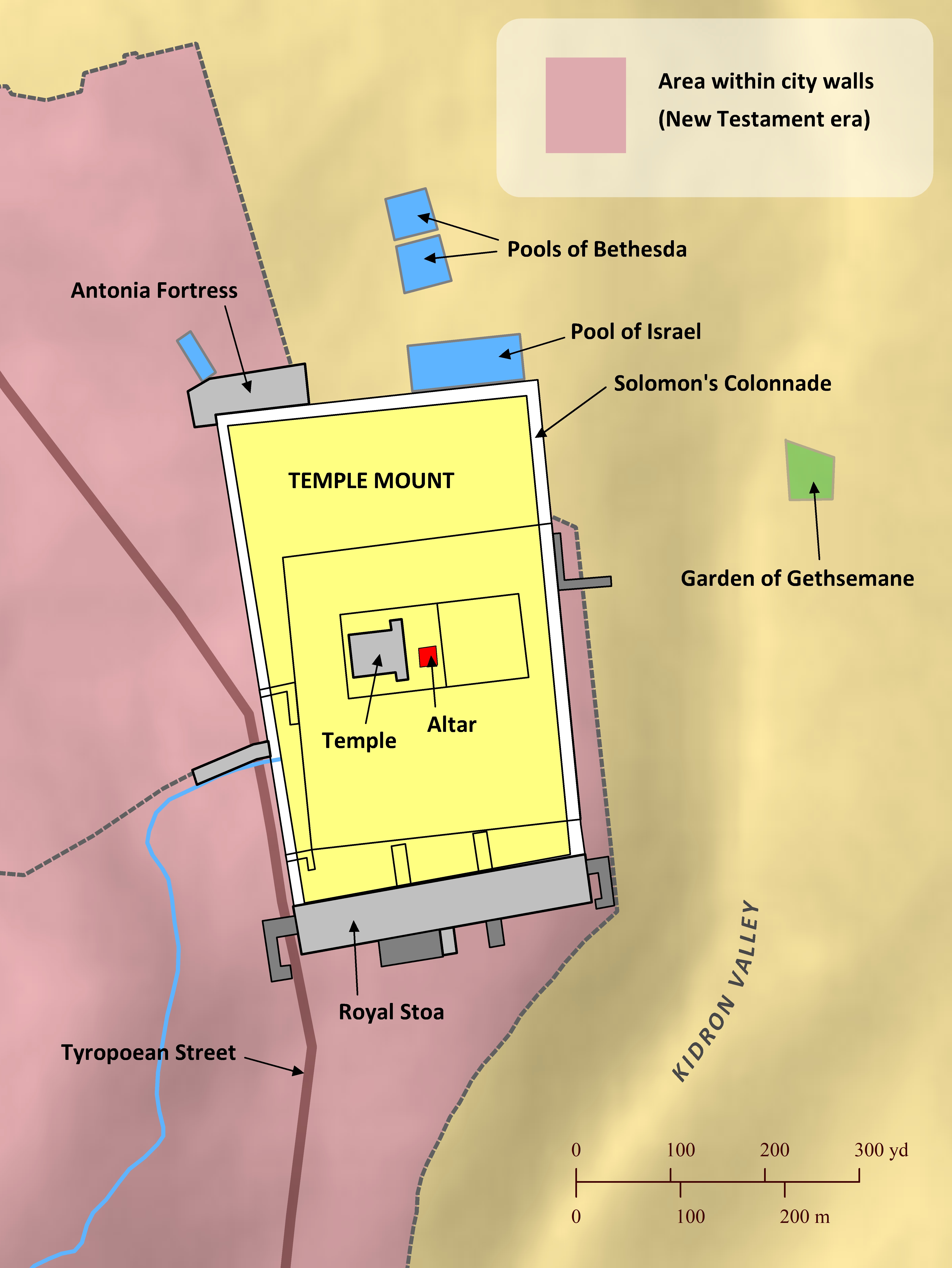
The Temple of the Lord in Jerusalem, where all Israelite males were commanded to offer sacrifices to the Lord (Exodus 23:14-19; Deuteronomy 16:16-17), underwent several stages of reconstruction and development over hundreds of years. The first Temple was built by King Solomon to replace the aging Tabernacle, and it was constructed on a threshing floor on high ground on the north side of the city (2 Samuel 24; 1 Chronicles 21). Hundreds of years later King Hezekiah expanded the platform surrounding the Temple. When Jerusalem fell to the Babylonians in 586 B.C., the Temple was completely destroyed (2 Kings 25:1-21; 2 Chronicles 36:17-21; Jeremiah 39:1-10; 52:1-30). It was rebuilt in 515 B.C. after a group of Jews returned to Judea from exile in Babylon (Ezra 1:5-6:15; Nehemiah 7:5-65). Herod the Great completely rebuilt and expanded the Temple once again around 20 B.C., making it one of the largest temples in the Roman world. Jesus’ first believers often met together in Solomon’s Colonnade, a columned porch that encircled the Temple Mount, perhaps carrying on a tradition started by Jesus himself (John 10:23; Acts 3:11; 5:12). But Herod’s Temple did not last long: After many Jews revolted against Rome, the Romans eventually recaptured Jerusalem and destroyed the Temple in A.D. 70.