
OET OET-RV OET-LV GHT ULT UST BSB MSB BLB AICNT OEB WEBBE WMBB NET LSV FBV TCNT T4T LEB BBE Moff JPS Wymth ASV DRA YLT Drby RV SLT Wbstr KJB-1769 KJB-1611 Bshps Gnva Cvdl TNT Wycl SR-GNT UHB BrLXX BrTr Related Parallel Simple Interlinear Topics Reference Dictionary Search
OET By Document By Section By Chapter Details
OET INT FRT GEN EXO LEV NUM DEU JOB JOS JDG RUTH 1 SAM 2 SAM PSA AMOS HOS 1 KI 2 KI 1 CHR 2 CHR PROV ECC SNG JOEL MIC ISA ZEP HAB JER LAM YNA NAH OBA DAN EZE EZRA EST NEH HAG ZEC MAL GES LES ESG DNG 2 PS TOB JDT WIS SIR BAR MAN 1 MAC 2 MAC 3 MAC 4 MAC YHN MARK MAT LUKE ACTs YAC GAL 1 TH 2 TH 1 COR 2 COR ROM COL PHM EPH PHP 1 TIM TIT 1 PET 2 PET 2 TIM HEB YUD 1 YHN 2 YHN 3 YHN REV
EZRA Intro C1 C2 C3 C4 C5 C6 C7 C8 C9 C10
This is still an early look into the drafted text of the Open English Translation of the Bible. Please double-check the text in advance before using in public.
2:1 The list of returning exiles
2 Out of the captives that Babylonian King Nevukadnetstsar (Nebuchadnezzar) had brought as slaves to Babylon, these are their descendants who returned to Yerushalem in Yehudah—each person returning to their own ancestral town. 2 The ones who went with Zerubabel were: Yeshua, Nehemyah, Serayah, Re’elayah, Mordecai, Bilshan, Mispar, Bigvai, Rehum, and Ba’anah.
Their numbers were:
21 And from these towns:
43 The temple servants who returned:
55 The descendants of Shelomoh’s (Solomon’s) servants who returned:
58 Altogether there were 392 descendants of temple workers and Shelomoh’s servants who returned.
59 Another group went from the towns of Tel-Melah, Tel-Harsha, Keruv, Addon, and Immer, but they didn’t know their ancestry from before they were taken as captives.
60 There were 652 people who were descendants of Delayah, Toviyah, and Nekoda, 61 and from the sons of the priests: the descendants of Havayyah; the descendants of Hakkots; and the descendants of Barzillai, who took a wife from the daughters of Barzillai the Gileadite, so he was called by their name. 62 They had searched for their records among the genealogies, but couldn’t find their families listed, so they were disqualified to serve as priests. 63 Also the governor told them that they mustn’t eat any of the holiest food until a priest could use the Urim and Thummim to determine their status.[ref]
64 Altogether in this group, 42,360 people returned to Yehudah. 65 not counting their 7,337 male and female servants, plus 200 male and female musicians. 66 They also took 736 horses and 245 mules, 67 435 camels and 6,720 donkeys.
68 When some of the heads of families got to Yahweh’s temple in Yerushalem, they freely donated so that it could be rebuilt. 69 They each donated to the treasury according to their individual resources—a total of sixty-one thousand gold coins, five thousand silver bars, and a hundred sets of clothing for the priests.
70 So the priests and the Levites, and some of the people, and the singers, and the gatekeepers and the temple servants returned to live in their ancestral cities, and so all the Israeli cities had returnees living in them.[ref]

2:1 OSHB variant note: נבוכדנצור: (x-qere) ’נְבוּכַדְנֶצַּ֥ר’: lemma_5020 morph_HNp id_15PGK נְבוּכַדְנֶצַּ֥ר
2:46 OSHB variant note: שמלי: (x-qere) ’שַׁלְמַ֖י’: lemma_8014 n_0.0 morph_HNp id_15Sjh שַׁלְמַ֖י
2:50 OSHB variant note: מעינים: (x-qere) ’מְעוּנִ֖ים’: lemma_4586 n_0.0 morph_HNgmpa id_15Abd מְעוּנִ֖ים
2:50 OSHB variant note: נפיסים: (x-qere) ’נְפוּסִֽים’: lemma_5304 n_0 morph_HNgmpa id_15gMU נְפוּסִֽים
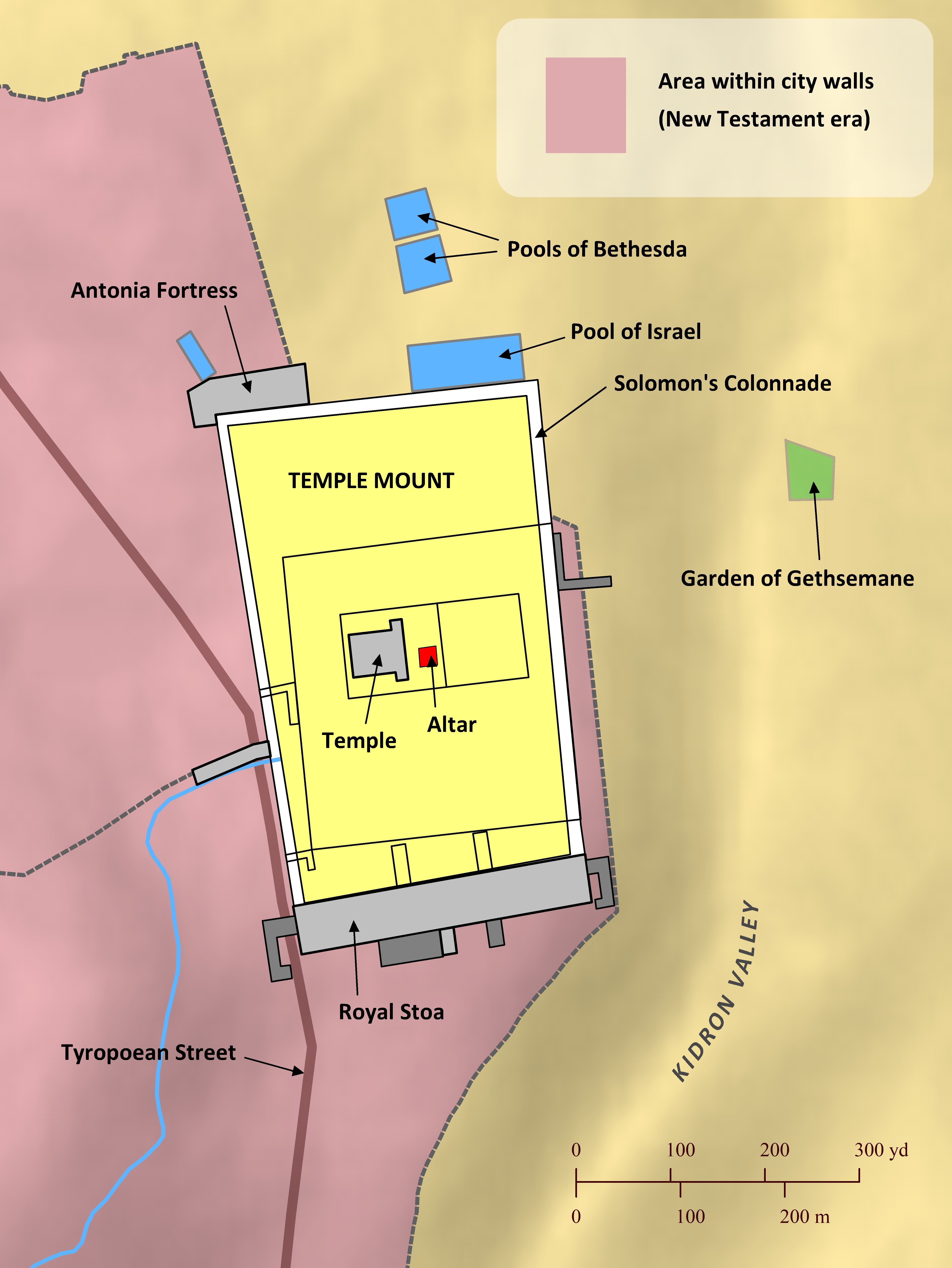
The Temple of the Lord in Jerusalem, where all Israelite males were commanded to offer sacrifices to the Lord (Exodus 23:14-19; Deuteronomy 16:16-17), underwent several stages of reconstruction and development over hundreds of years. The first Temple was built by King Solomon to replace the aging Tabernacle, and it was constructed on a threshing floor on high ground on the north side of the city (2 Samuel 24; 1 Chronicles 21). Hundreds of years later King Hezekiah expanded the platform surrounding the Temple. When Jerusalem fell to the Babylonians in 586 B.C., the Temple was completely destroyed (2 Kings 25:1-21; 2 Chronicles 36:17-21; Jeremiah 39:1-10; 52:1-30). It was rebuilt in 515 B.C. after a group of Jews returned to Judea from exile in Babylon (Ezra 1:5-6:15; Nehemiah 7:5-65). Herod the Great completely rebuilt and expanded the Temple once again around 20 B.C., making it one of the largest temples in the Roman world. Jesus’ first believers often met together in Solomon’s Colonnade, a columned porch that encircled the Temple Mount, perhaps carrying on a tradition started by Jesus himself (John 10:23; Acts 3:11; 5:12). But Herod’s Temple did not last long: After many Jews revolted against Rome, the Romans eventually recaptured Jerusalem and destroyed the Temple in A.D. 70.