
OET OET-RV OET-LV GHT ULT UST BSB MSB BLB AICNT OEB WEBBE WMBB NET LSV FBV TCNT T4T LEB BBE Moff JPS Wymth ASV DRA YLT Drby RV SLT Wbstr KJB-1769 KJB-1611 Bshps Gnva Cvdl TNT Wycl SR-GNT UHB BrLXX BrTr Related Parallel Simple Interlinear Topics Reference Dictionary Search
OET By Document By Section By Chapter Details
OET INT FRT GEN EXO LEV NUM DEU JOB JOS JDG RUTH 1 SAM 2 SAM PSA AMOS HOS 1 KI 2 KI 1 CHR 2 CHR PROV ECC SNG JOEL MIC ISA ZEP HAB JER LAM YNA (JNA) NAH OBA DAN EZE EZRA EST NEH HAG ZEC MAL GES LES ESG DNG 2 PS TOB JDT WIS SIR BAR MAN 1 MAC 2 MAC 3 MAC 4 MAC YHN (JHN) MARK MAT LUKE ACTs YAC (JAM) GAL 1 TH 2 TH 1 COR 2 COR ROM COL PHM EPH PHP 1 TIM TIT 1 PET 2 PET 2 TIM HEB YUD (JUD) 1 YHN (1 JHN) 2 YHN (2 JHN) 3 YHN (3 JHN) REV
EZRA Intro C1 C2 C3 C4 C5 C7 C8 C9 C10
This is still an early look into the drafted text of the Open English Translation of the Bible. Please double-check the text in advance before using in public.
6 So King Dareyavesh (Darius) ordered that a search be conducted in all the archives where treasures had been deposited there in Babylon, 2 and one scroll was found in the fortress at Ecbatana in the province of Media, and this record had been made:
3 “In year one of Koresh the king, he made a decree about the house of God in Yerushalem:
‘Let the house be built in the same place where sacrifices were made. Establish its foundations and build it 27m high and 27m wide 4 with three layers of large stones and a layer of new timber. That should all be paid for from the royal treasury. 5 Also, the gold and silver containers from the house of God that Nevukadnetstsar had taken out from the Yerushalem temple and had brought to Babylon, must be returned to their places in the temple in Yerushalem. So you must put them in the house of God.’ ”
6 Therefore King Dareyavesh wrote: “Now to Governor Tattenai in the province west of the Euphrates, Shetar-Bozenai, and their companions, the officials who in that province:
Keep away from that place. 7 Leave alone the work on that house of God. Let the Jewish governor and elders build that temple in its place. 8 So here’s my decree about what should be done for those Jewish elders to build that house of God: Using the king’s treasures that come from the tribute of that west-Euphrates province, let those workers costs be regularly reimbursed so that the work doesn’t stop. 9 Whatever is needed (including young bulls, or rams, or lambs for burnt offerings to the god of the heavens, wheat, salt, wine, or oil, according to the command of the priests in Yerushalem), let it be given to them day by day (that is, without delay), 10 so that they can be offering sweet-smelling sacrifices to the god of the heavens and praying for the life of the king and his sons. 11 Also I decree that any man who changes this edict should have a beam pulled from his house, and after it’s sharpened and set into the ground, then he should be impaled on it. Then his entire house should be made into a rubbish heap because of what he did. 12 May the god who has established his name there overthrow any king or person who makes any attempt to change this decree or to destroy that house of God in Yerushalem. I, Dareyavesh, have made a decree. Let it be done diligently.”
6:6 OSHB note: We read one or more accents in L differently from BHQ.
13 Then Tattenai, the governor of the region west of the Euphrates, Shetar-Bozenai, and their companions worked hard to follow the instructions sent by King Dareyavesh (Darius). 14 So the Jewish elders continued building, and they were encouraged by the prophesying of the prophet Haggai[ref] and Iddo’s son Zekaryah.[ref] As a result of the decrees of the Persian kings Koresh, and Dareyavesh and Artahshasta, they were able to fulfil God’s decree to rebuild the temple. 15 The rebuilt temple was finished in mid-March in the sixth year of King Dareyavesh’s reign.
16 Then the Israeli people, the priests, and the Levites, and the ones that had returned from exile, performed the dedication of this house of God with celebrations. 17 During the dedication, they offered a hundred bulls, two-hundred rams, and four-hundred lambs, as well as twelve male goats for a sin offering for all Yisrael (matching the number of the tribes). 18 Then they organised the priests to stand in their divisions and the Levites in their sections to serve the god who resides in Yerushalem, according to the instructions written by Mosheh (Moses).
19 So the people who’d returned from exile celebrated the ‘pass-over’ in late April.[ref] 20 The priests and Levites all had to be individually purified, and they slaughtered the lambs for all the exiles and for their brothers the priests, and for themselves. 21 Then all the Israelis ate the meal—those who’d returned from the exile and every one who’d separated themselves from the uncleanness of the nations of the land in order to search for Israel’s god Yahweh. 22 Then they happily enjoyed the Flat Bread Celebration for seven days, because Yahweh had made them happy, and had caused the Assyrian king to show favour to them, to assist their work rebuilding the house of God, the god of Yisrael.

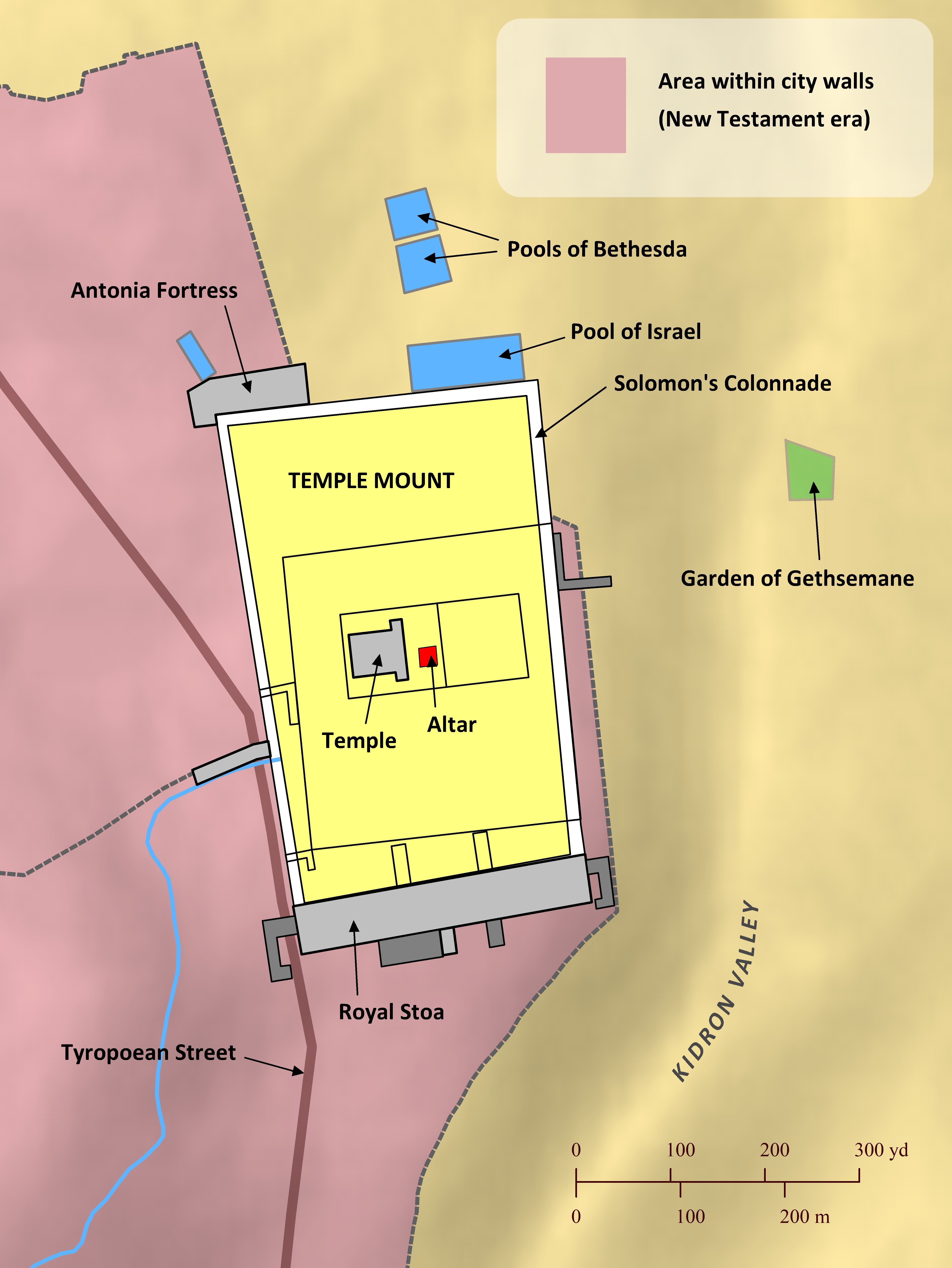
The Temple of the Lord in Jerusalem, where all Israelite males were commanded to offer sacrifices to the Lord (Exodus 23:14-19; Deuteronomy 16:16-17), underwent several stages of reconstruction and development over hundreds of years. The first Temple was built by King Solomon to replace the aging Tabernacle, and it was constructed on a threshing floor on high ground on the north side of the city (2 Samuel 24; 1 Chronicles 21). Hundreds of years later King Hezekiah expanded the platform surrounding the Temple. When Jerusalem fell to the Babylonians in 586 B.C., the Temple was completely destroyed (2 Kings 25:1-21; 2 Chronicles 36:17-21; Jeremiah 39:1-10; 52:1-30). It was rebuilt in 515 B.C. after a group of Jews returned to Judea from exile in Babylon (Ezra 1:5-6:15; Nehemiah 7:5-65). Herod the Great completely rebuilt and expanded the Temple once again around 20 B.C., making it one of the largest temples in the Roman world. Jesus’ first believers often met together in Solomon’s Colonnade, a columned porch that encircled the Temple Mount, perhaps carrying on a tradition started by Jesus himself (John 10:23; Acts 3:11; 5:12). But Herod’s Temple did not last long: After many Jews revolted against Rome, the Romans eventually recaptured Jerusalem and destroyed the Temple in A.D. 70.