
OET INT FRT GEN EXO LEV NUM DEUT JOB YEHO (JOS) HERO (JDG) RUTH 1 SAM 2 SAM PSA AMOS HOS 1 KI 2 KI 1 CHR 2 CHR PROV ECC SNG YOEL (JOEL) MIC ISA ZEP HAB YIR (JER) LAM YNA (JNA) NAH OBAD DAN EZEK EZRA EST NEH HAG ZEC MAL 2 PS WIS TOB MAN BAR G DAN G ESD L ESD ESG JDT 3 MAC SIR 1 MAC 2 MAC 4 MAC YHN (JHN) MARK MAT LUKE ACTs YAC (JAM) GAL 1 TH 2 TH 1 COR 2 COR ROM COL LAOD PHM EPH PHP 1 TIM TIT 1 PET 2 PET 2 TIM HEB YUD (JUD) 1 YHN (1 JHN) 2 YHN (2 JHN) 3 YHN (3 JHN) REV
OET 2 CHR Intro C1 C2 C3 C4 C5 C6 C7 C8 C9 C10 C11 C12 C13 C14 C15 C16 C17 C18 C19 C20 C21 C22 C23 C24 C25 C26 C27 C28 C29 C30 C31 C32 C33 C34 C35 C36
This is still an early look into the drafted text of the Open English Translation of the Bible. Please double-check the text in advance before using in public.
22 During the first year that King Koresh (Cyrus) reigned over Paras (Persia), in order to further fulfil what Yahweh had said via the prophet Yirmiyah (Jeremiah), Yahweh worked on the spirit of King Koresh who then wrote this ruling and sent messengers to announce it throughout his kingdom: 23 “I, Paras’s King Koresh, declare that Yahweh, the god of the heavens, has given me all these earthly kingdoms, and he’s given me the job of building a house for him in Yerushalem (Jerusalem), which is in Yehudah (Judah).[ref] To help with that, anyone who’s from there is allowed to return, and may their god Yahweh be with them and help them.

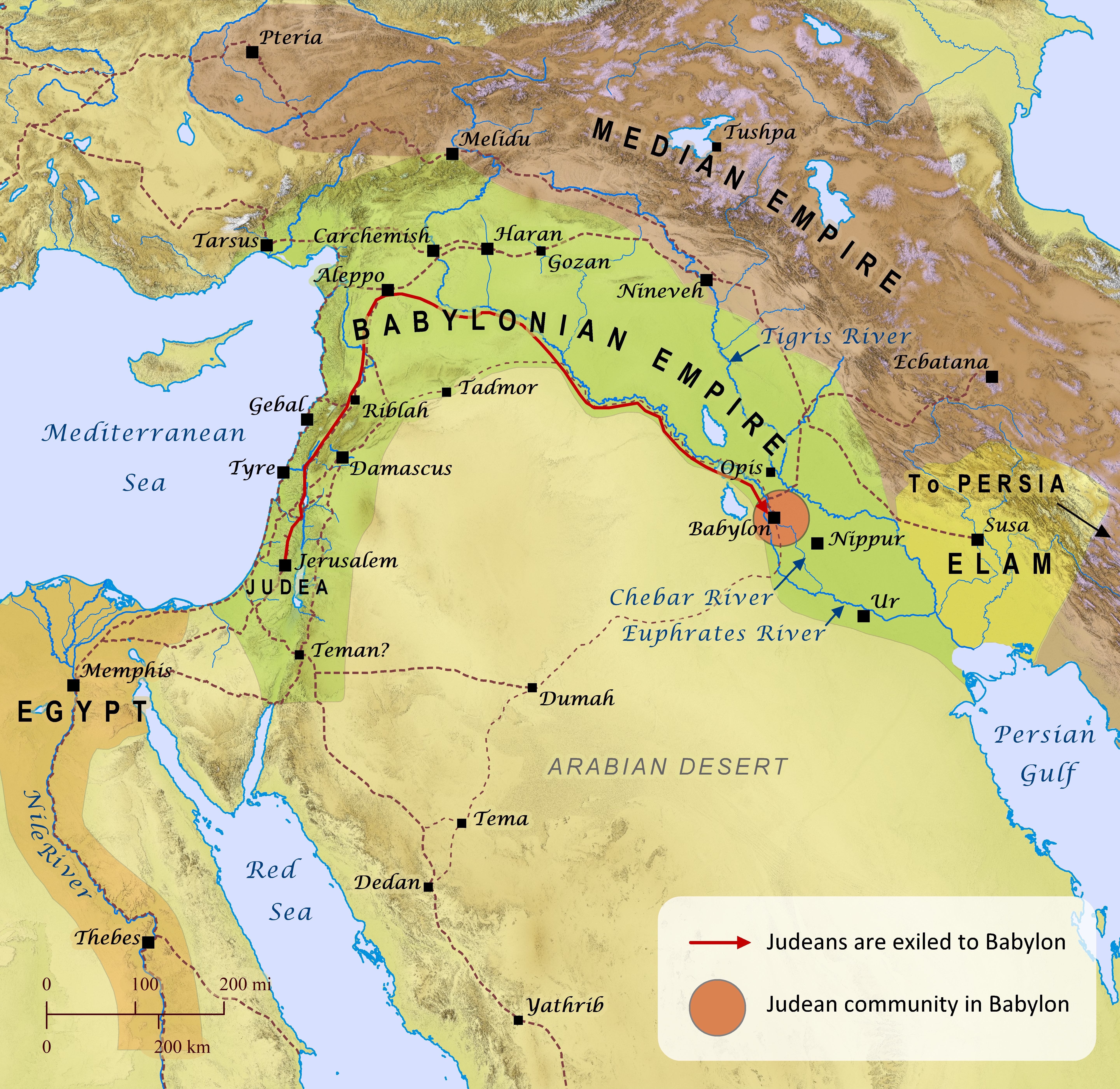
Daniel 1; 2 Kings 24-25; 2 Chronicles 36; Jeremiah 39; 52
One of the most significant events in the story of the Old Testament is the exile of Judah to Babylon in 586 B.C. This event–actually the third in a series of exiles to Babylon (the others occurring in 605 B.C. and 597 B.C.)–precipitated several crises in the nation and in Judaism. The northern kingdom of Israel had already been exiled to Assyria over a century earlier in 722 B.C. (2 Kings 15:29; 17:1-6; 1 Chronicles 5:26; see also “Israelites Are Exiled to Assyria” map), and in some ways that exile was even more devastating. Nevertheless, the Temple of the Lord remained intact in Jerusalem as a place where the faithful could continue to offer their sacrifices. With the destruction of Jerusalem and the Temple of the Lord at the hands of the Babylonians, however, sacrifices could no longer be offered at the Tabernacle or Temple of the Lord (Leviticus 17:2-4; Deuteronomy 12:5-7), and the Lord’s promise to provide a land for his people and a descendant on the throne of David no doubt seemed abandoned. At the same time, however, the Judean exiles were allowed to maintain their religious traditions in Babylon, and many even began to thrive there, including Daniel and his friends, who served at the royal court (Daniel 1; see also “The Land of Exile” map). One of the last kings of Babylon expanded Babylonia further by capturing the desert oases of Dumah, Tema, Dedan, and Yathrib (see “Oases of the Arabian Desert” map), but eventually the Median Empire to the north merged with the Persian Empire to the southeast and conquered the Babylonian Empire. King Cyrus of Persia then decreed that the exiled Judeans, now called “Jews,” could return to their homeland if they desired (2 Chronicles 36:22-23; Ezra 1-2; see also “Jews Return from Exile” map).
OET 2 CHR Intro C1 C2 C3 C4 C5 C6 C7 C8 C9 C10 C11 C12 C13 C14 C15 C16 C17 C18 C19 C20 C21 C22 C23 C24 C25 C26 C27 C28 C29 C30 C31 C32 C33 C34 C35 C36