
OET OET-RV OET-LV GHT ULT UST BSB MSB BLB AICNT OEB WEBBE WMBB NET LSV FBV TCNT T4T LEB BBE Moff JPS Wymth ASV DRA YLT Drby RV SLT Wbstr KJB-1769 KJB-1611 Bshps Gnva Cvdl TNT Wycl SR-GNT UHB BrLXX BrTr Related Parallel Simple Interlinear Topics Reference Dictionary Search
OET By Document By Section By Chapter Details
OET INT FRT GEN EXO LEV NUM DEU JOB JOS JDG RUTH 1 SAM 2 SAM PSA AMOS HOS 1 KI 2 KI 1 CHR 2 CHR PROV ECC SNG JOEL MIC ISA ZEP HAB JER LAM YNA NAH OBA DAN EZE EZRA EST NEH HAG ZEC MAL GES LES ESG DNG 2 PS TOB JDT WIS SIR BAR MAN 1 MAC 2 MAC 3 MAC 4 MAC YHN MARK MAT LUKE ACTs YAC GAL 1 TH 2 TH 1 COR 2 COR ROM COL PHM EPH PHP 1 TIM TIT 1 PET 2 PET 2 TIM HEB YUD 1 YHN 2 YHN 3 YHN REV
2 CHR Intro C1 C2 C3 C4 C5 C6 C7 C8 C9 C10 C11 C12 C13 C14 C15 C16 C17 C18 C19 C20 C21 C22 C23 C24 C25 C26 C27 C28 C29 C30 C31 C32 C33 C34 C35 C36
⌂ ← 2 CHR 34:1–34:33 → ‴ ║ ═ ©
This is still an early look into the drafted text of the Open English Translation of the Bible. Please double-check the text in advance before using in public.
34 Yoshiyah was eight when he became king, and he reigned from Yerushalem for thirty-one years.[ref] 2 He did what Yahweh had said was right, and made similar decisions to his ancestor David—not deviating to the right or the left.
3 In the eighth year of his reign, while he was still a teenager, he began to learn more about the god of his ancestor David, and in the twelfth year, he began to remove the hilltop shrines from Yerushalem and across Yehudah, as well as the Asherah poles, and the carved and cast metal idols. 4 He watched while they tore down the altars for the Baals and cut down the incense altars that were above them. He shattered the Asherah poles and the idols, then crushed them to powder, which he scattered over the graves of the people who’d sacrificed to them.[ref] 5 He burnt the bones of those priests on their altars, and that’s how he purified Yerushalem and all of Yehudah,[ref] 6 as well as the cities in the tribes of Menashsheh, Efrayim, Shimeon, and as far north as Naftali, including in the ruins around them. 7 He tore down the altars and the Asherah poles, ground the idols into pieces, and cut down the incense altars in all of Yisrael, before returning to Yerushalem.
8 In his eighteenth year as king, in order to purify the land and the temple, he sent Atsalyah’s son Shafan, Maaseyah the city official, and Yoahaz’s son Yoah the secretary, to repair his god Yahweh’s residence. 9 They went to Hilkiyah the high priest and handed over the funds that had been donated for God’s house, which had been collected by the Levites as doorkeepers—the money was from the tribes of Menashsheh, Efrayim, and other places in the northern kingdom of Yisrael, as well as from Yerushalem’s inhabitants and people across all of Yehudah and Benyamin. 10 The priests then paid the workers who’d been assigned to work in Yahweh’s temple to repair and strengthen it. 11 They also paid the carpenters and builders to buy cut stone and timber for the beams and braces which Yehudah’s kings had allowed to deteriorate, 12 and the workers did their work faithfully. Their supervisors were Yahat and Ovadyah (Levites descended from Merari), as well as Zekaryah and Meshullam (descendants of Levi’s son Kohat), and all the Levites who were good on their musical instruments. 13 They also supervised the porters and people working on various other tasks. Some of the Levites were secretaries, officials, and guards.
14 When they were bringing the money out of the temple, Hilkiyah the high priest found a scroll containing Yahweh’s instructions that had been given via Mosheh (Moses). 15 Hilkiyah informed the scribe Shafan that he’d found a Torah scroll in the temple, and he gave him the scroll. 16 Shafan took the scroll with him to the king and reported to him, “Your servants are doing everything they were assigned to do. 17 They’ve taken the cash that was in Yahweh’s residence, and passed it on to the supervisors of the workers.” 18 Then Shafan told the king, “I’ve brought a scroll that the priest Hilkiyah gave me,” and then he started reading it out to the king.
19 When the king heard the words of God’s instructions, he tore his clothes in grief. 20 Then he commanded Hilkiyah, Shafan’s son Ahikam, Mikah’s son Avdon, Shafan himself, and the king’s special advisor Asayah, 21 “Go and ask Yahweh on my behalf, and on behalf of everyone in Yisrael and Yehudah, what he wants us to do with respect to the instructions on the scroll that’s just been found, because it seems that Yahweh will be very angry at us because our ancestors haven’t followed all of Yahweh’s instructions as they’re written on that scroll.”
22 So Hilkiyah and the others went to Yerushalem’s Second District, to the prophetess Huldah (wife of Shallum, son of Tokahat, son of Hasrah who took care of the temple robes). They passed on the king’s question, 23 and she replied, “Yisrael’s god Yahweh says to tell the king: 24 Yahweh says, ‘Listen, I’m going to bring disaster on this place and its inhabitants, as per all the curses written on that scroll that was read to Yehudah’s king, 25 because they’ve abandoned me and offered incense to other gods. That’s made me angry, and so my rage will be poured out on this place, and it can’t be prevented.’ 26 However, Yehudah’s king sent you all to ask for Yahweh’s direction, so tell him, ‘Yisrael’s god Yahweh says that after hearing the scroll’s words, 27 you were sincere, and you humbled yourself in front of God when you heard his words about this place and its inhabitants. Yes, Yahweh declares you’ve humbled yourself in front of me and torn your clothes, and wept in front of me, and I’ve personally heard you. 28 So listen, I’ll allow you to die and be buried in peace, and so your eyes won’t see the disaster that I’ll send to this place and its inhabitants.’ ”
So they took that response back to the king.
29 Then the king summoned all the elders from Yerushalem and from across Yehudah, 30 and they all walked up to the temple, with the inhabitants of Yerushalem and all of Yehudah, and the priests and the Levites, and all the people, irrespective of their standing in the community. Then the king read everything out to them that was on the Torah scroll that had been found in the temple. 31 Then the king stood at his normal place and made an agreement with Yahweh: to obey Yahweh and follow his instructions and his regulations and statutes, sincerely and with all his energy—doing what was in the joint understanding that had been written on the scroll. 32 Then he had everyone from Yerushalem and Benyamin take a stand in agreement to it, and so Yerushalem’s inhabitants renewed their agreement with their ancestors’ god. 33 So King Yoshiyah removed all the disgusting idols from all the Israeli regions, and he made everyone in Yisrael serve their god Yahweh—during his lifetime they never turned away from Yahweh, their ancestors’ god.

34:5 OSHB variant note: מזבחותים: (x-qere) ’מִזְבְּחוֹתָ֑/ם’: lemma_4196 n_1 morph_HNcmpc/Sp3mp id_14MNm מִזְבְּחוֹתָ֑/ם
34:6 OSHB variant note: ב/הר בתי/הם: (x-qere) ’בְּ/חַרְבֹתֵי/הֶ֖ם’: lemma_b/2719 n_0.0 morph_HR/Ncfpc/Sp3mp id_14CXE בְּ/חַרְבֹתֵי/הֶ֖ם
34:9 OSHB variant note: ו/ישבי: (x-qere) ’וַ/יָּשֻׁ֖בוּ’: lemma_c/7725 n_0.0 morph_HC/Vqw3mp id_14d7c וַ/יָּשֻׁ֖בוּ
34:22 OSHB variant note: תוקהת: (x-qere) ’תָּקְהַ֗ת’: lemma_8445 n_1.1.1 morph_HNp id_14SpF תָּקְהַ֗ת
34:25 OSHB variant note: ו/יקטירו: (x-qere) ’וַֽ/יְקַטְּרוּ֙’: lemma_c/6999 a n_1.2.0 morph_HC/Vpw3mp id_14LnE וַֽ/יְקַטְּרוּ֙
34:25 OSHB note: Yathir readings in L which we have designated as Qeres when both Dothan and BHS list a Qere.
2 Kings 22-23; 2 Chronicles
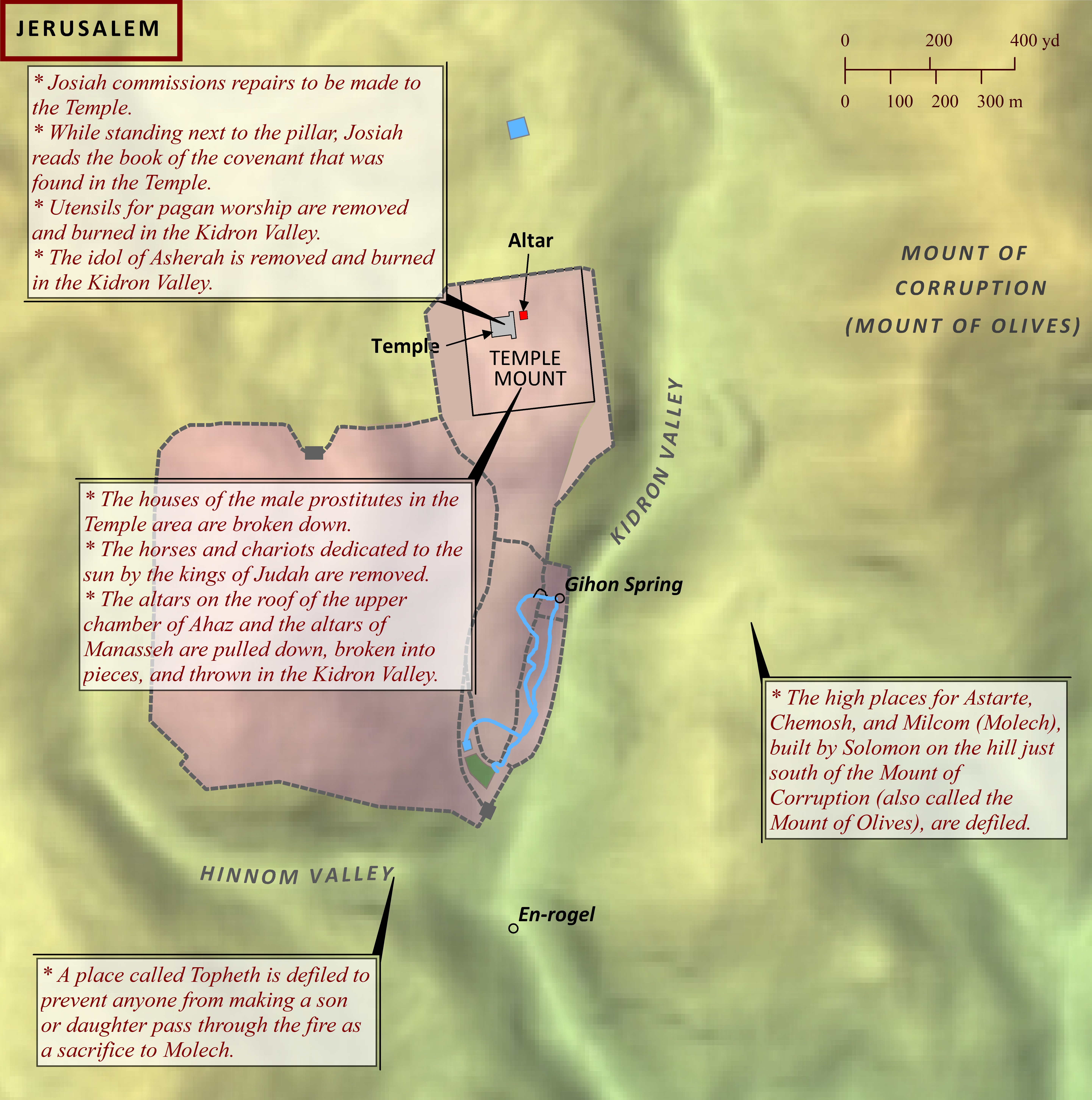
If ever there was a point in biblical history when the worship of Yahweh seemed all but extinguished, it was during the years leading up to King Josiah’s birth. Yet it was against this incredibly dark backdrop that the Lord raised up Josiah of Judah to bring about one of the greatest spiritual reforms his nation had ever seen. Josiah was the grandson of Manasseh, one of the most wicked and idolatrous kings of Judah (2 Kings 21:1-9; 2 Chronicles 33:1-9), though Manasseh later repented (2 Chronicles 33:12-19), and the son of Amon, another wicked, idolatrous king (2 Kings 21:18-22; 2 Chronicles 33:20-23). After his father’s death, Josiah became king at the young age of eight, so perhaps it was this lack of influence from his wicked father during some of his most formative years as a leader that enabled him to become such a force for spiritual renewal throughout Judah. Whatever the reason for his spiritual fervor, Josiah’s passion also coincided with a period of Assyrian decline, which allowed him to expand his renewal even to the lands once ruled by the northern kingdom of Israel. Josiah began his reforms by commissioning repairs to be made to the Temple of the Lord in Jerusalem. During these repairs, the book of the law, likely the book of Deuteronomy, was found in the Temple and brought to Josiah. When Josiah read the book, he tore his clothes in anguish over the punishment that surely awaited the nation for their disobedience to the laws of Moses. He called for all the elders of Judah and Jerusalem to gather by the pillar of the Temple, and he read the law to them as well and led them to establish a new covenant to follow the laws of Moses. Josiah then began a great purge of idolatry throughout Jerusalem, Judah, and even Israel. Utensils used for pagan worship were removed from the Temple in Jerusalem and burned in the Kidron Valley, and their ashes were carried to Bethel. The image of Asherah was also removed and burned in the Kidron Valley, and the remains were ground to dust and spread over graves of the common people. The houses of the male prostitutes in the Temple area were also broken down. The horses and chariots dedicated to the sun by the kings of Judah were removed, and the chariots were burned. The altars on the roof of the upper chamber of Ahaz and the altars that Manasseh had made in Temple courtyard were pulled down and broken in pieces, and the rubble was thrown into the Kidron Valley. A place called Topheth in the Hinnom Valley was defiled so that no one would make a son or daughter pass through fire as an offering to Molech. Just east of Jerusalem the high places built by King Solomon for his pagan wives on the Mount of Corruption (also called the Mount of Olives; 1 Kings 11:7-8) were defiled. Josiah’s reforms throughout Judah included putting away the mediums, wizards, teraphim, idols, and all the abominations that were seen in the land. At Bethel he tore down the altar and the high place erected by Jeroboam son of Nebat. He burned the high place, crushing it to dust, and burned the sacred pole. There he also saw tombs of people who must have been associated with the pagan rituals there, so he removed the bones and burned them on the altar, thus defiling it, as was prophesied years earlier (1 Kings 13:1-10). Josiah then extended his reforms to lands that formerly belonged to Israel but were now directly governed by Assyria. Throughout the towns of Samaria all the shrines of the high places were removed, the priests of the high places were slaughtered on the pagan altars, and their bones were burned on them. Throughout the rest of the land of Israel and Judah–in Manasseh, Ephraim, Simeon, and as far as Naphtali–Josiah also broke down the altars, ground the sacred poles and images into powder, and demolished all the incense altars. When Josiah returned to Jerusalem, he celebrated the Passover in a way that exceeded all the Passover celebrations since the time of the Judges.
⌂ ← 2 CHR 34:1–34:33 → ‴ ║ ═ ©
2 CHR Intro C1 C2 C3 C4 C5 C6 C7 C8 C9 C10 C11 C12 C13 C14 C15 C16 C17 C18 C19 C20 C21 C22 C23 C24 C25 C26 C27 C28 C29 C30 C31 C32 C33 C34 C35 C36