
OET INT FRT GEN EXO LEV NUM DEUT JOB YEHO (JOS) HERO (JDG) RUTH 1 SAM 2 SAM PSA AMOS HOS 1 KI 2 KI 1 CHR 2 CHR PROV ECC SNG YOEL (JOEL) MIC ISA ZEP HAB YIR (JER) LAM YNA (JNA) NAH OBAD DAN EZEK EZRA EST NEH HAG ZEC MAL 2 PS WIS TOB MAN BAR G DAN G ESD L ESD ESG JDT 3 MAC SIR 1 MAC 2 MAC 4 MAC YHN (JHN) MARK MAT LUKE ACTs YAC (JAM) GAL 1 TH 2 TH 1 COR 2 COR ROM COL LAOD PHM EPH PHP 1 TIM TIT 1 PET 2 PET 2 TIM HEB YUD (JUD) 1 YHN (1 JHN) 2 YHN (2 JHN) 3 YHN (3 JHN) REV
OET 1 KI Intro C1 C2 C3 C4 C5 C6 C7 C8 C9 C10 C11 C12 C13 C14 C15 C16 C17 C18 C19 C20 C21 C22
⌂ ← 1 KI 11:41–11:43 → ‴ ║ ═ ©
This is still an early look into the drafted text of the Open English Translation of the Bible. Please double-check the text in advance before using in public.
41 A record of all the other things that Shelomoh (Solomon) did, and all the wise things that he said, was written in the ‘Record of Shelomoh’s Achievements’. 42 Shelomoh reigned over all Yisrael (Israel) from Yerushalem (Jerusalem) for forty years, 43 then he died and was buried in the City of David, and his son Rehav’am (Rehoboam) became king.

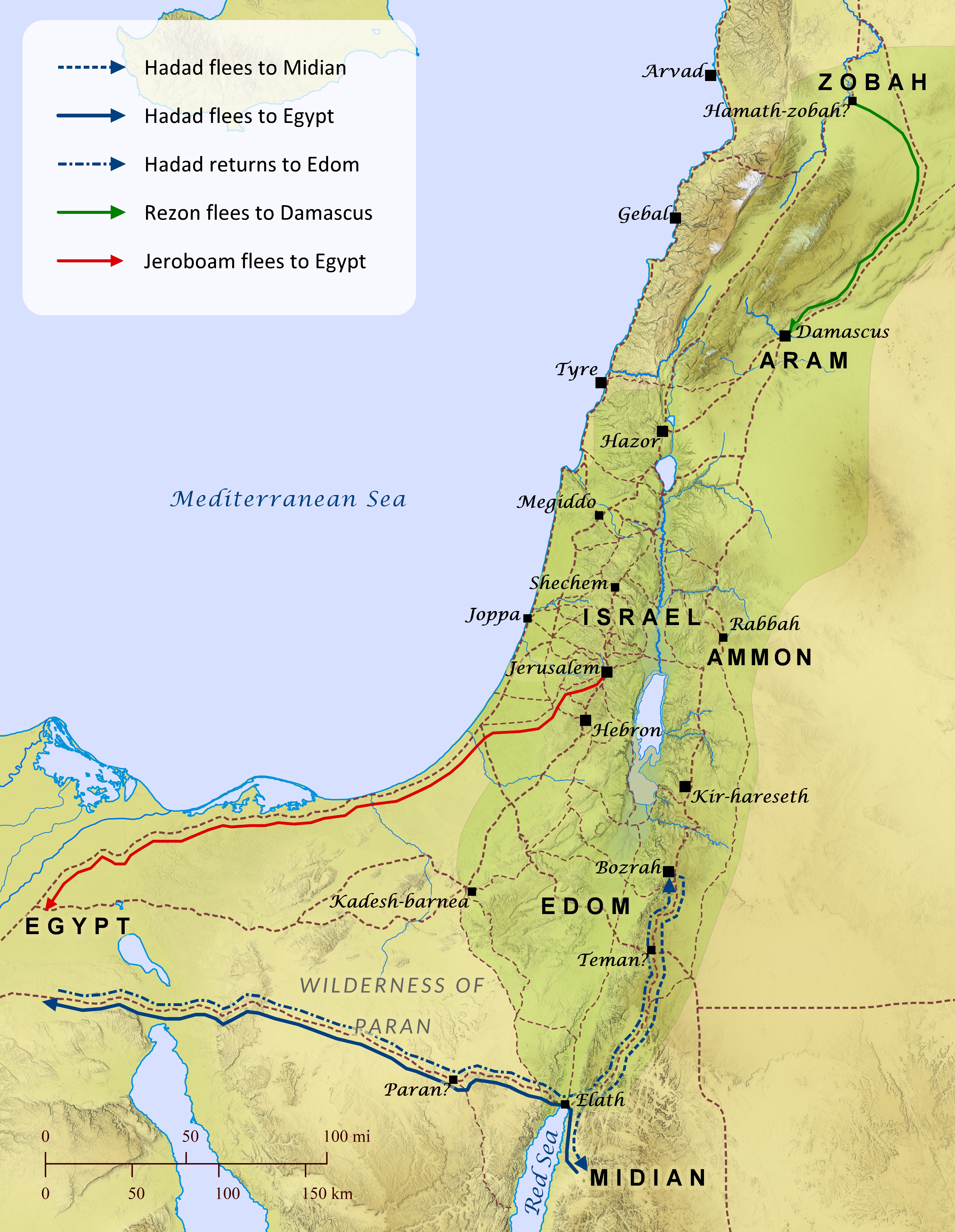
1 Kings 11
Solomon ruled over a powerful kingdom that brought him great wealth, but he allowed his many wives to lead his heart astray to worship the gods of other nations. Many of these wives were likely given to him by foreign rulers to seal political alliances (e.g., 1 Kings 3:1). Because of Solomon’s unfaithfulness to the God of Israel, the Lord declared that he would tear away much of the kingdom from Solomon and give it to one of his servants. The Bible then recounts the origins of a few adversaries of Solomon who must have caused trouble during his reign. It was actually events during David’s reign that precipitated the rise of two of these adversaries, though apparently it wasn’t until Solomon’s reign that these men became significant agents of opposition. The first adversary mentioned is Hadad the Edomite, who belonged to the royal court of Edom. Sometime during the time when David was in Edom (see 2 Samuel 8:13-14) his commander Joab tried to kill every male in Edom, but Hadad fled with some of his father’s servants. Apparently he fled first to Midian (see 1 Kings 11:18) and then made his way to Paran, where others joined him, and then they crossed the wilderness to Egypt. There Hadad was very favorably received by Pharaoh and given land, food, and even a wife from Pharaoh’s royal household. After David died, Hadad chose to return to Edom. The second adversary mentioned is Rezon, who had fled from King Hadadezer of Zobah and became the leader of a gang of rebels. After David defeated Hadadezer (2 Samuel 8-10; 1 Chronicles 18-19), Rezon and his men fled to Damascus, where they made him king over Aram. He continued to cause trouble for Solomon throughout his reign. The last adversary mentioned is Jeroboam son of Nebat, one of Solomon’s own officials, who had been put in charge of rebuilding a portion of Jerusalem. One day as Jeroboam was leaving the city, a prophet named Ahijah met him and told him that the Lord was going to tear away ten of the tribes of Israel and give them to him. Solomon must have heard about Ahijah’s prophecy, because he tried to kill Jeroboam, but Jeroboam fled to King Shishak of Egypt. Later Jeroboam would return to Israel, and the ten northern tribes appointed him king after rejecting the rule of Rehoboam, the son of Solomon (1 Kings 12; 2 Chronicles 10).
⌂ ← 1 KI 11:41–11:43 → ‴ ║ ═ ©
OET 1 KI Intro C1 C2 C3 C4 C5 C6 C7 C8 C9 C10 C11 C12 C13 C14 C15 C16 C17 C18 C19 C20 C21 C22