
OET OET-RV OET-LV GHT ULT UST BSB MSB BLB AICNT OEB WEBBE WMBB NET LSV FBV TCNT T4T LEB BBE Moff JPS Wymth ASV DRA YLT Drby RV SLT Wbstr KJB-1769 KJB-1611 Bshps Gnva Cvdl TNT Wycl SR-GNT UHB BrLXX BrTr Related Parallel Simple Interlinear Topics Reference Dictionary Search
OET By Document By Section By Chapter Details
OET INT FRT GEN EXO LEV NUM DEU JOB JOS JDG RUTH 1 SAM 2 SAM PSA AMOS HOS 1 KI 2 KI 1 CHR 2 CHR PROV ECC SNG JOEL MIC ISA ZEP HAB JER LAM YNA NAH OBA DAN EZE EZRA EST NEH HAG ZEC MAL GES LES ESG DNG 2 PS TOB JDT WIS SIR BAR MAN 1 MAC 2 MAC 3 MAC 4 MAC YHN MARK MAT LUKE ACTs YAC GAL 1 TH 2 TH 1 COR 2 COR ROM COL PHM EPH PHP 1 TIM TIT 1 PET 2 PET 2 TIM HEB YUD 1 YHN 2 YHN 3 YHN REV
1 KI Intro C1 C2 C3 C4 C5 C6 C7 C8 C9 C10 C11 C12 C13 C14 C15 C16 C17 C18 C19 C20 C21 C22
This is still an early look into the drafted text of the Open English Translation of the Bible. Please double-check the text in advance before using in public.
18:1 Eliyah versus Baal’s prophets
18 In the third year of drought, Yahweh told Eliyah to go and show himself to King Ahav and tell him that it would soon rain, 2 so he went to present himself to Ahav.
Meanwhile in Shomron (Samaria), the food shortage was terrible 3 and King Ahav had summoned his palace manager Ovadyah. (Ovadyah was a sincere follower of Yahweh. 4 When Queen Izevel had tried to kill Yahweh’s prophets, Ovadyah had hidden a hundred prophets—fifty in each of two caves and kept them supplied with food and water.) 5 King Ahav told Ovadyah, “We’ll go across the country to all the springs and all the valleys that water sometimes flows in. Perhaps we’ll find some grass so we can keep a horse or a mule or two alive and not lose our breeding stock.” 6 So they divided the country into two, and they each went off in a different direction.
7 While Ovadyah was on a path, Eliyah came to meet him. Ovadyah recognised him and fell to his knees with his face to the ground, and asked, “Is it really you, my master Eliyah?”
8 “Yes, it’s me,” he replied. “Now go and tell your master that I’m here.”
9 “How have I sinned,” Ovadyah responded, “that you’re giving your servant a death sentence? 10 As your god Yahweh lives, my master sent people to every kingdom to try to find you, and if they said you weren’t there, then he made them promise under oath that it was true. 11 So now you tell me to tell my master that you’re here, 12 but as soon as I leave you, Yahweh’s spirit will take you to goodness knows where. Meanwhile I’ll go and tell Ahav, and he’ll come here and not find you, so then he’ll kill me, even though I’ve been trying to obey Yahweh since I was young. 13 Haven’t you heard, my master, what I did when Izevel was killing Yahweh’s prophets and I hid a hundred of them in two caves and kept them supplied with food and water? 14 Yet now you’re trying to get me killed by telling my master that he’ll find you here.”
15 “As Commander-in-chief Yahweh lives—the one I serve,” Eliyah replied, “I’ll definitely be here to see him today.”
16 So Ovadyah went and informed Ahav who then came to meet Eliyah. 17 When he saw Eliyah, Ahav asked him, “Is that you—the one who causes trouble for Yisrael?”
18 “It’s not me who brings trouble onto Yisrael,” Eliyah replied. “But rather it’s you and your father’s families who decided to ignore Yahweh’s commands and serve the Baals instead. 19 So now, get all Yisrael to go to Mt. Karmel, along with the 450 prophets of Baal and the 400 prophets of Asherah who Queen Izevel feeds at her table.”
20 So Ahav summoned all the Israelis and the prophets to go to Mt. Karmel, 21 and Eliyah addressed the people, “How much longer are you all going to remain unsure who to follow? If Yahweh is God, follow him, but if it’s Baal, follow him.” But the people just stayed silent. 22 Then he said, “I’m Yahweh’s only remaining prophet, but Baal has 450 prophets. 23 Let them get us two bulls and they can choose one for themselves. Then they can cut it into pieces and lay them a pile of wood that they’ve set for a fire, but they can’t light the fire. I’ll do the same with the other bull, but also won’t light the fire. 24 Then they must call to their god and I’ll call to Yahweh, and the god who answers by setting the wood on fire must be the true God.”
“It sounds good to us,” the people answered.
25 So Eliyah told Baal’s prophets, “Okay, there’s a lot more of you guys, so you choose your bull and go first and call out to your god, but don’t set fire to the pile.”
26 So they took the bull he gave them and prepared it all, and then they called out to Baal from morning until midday, shouting, “Baal, answer us!” But they didn’t hear any voice and got no answer. Then they hopped around the altar they’d made.
27 Finally at noon, Eliyah began mocking them, saying, “Call out louder because he’s a god. Maybe he’s thinking about something else, or busy with something, or travelling somewhere. Pehaps he’s asleep and needs waking up.” 28 So they shouted even louder and did their usual cutting of their bodies with knives and swords until a lot of blood flowed. 29 Midday passed and they continued raving all afternoon, but they didn’t hear any voice, and they got no answer or even any suggestion that their god was listening.
30 Then Eliyah told the people, “Okay, now come over here by me.” So all the people came over by him, and he repaired the altar of Yahweh that had been torn down. 31 He took twelve stones (the number of the sons of Yakob (Jacob) who Yahweh told would be called Yisrael)[ref] 32 and used them to rebuild Yahweh’s altar. Then around the altar he made a trench large enough to hold the water to water in two drums of seed.[fn] 33 He arranged the firewood, and cut the bull into pieces and placed them on top, 34 and then ordered, “Fill four jars with water and pour it on the burnt offering and the firewood.” Then he said “Now do it a second time,” and they did it a second time, and again he said, “Do it a third time,” and they did it a third time. 35 The water ran around the altar and even filled the trench.
36 When it was time to offer the evening sacrifices, the prophet Eliyah approached the altar and prayed, “Yahweh, God of Abraham, Yitshak, and Yisrael, let it be known today that you are God in Yisrael and I’m your servant, and I’ve done all these things following your instructions. 37 Answer me, Yahweh! Answer me, so that this country will understand that you, Yahweh, are God, and that you can turn their hearts back again.”
38 Then Yahweh sent fire down from the sky that consumed the pieces of meat, the firewood, the stones, and the dirt around the altar, including all the water that had been in the trench. 39 When all the people saw what had happened, they fell onto their knees and bowed their faces to the ground, saying, “Yahweh is God! Yahweh is God!”
40 Then Eliyah ordered them, “Grab hold of Baal’s prophets. Don’t let any of them sneak away.” So they seized them, and Eliyah brought them down to the Kishon valley and he slaughtered them there.
18:32 A more Jewish interpretation that seems to agree with v34–35—see https://hermeneutics.stackexchange.com/questions/31555/water-in-elijahs-trench.

18:34 Note: KJB: 1Kgs.18.34
18:36 OSHB variant note: ו/ב/דברי/ך: (x-qere) ’וּ/בִ/דְבָרְ/ךָ֣’: lemma=c/b/1697 morph=HC/R/Ncmsc/Sp2ms id=11VuX וּ/בִ/דְבָרְ/ךָ֣
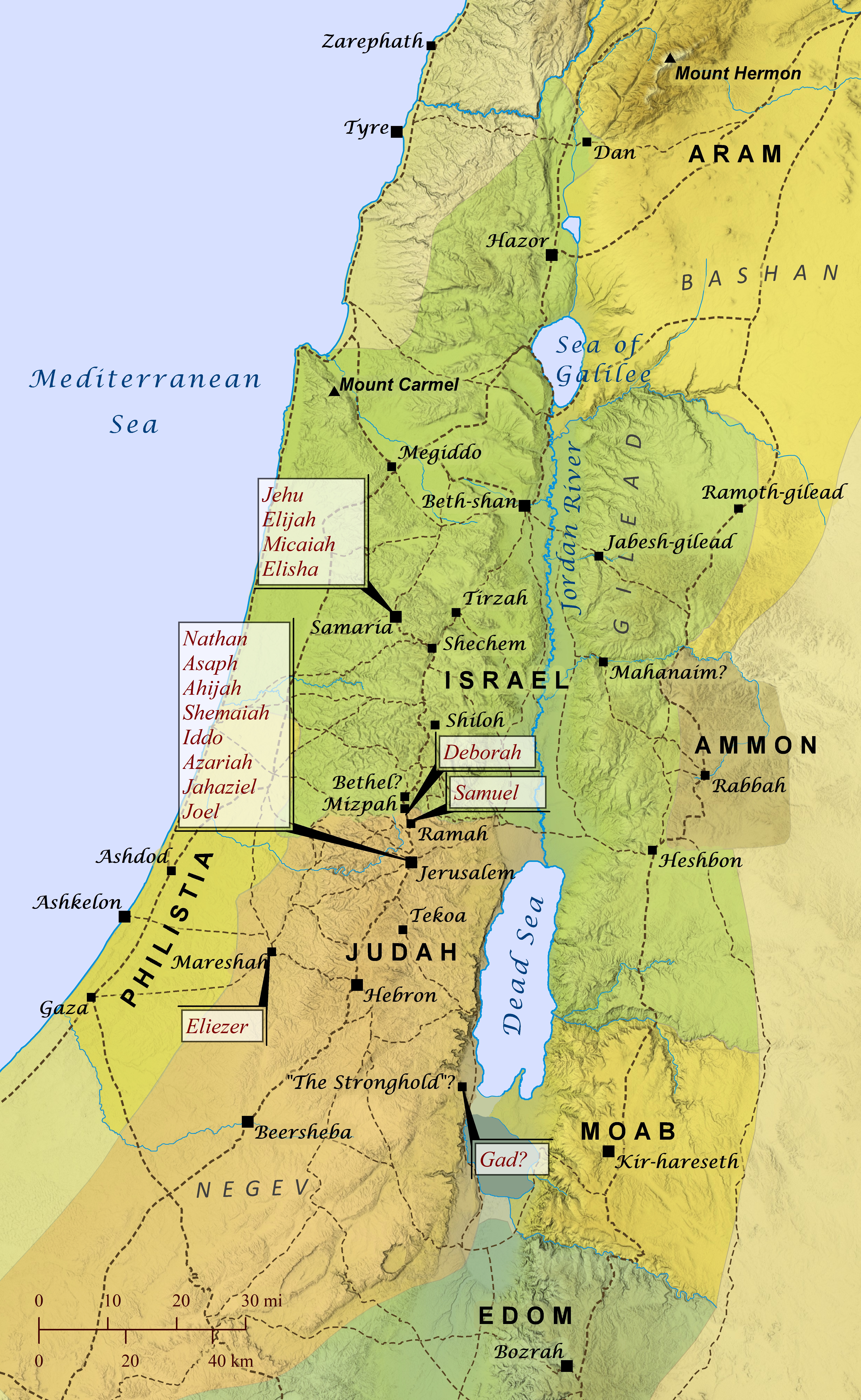
If you ask someone today what biblical prophets did, they will likely tell you that they divinely foretold of future events. While this was often the case, most prophets in the Bible focused as much on “forthtelling” God’s messages as they did on “foretelling” the future. That is, their primary role was to simply “forthtell” divinely acquired messages to leaders and groups of people, and at times that included foretelling of coming judgment, blessing, rescue, etc. Also, though plenty of prophets (sometimes called “seers” in Scripture) often spoke in confrontational or eccentric language that put them at odds with kings and religious leaders, the biblical writers also applied the term prophet to people who communicated God’s messages in ways that many readers today might not think of as prophecy, such as worship leaders appointed by David to “prophesy with lyres, harps, and cymbals” (1 Chronicles 25:1). Similarly, the books of Joshua, Judges, 1 & 2 Samuel, and 1 & 2 Kings are typically categorized as history by Christians, but in the Hebrew canon they belong to the category of Former Prophets. The Lord raised up prophets throughout all of biblical history, from the giving of the law under Moses to the revelation of the last days by the apostle John, and the kings of Israel and Judah often recognized and supported specific people as official prophets of the royal court and consulted them to find out God’s perspective about official matters. Following is a list of nearly everyone designated as prophet or seer in the Old Testament and the primary area of their ministry.
• Deborah (1216 B.C.) [Judges 4:4] => Baal-tamar?
• Samuel (1070 B.C.) [1 Samuel 3:20; 1 Chronicles 29:29; 2 Chronicles 35:18] => Ramah
• Gad (1018 B.C.) [2 Samuel 24:11; 1 Chronicles 21:9; 29:29; 2 Chronicles 29:25] => Masada?
• Nathan (1000 B.C.) [2 Samuel 12:1; 1 Chronicles 29:29; 2 Chronicles 29:25] => Jerusalem
• Asaph (1000 B.C.) [2 Chronicles 29:30] => Jerusalem
• Ahijah (935 B.C.) [1 Kings 11:29; 2 Chronicles 9:29] => Jerusalem
• Shemaiah (930 B.C.) [2 Chronicles 12:2-15] => Jerusalem
• Iddo (913 B.C.) [2 Chronicles 9:29; 12:15; 13:22] => Jerusalem
• Jehu son of Hanani (890 B.C.) [1 Kings 16:1-7; 2 Chronicles 19:2] => Samaria?
• Azariah (890 B.C.) [2 Chronicles 15:1-8] => Jerusalem
• Elijah (860 B.C.) [1 Kings 18:36] => Samaria
• Micaiah (853 B.C.) [1 Kings 22:8-23; 2 Chronicles 18:7-22] => Samaria
• Jahaziel (853 B.C.) [2 Chronicles 20:14] => Jerusalem
• Eliezer (853 B.C.) [2 Chronicles 20:37] => Mareshah
• Elisha (850 B.C.) [1 Kings 19:16; 2 Kings 2:15] => Samaria
• Joel (835 B.C.) [Joel 1:1] => Jerusalem
1 KI Intro C1 C2 C3 C4 C5 C6 C7 C8 C9 C10 C11 C12 C13 C14 C15 C16 C17 C18 C19 C20 C21 C22