
OET OET-RV OET-LV GHT ULT UST BSB MSB BLB AICNT OEB WEBBE WMBB NET LSV FBV TCNT T4T LEB BBE Moff JPS Wymth ASV DRA YLT Drby RV SLT Wbstr KJB-1769 KJB-1611 Bshps Gnva Cvdl TNT Wycl SR-GNT UHB BrLXX BrTr Related Parallel Simple Interlinear Topics Reference Dictionary Search
OET By Document By Section By Chapter Details
OET INT FRT GEN EXO LEV NUM DEU JOB JOS JDG RUTH 1 SAM 2 SAM PSA AMOS HOS 1 KI 2 KI 1 CHR 2 CHR PROV ECC SNG JOEL MIC ISA ZEP HAB JER LAM YNA (JNA) NAH OBA DAN EZE EZRA EST NEH HAG ZEC MAL 2 PS WIS TOB MAN BAR DNG GES LES ESG JDT 3 MAC SIR 1 MAC 2 MAC 4 MAC YHN (JHN) MARK MAT LUKE ACTs YAC (JAM) GAL 1 TH 2 TH 1 COR 2 COR ROM COL LAO PHM EPH PHP 1 TIM TIT 1 PET 2 PET 2 TIM HEB YUD (JUD) 1 YHN (1 JHN) 2 YHN (2 JHN) 3 YHN (3 JHN) REV
JOS Intro C1 C2 C3 C4 C5 C6 C7 C8 C9 C10 C11 C12 C13 C14 C15 C16 C17 C18 C19 C20 C21 C22 C23 C24
This is still an early look into the drafted text of the Open English Translation of the Bible. Please double-check the text in advance before using in public.
18:11 The allocation to Benyamin’s descendants
11 The tribe of Benyamin won the first draw and the area for their clans was between the land assigned to Yehudah (Judah) and that assigned to Efrayim (Ephraim) and Menasheh (Manasseh). 12 Their northern border went from the Yarden (Jordan) then to the northern side of Yeriho (Jericho) and up into the hill country to the west, coming out in the wilderness at Beyt-Aven. 13 Then it went across towards Luz (now called Beyt-El (Bethel)) to the southern edge then downhill towards Atrot-Adar beside the hill south of lower Beyt-Horon. 14 Then the western border turned from that hill and went south, coming out at Kiryat-Ba’al (also called Kiryat-Yearim—a town belonging to Yehudah) thus forming the western side. 15 The southern border went west from Kiryat-Yearim to the spring at Neftoah, 16 then downhill to the Ben-Hinom valley (in the valley of the Refaim to the north) then downhill to Hinom valley to the edge of the Yevusim and downhill to Eyn-Rogel. 17 Then it turned northward and went west to Eyn-Shemesh and across to Gelilot opposite the Adumim pass, before going downhill to the Stone of Bohan (Re’uven’s son). 18 It extended over to the northern slope of the Yarden valley and then downhill into the actual valley. 19 It then went east to the northern slope of Beyt-Hoglah before coming out at the north end of the Dead Sea (also called the Salt Sea) where the Yarden river flows into it. That was the southern boundary 20 and the Yarden borders it on the east. Those were the borders of Benyamin’s descendants’ inheritance according to their clans.
21 The cities allocated to Benyamin’s descendants and their clans were: Yeriho (Jericho), Beyt-Hoglah, Emek-Ketsits, 22 Beyt-Ha’aravah, Tsemarayim, Beyt-El (Bethel), 23 Avim, Parah, Ofrah, 24 Kefar-Ha’amoni, Ofni, and Geva—a total of twelve cities as well as their surrounding villages. 25 Also Giveon, Ramah, Be’erot, 26 Mitspah, Kefirah, Motsah, 27 Rekem, Yirpe’el, Tar’alah, 28 Tsela, Haelef, Yevus (now called Yerushalem (Jerusalem)), Giveah, and Kiryat—a total of fourteen cities as well as their surrounding villages. Those were Benyamin’s descendants’ inheritance according to their clans.

18:12 OSHB variant note: ו/היה: (x-qere) ’וְ/הָיוּ֙’: lemma=c/1961 n=0.1.0 morph=HC/Vqq3cp id=06g2a וְ/הָיוּ֙
18:14 OSHB variant note: ו/היה: (x-qere) ’וְ/הָי֣וּ’: lemma=c/1961 morph=HC/Vqq3cp id=06sau וְ/הָי֣וּ
18:19 OSHB variant note: ו/היה: (x-qere) ’וְ/הָי֣וּ’: lemma=c/1961 n=1.1.1.0 morph=HC/Vqq3cp id=06RMp וְ/הָי֣וּ
18:19 OSHB variant note: תצאותי/ו: (x-qere) ’תֹּצְא֣וֹת’: lemma=8444 morph=HNcfpc id=06JXW תֹּצְא֣וֹת
18:24 OSHB variant note: העמני: (x-qere) ’הָֽעַמֹּנָ֛ה’: lemma=3726 n=1.0.0 morph=HNp id=06rDJ הָֽעַמֹּנָ֛ה
18:28 OSHB note: We read one or more accents in L differently than BHS. Often this notation indicates a typographical error in BHS.
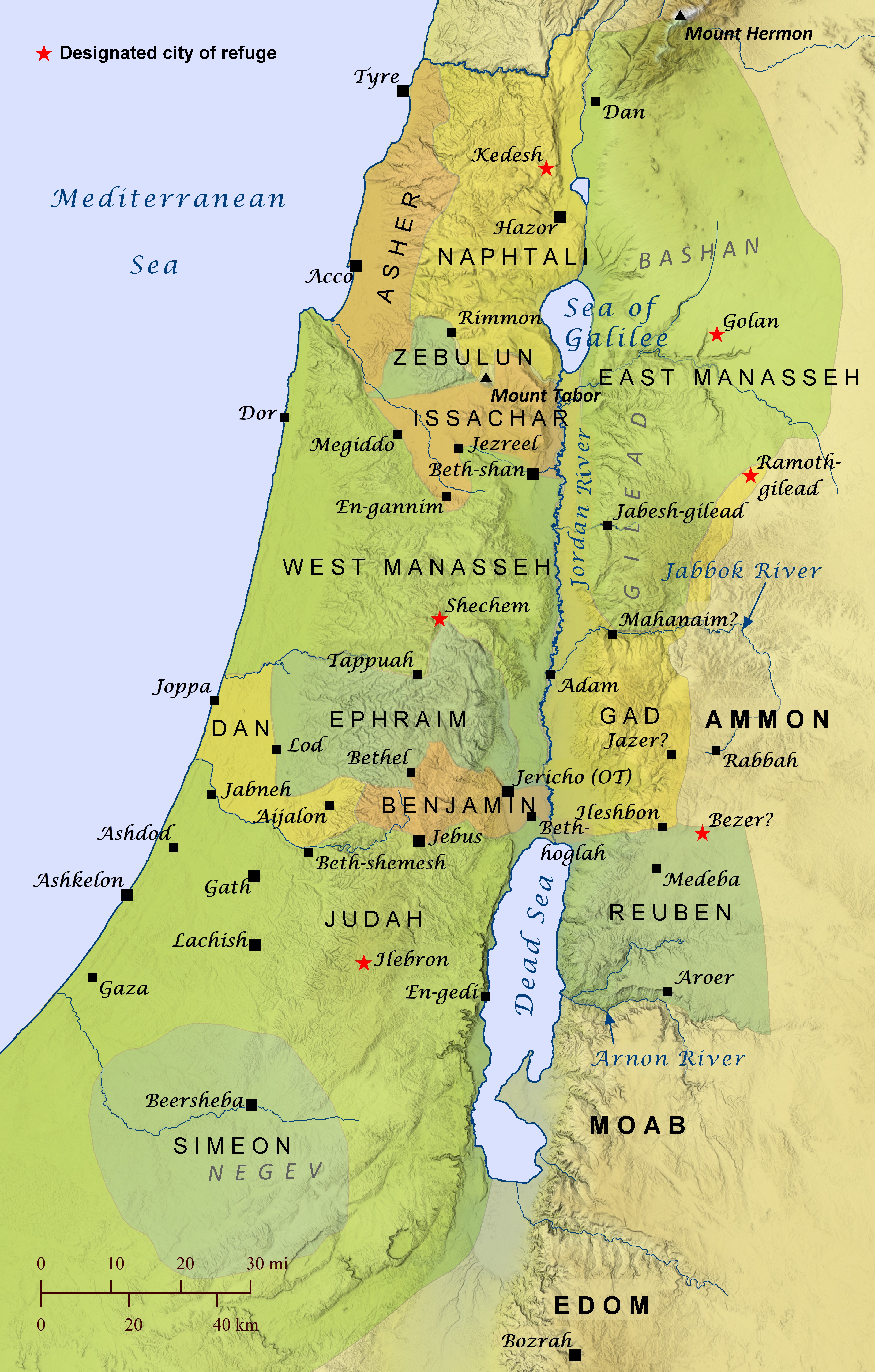
After the Israelites had conquered portions of the Promised Land and Joshua had grown old, the Lord directed him to divide the rest of the land among the tribes of Israel as their inheritance (Joshua 13-20). The eastern tribes had already been allotted their land under Moses’ leadership (Numbers 32), but they continued to help the other tribes drive out the Canaanites from land west of the Jordan River. The Lord also instructed the Israelites to designate several cities of refuge, where someone could flee for protection from an avenger if they accidentally killed someone (Numbers 35; Joshua 20).
The descendants of Jacob’s son Benjamin occupied one of the smallest of the Israelite tribal allotments–measuring a mere 27 miles (43 km) wide by 14 miles (23 km) high–yet the significance of all the biblical events that took place within it is immense. Benjamin was the location of the Israelites’ very first battles to conquer to the Promised Land, beginning with Jericho and moving on to Ai (see “The Israelites Conquer Ai” map). After this, four Gibeonite towns–all located in western Benjaminite territory–deceived the Israelites into forming an alliance with them (see “The Conquest of Canaan: The Southern Campaign” map) in order to avoid being wiped out by them. Two judges (Ehud and Deborah; see “Ehud Rescues Israel” and “Deborah and Barak Defeat Sisera” maps) hailed from Benjamin as did the prophet Samuel (see “The Tribe of Benjamin” map). After the Ark of the Covenant was captured near Aphek and Shiloh was overrun by the Philistines, it appears that the altar was moved to the High Place of Gibeah by the time of Solomon (see “The Ark of the Covenant in the Promised Land” map). In the closing years of the judges, a tragic incident at Gibeah led to a war between Benjamin and the rest of the Israelites tribes (see “Israel Battles Benjamin” map). Saul, the first king of Israel, also hailed from Benjamin (see “Saul Searches for His Father’s Donkeys” map). While King David’s capital was at Hebron, a detachment of his forces attacked those of Saul’s son Ish-bosheth at Gibeon, leading them to flee to the Hill of Ammah (likely the same as Emmaus; see “The Battle at the Pool of Gibeon” map). David later established Jerusalem, technically located within Benjamin’s territory, as his new capital over all Israel (2 Samuel 5:6-9). The borders of Benjamin’s tribal allotment and the adjacent borders of its neighboring tribes are meticulously defined in Joshua 15:1-16:3 and Joshua 18:11-28, demonstrating the biblical writers’ acute awareness of Benjamin’s territory. Several stretches of these borders appear to follow established roads that existed during the settlement era.
JOS Intro C1 C2 C3 C4 C5 C6 C7 C8 C9 C10 C11 C12 C13 C14 C15 C16 C17 C18 C19 C20 C21 C22 C23 C24