
Open Bible Data Home About News OET Key
OET OET-RV OET-LV ULT UST BSB MSB BLB AICNT OEB WEBBE WMBB NET LSV FBV TCNT T4T LEB BBE Moff JPS Wymth ASV DRA YLT Drby RV SLT Wbstr KJB-1769 KJB-1611 Bshps Gnva Cvdl TNT Wycl SR-GNT UHB BrLXX BrTr Related Topics Parallel Interlinear Reference Dictionary Search
OET By Document By Section By Chapter Details
OET GEN EXO LEV NUM DEU JOB JOS JDG RUTH 1 SAM 2 SAM PSA AMOS HOS 1 KI 2 KI 1 CHR 2 CHR PROV ECC SNG JOEL MIC ISA ZEP HAB JER LAM YNA NAH OBA DAN EZE EZRA EST NEH HAG ZEC MAL YHN MARK MAT LUKE ACTs YAC GAL 1 TH 2 TH 1 COR 2 COR ROM COL PHM EPH PHP 1 TIM TIT 1 PET 2 PET 2 TIM HEB YUD 1 YHN 2 YHN 3 YHN REV
2 SAM Intro C1 C2 C3 C4 C5 C6 C7 C8 C9 C10 C11 C12 C13 C14 C15 C16 C17 C18 C19 C20 C21 C22 C23 C24
This is still a very early look into the unfinished text of the Open English Translation of the Bible. Please double-check the text in advance before using in public.
24:18 David builds an altar
18 Gad came to David that day, and instructed him, “Go to the Yebusite Aravnah’s threshing floor and build an altar to Yahweh there.” 19 So David went there just as Yahweh had instructed him through Gad’s message. 20 When Aravnah looked out and saw the king and his servants approaching, he went out and fell to his knees in front of the king and bowed his face to the ground. 21 “Why would my master the king come to his servant?” Aravnah asked.
“I want to buy your threshing floor to build an altar for Yahweh,” David answered. “So that the plague afflicting the people can be stopped.”
22 “May my master the king take it,” Aravnah responded. “Use it in whatever way you think best. See, you can use the oxen for the burnt offering, and the threshing instruments and the oxen’s equipment for firewood. 23 I give it all to you, the king. May your god Yahweh accept your offering.”
24 “No,” the king answered. “I’ll definitely buy it from you. I couldn’t offer something to my god Yahweh that cost me nothing.” 25 So David built an altar there to Yahweh, and he instructed for burnt offerings and peace offerings to be made. Then Yahweh accepted prayers for the country and the plague against Yisrael was stopped.

24:18 OSHB variant note: ארניה: (x-qere) ’אֲרַ֥וְנָה’: lemma_728 morph_HNp id_10TEw אֲרַ֥וְנָה
24:22 OSHB variant note: ב/עינ/ו: (x-qere) ’בְּ/עֵינָ֑י/ו’: lemma_b/5869 a n_1 morph_HR/Ncbdc/Sp3ms id_10pLt בְּ/עֵינָ֑י/ו
24:24 OSHB note: We read one or more accents in L differently than BHS. Often this notation indicates a typographical error in BHS.
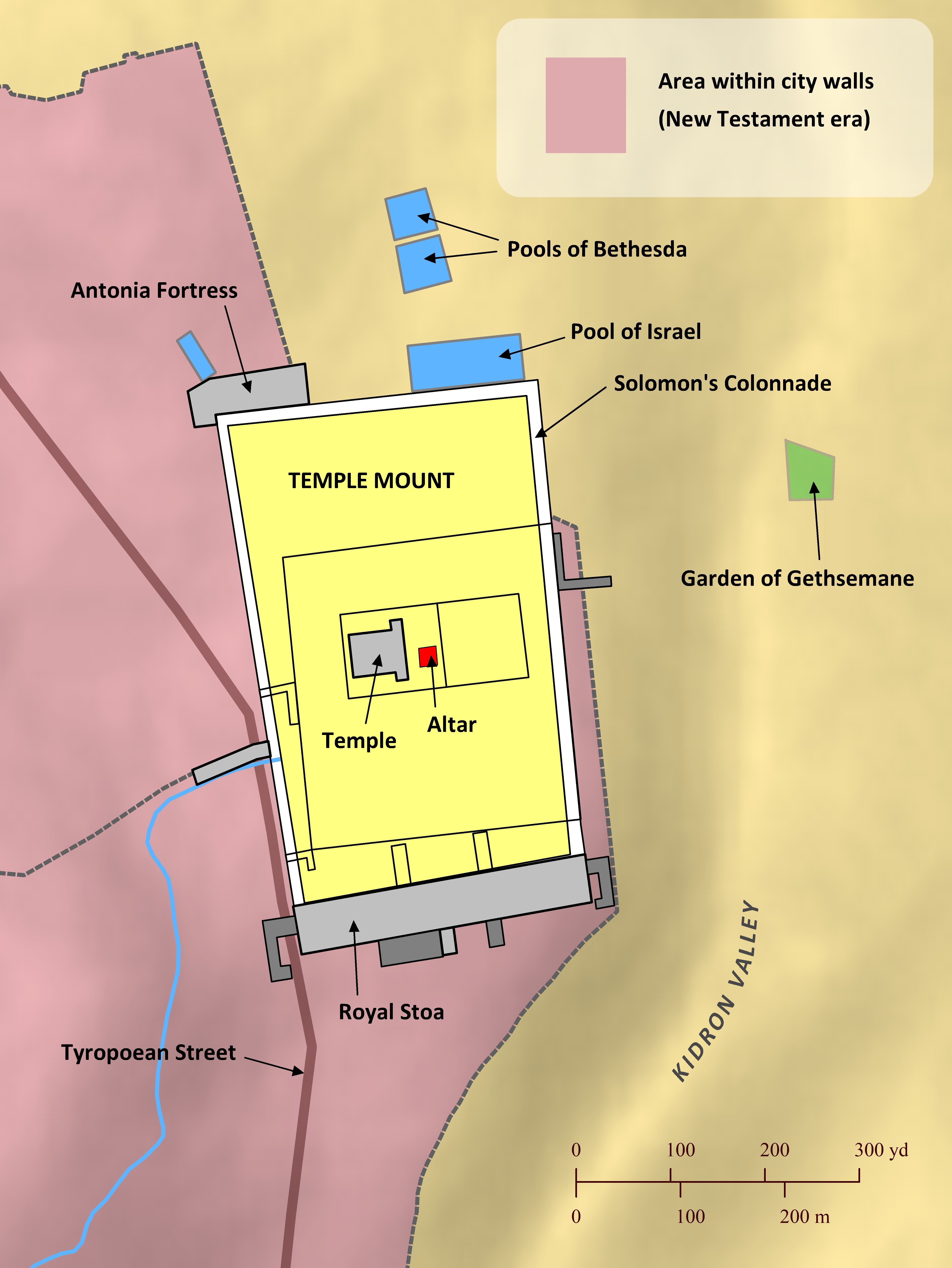
The Temple of the Lord in Jerusalem, where all Israelite males were commanded to offer sacrifices to the Lord (Exodus 23:14-19; Deuteronomy 16:16-17), underwent several stages of reconstruction and development over hundreds of years. The first Temple was built by King Solomon to replace the aging Tabernacle, and it was constructed on a threshing floor on high ground on the north side of the city (2 Samuel 24; 1 Chronicles 21). Hundreds of years later King Hezekiah expanded the platform surrounding the Temple. When Jerusalem fell to the Babylonians in 586 B.C., the Temple was completely destroyed (2 Kings 25:1-21; 2 Chronicles 36:17-21; Jeremiah 39:1-10; 52:1-30). It was rebuilt in 515 B.C. after a group of Jews returned to Judea from exile in Babylon (Ezra 1:5-6:15; Nehemiah 7:5-65). Herod the Great completely rebuilt and expanded the Temple once again around 20 B.C., making it one of the largest temples in the Roman world. Jesus’ first believers often met together in Solomon’s Colonnade, a columned porch that encircled the Temple Mount, perhaps carrying on a tradition started by Jesus himself (John 10:23; Acts 3:11; 5:12). But Herod’s Temple did not last long: After many Jews revolted against Rome, the Romans eventually recaptured Jerusalem and destroyed the Temple in A.D. 70.
2 SAM Intro C1 C2 C3 C4 C5 C6 C7 C8 C9 C10 C11 C12 C13 C14 C15 C16 C17 C18 C19 C20 C21 C22 C23 C24