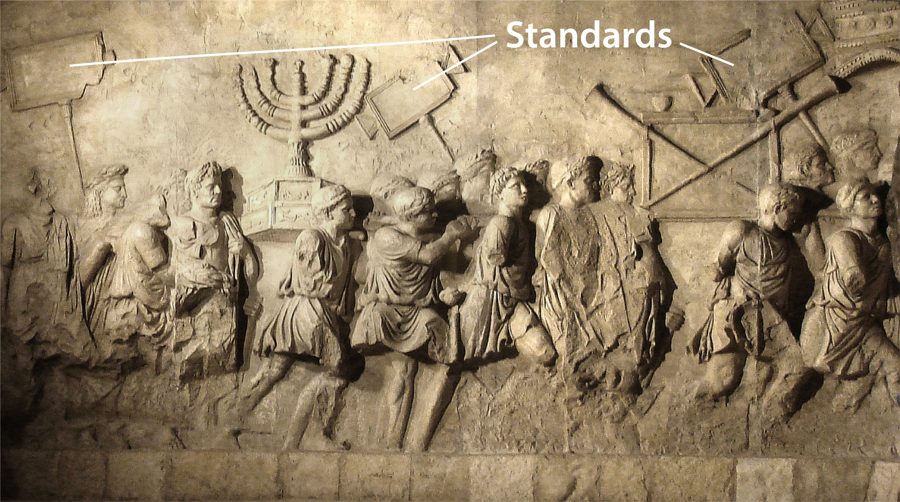
Reconstruction of the Titos (Titus) Arch frieze (Romai (Rome)), showing a menorah and standards from the temple being carried off by the Roman victors (71 C.E.) (© Original file by Steerpike (File:Arch of Titus Menorah.png), CC BY 3.0, via Wikimedia Commons)
References
- Hebrew אוֹת ’oth: NUM 2:2, PSA 74:4
- Hebrew דגל dagal (verb): PSA 20:5, SNG 6:4, SNG 6:10
- Hebrew דֶּגֶל degel: NUM 1:52, NUM 2:2, NUM 2:3, NUM 2:10, NUM 2:17, NUM 2:18, NUM 2:25, NUM 2:31
- Hebrew נֵס nes: EXO 17:15, NUM 21:8, NUM 21:9, PSA 60:4, ISA 5:26, ISA 11:10, ISA 11:12, ISA 13:2
- Hebrew נסס nasas (verb): ZEC 9:16
- Hebrew תֹּרֶן toren: ISA 30:17
Description and usage
The standard was a distinctive device used to identify a particular group. It could be a flag or a board attached to a stick. In many cases it was a metal device or image (such as an eagle or the head of a lion) that was fitted over the end of a pole in much the same way that a spearhead was attached to a spear.
———
Translation
The Hebrew words listed above occur in both military and religious contexts. In a time of war the standard was carried with the army into combat and served as a rallying point for the soldiers. If a victory was won or a strategic position was captured, the standard might be set up in that place as a sign of victory. So in a language where flags or military standards are unfamiliar, it is possible to say the following in PSA 74:4: “they have placed their signs of victory here” or “they have put up the signs that show they have defeated us.”
There is a textual problem in EXO 17:16. While the Hebrew text reads kes, meaning “seat” or “throne,” some translations accept an emended text that reads nes, which appears also in the previous verse; for example, for the first half of this verse GNT has “He said, ‘Hold high the banner of Yahweh!’ ” Other translations prefer to translate the word kes without emendation; for example, NIV has “He said, ‘For hands were lifted up to the throne of Yahweh.’ ”
ZEC 9:16: The precise meaning of the Hebrew verb form mithnossoth is doubtful. If it is related to the word nes, then the literal meaning is “lifted up as an ensign.” However, very few translations (KJV, NAB, Vulgate) express this meaning. Most translators and commentators take the word to be related to a different Hebrew root meaning “to shine” or “to sparkle.”
 Open English Translation (OET)