
OET OET-RV OET-LV GHT ULT UST BSB MSB BLB AICNT OEB WEBBE WMBB NET LSV FBV TCNT T4T LEB BBE Moff JPS Wymth ASV DRA YLT Drby RV SLT Wbstr KJB-1769 KJB-1611 Bshps Gnva Cvdl TNT Wycl SR-GNT UHB BrLXX BrTr Related Parallel Simple Interlinear Topics Reference Dictionary Search
OET By Document By Section By Chapter Details
OET INT FRT GEN EXO LEV NUM DEU JOB JOS JDG RUTH 1 SAM 2 SAM PSA AMOS HOS 1 KI 2 KI 1 CHR 2 CHR PROV ECC SNG JOEL MIC ISA ZEP HAB JER LAM YNA (JNA) NAH OBA DAN EZE EZRA EST NEH HAG ZEC MAL GES LES ESG DNG 2 PS TOB JDT WIS SIR BAR MAN 1 MAC 2 MAC 3 MAC 4 MAC YHN (JHN) MARK MAT LUKE ACTs YAC (JAM) GAL 1 TH 2 TH 1 COR 2 COR ROM COL PHM EPH PHP 1 TIM TIT 1 PET 2 PET 2 TIM HEB YUD (JUD) 1 YHN (1 JHN) 2 YHN (2 JHN) 3 YHN (3 JHN) REV
This is still an early look into the drafted text of the Open English Translation of the Bible. Please double-check the text in advance before using in public.
≈ and listen, all you people that live in this country.
Has this sort of thing ever happened in your lifetime
≈ or in the days of your ancestors?
3 Tell your children about it,
and your children to their children,
and their children to the following generation.
4 What the cutting locusts left behind, the swarming locusts have eaten,
and what the swarming locusts left behind, the hopping locusts have eaten,
and what the hopping locusts left behind, the destroying locusts have eaten.
5 Wake up, drunkards, and weep.
Yes, wail, all you wine drinkers.
Wail about the sweet wine, because it’s all gone now.
6 Because a powerful nation (of locusts) with innumerable soldiers has come against my land,
Its teeth are like a lion’s teeth,
≈ and the fangs are like those of a lioness.[ref]
7 It’s made my grapevine into a piece of rubbish
≈ and my fig tree into splinters.
Stripping everything, it’s stripped it and thrown it away.
Its branches have become white (without the bark).
8 Mourn like a young woman dressed in sackcloth after losing her young husband.
9 The grain offering and the drink offering have been discontinued at Yahweh’s temple.
The priests mourn—Yahweh’s servants.
10 The countryside has been devastated.
The soil mourns, because the grain has been destroyed.
11 Feel shame, farmers, for the wheat and for the barley.
≈ Wail, vinedressers, because the harvest from the countryside has perished.
12 The grapevine has dried up and the fig tree has been made weak.
≈ The pomegranate tree, also the palm tree and the apple tree, all of the trees across the countryside have dried up.
→ So humanity’s joy has dried up.
13 Get dressed in sackcloth and sing dirges, you priests.
≈ Wail, you servants of the altar.
Come, spend the night in sackcloth, servants of my god,
because the grain offering and the drink offering have been withheld from the house of your god.
Gather the elders and all the residents of the country
to the house of Yahweh your god,
and it will come as destruction from the powerful one.[ref]
16 Hasn’t our food been cut off right in front of our eyes,
and joy and gladness cut off from God’s house?
17 The seeds have shrivelled under their clods.
The storehouses are in ruins.
The granaries have been torn down,
because the grain has dried up.
≈ The herds of cattle are perplexed,
because there’s no pasture to graze.
Also the flocks of sheep have suffered.
19 I call for help to you, Yahweh,
because fire has devoured the pastures in the wilderness,
and the flame has burnt all the trees in the countryside.
20 Even the wild animals pant for you,
1:15 OSHB note: We agree with both BHS 1997 and BHQ on an unexpected reading.

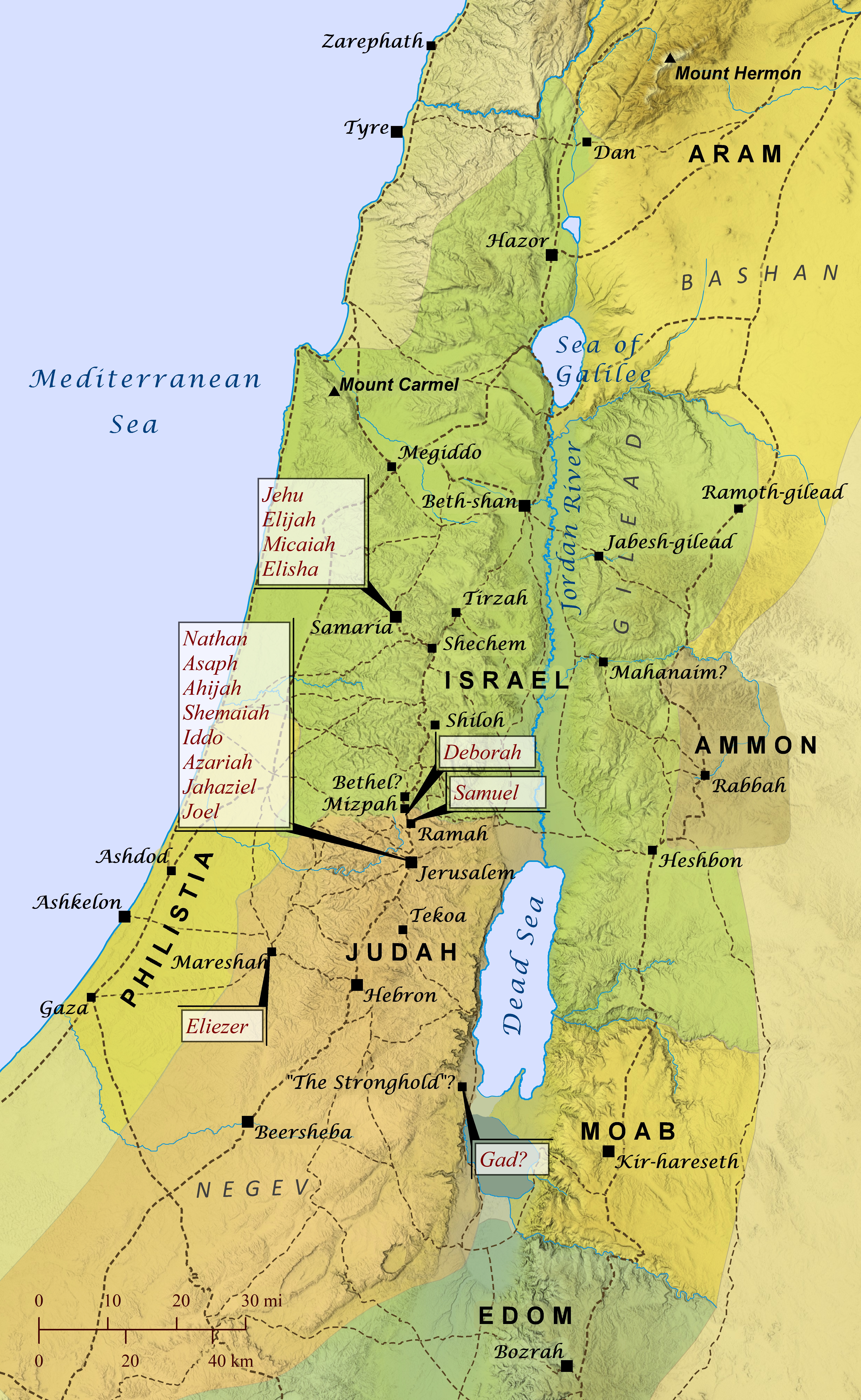
If you ask someone today what biblical prophets did, they will likely tell you that they divinely foretold of future events. While this was often the case, most prophets in the Bible focused as much on “forthtelling” God’s messages as they did on “foretelling” the future. That is, their primary role was to simply “forthtell” divinely acquired messages to leaders and groups of people, and at times that included foretelling of coming judgment, blessing, rescue, etc. Also, though plenty of prophets (sometimes called “seers” in Scripture) often spoke in confrontational or eccentric language that put them at odds with kings and religious leaders, the biblical writers also applied the term prophet to people who communicated God’s messages in ways that many readers today might not think of as prophecy, such as worship leaders appointed by David to “prophesy with lyres, harps, and cymbals” (1 Chronicles 25:1). Similarly, the books of Joshua, Judges, 1 & 2 Samuel, and 1 & 2 Kings are typically categorized as history by Christians, but in the Hebrew canon they belong to the category of Former Prophets. The Lord raised up prophets throughout all of biblical history, from the giving of the law under Moses to the revelation of the last days by the apostle John, and the kings of Israel and Judah often recognized and supported specific people as official prophets of the royal court and consulted them to find out God’s perspective about official matters. Following is a list of nearly everyone designated as prophet or seer in the Old Testament and the primary area of their ministry.
• Deborah (1216 B.C.) [Judges 4:4] => Baal-tamar?
• Samuel (1070 B.C.) [1 Samuel 3:20; 1 Chronicles 29:29; 2 Chronicles 35:18] => Ramah
• Gad (1018 B.C.) [2 Samuel 24:11; 1 Chronicles 21:9; 29:29; 2 Chronicles 29:25] => Masada?
• Nathan (1000 B.C.) [2 Samuel 12:1; 1 Chronicles 29:29; 2 Chronicles 29:25] => Jerusalem
• Asaph (1000 B.C.) [2 Chronicles 29:30] => Jerusalem
• Ahijah (935 B.C.) [1 Kings 11:29; 2 Chronicles 9:29] => Jerusalem
• Shemaiah (930 B.C.) [2 Chronicles 12:2-15] => Jerusalem
• Iddo (913 B.C.) [2 Chronicles 9:29; 12:15; 13:22] => Jerusalem
• Jehu son of Hanani (890 B.C.) [1 Kings 16:1-7; 2 Chronicles 19:2] => Samaria?
• Azariah (890 B.C.) [2 Chronicles 15:1-8] => Jerusalem
• Elijah (860 B.C.) [1 Kings 18:36] => Samaria
• Micaiah (853 B.C.) [1 Kings 22:8-23; 2 Chronicles 18:7-22] => Samaria
• Jahaziel (853 B.C.) [2 Chronicles 20:14] => Jerusalem
• Eliezer (853 B.C.) [2 Chronicles 20:37] => Mareshah
• Elisha (850 B.C.) [1 Kings 19:16; 2 Kings 2:15] => Samaria
• Joel (835 B.C.) [Joel 1:1] => Jerusalem