
OET OET-RV OET-LV GHT ULT UST BSB MSB BLB AICNT OEB WEBBE WMBB NET LSV FBV TCNT T4T LEB BBE Moff JPS Wymth ASV DRA YLT Drby RV SLT Wbstr KJB-1769 KJB-1611 Bshps Gnva Cvdl TNT Wycl SR-GNT UHB BrLXX BrTr Related Parallel Simple Interlinear Topics Reference Dictionary Search
OET By Document By Section By Chapter Details
OET INT FRT GEN EXO LEV NUM DEU JOB JOS JDG RUTH 1 SAM 2 SAM PSA AMOS HOS 1 KI 2 KI 1 CHR 2 CHR PROV ECC SNG JOEL MIC ISA ZEP HAB JER LAM YNA NAH OBA DAN EZE EZRA EST NEH HAG ZEC MAL GES LES ESG DNG 2 PS TOB JDT WIS SIR BAR MAN 1 MAC 2 MAC 3 MAC 4 MAC YHN MARK MAT LUKE ACTs YAC GAL 1 TH 2 TH 1 COR 2 COR ROM COL PHM EPH PHP 1 TIM TIT 1 PET 2 PET 2 TIM HEB YUD 1 YHN 2 YHN 3 YHN REV
MAT Intro C1 C2 C3 C4 C5 C6 C7 C8 C9 C10 C11 C12 C13 C14 C15 C16 C17 C18 C19 C20 C21 C22 C23 C24 C25 C26 C27 C28
This is still an early look into the drafted text of the Open English Translation of the Bible. Please double-check the text in advance before using in public.
19:1 Yeshua answers about divorce
19 When Yeshua had finished saying these things, he left Galilee and went to the Yudean regions on the other side of the Yordan River, 2 and large crowds followed him, and he healed them.
3 Some people from the Pharisees’ party approached him to test him by asking, “Is there any cause for which a man can dismiss his wife?”
4 “Haven’t you read,” he replied, “that God made them male and female from the beginning?[ref] 5 And then how he said, ‘A man will leave his parents and be joined together with his wife, and then the two of them will be a single body’?[ref] 6 So then, they’re no longer two but are now one body, therefore don’t let any person separate what God has joined together.”
7 “So why did Mosheh allow us to give her divorce papers and then send her away?” they asked him.[ref]
8 “It was because of your hard hearts that Mosheh allowed you to send away your wife,” Yeshua answered, “but it wasn’t like that at the beginning. 9 Now I’m telling you that anyone who divorces his wife, except in the case of sexual immorality, and then remarries, is responsible for sexual cheating. Also, if the woman who was sent away remarries, then she’s responsible for cheating, too.[ref]
10 His followers made the point, “If that’s the case for husband and wife, it’s better not to get married.”
11 “Not everyone can accept this,” Yeshua responded, “but only those with a special gift. 12 There are some men who are born without testicles, right from their mother’s womb, there are some who’ve been castrated by others, and there are some who castrate themselves because of the heavenly kingdom. Anyone who’s able to accept this can accept it.”

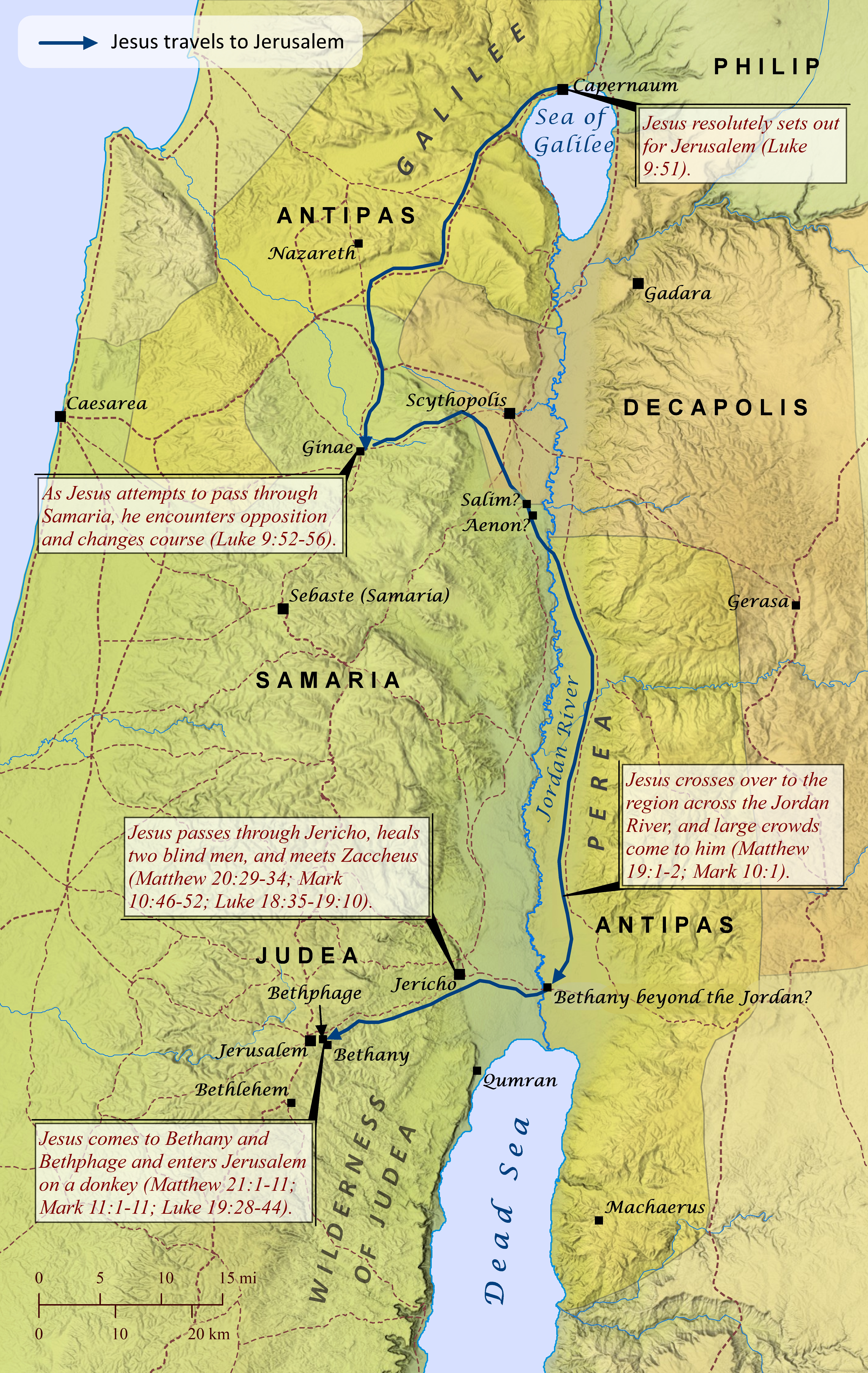
Much like the difficulties of discerning the Israelites’ journey to the Promised Land (see here), the task of reconciling the four Gospel accounts of Jesus’ final journey to Jerusalem into one coherent itinerary has proven very challenging for Bible scholars. As with many other events during Jesus’ ministry, the accounts of Matthew, Mark, and Luke (often referred to as the Synoptic Gospels) present a noticeably similar account of Jesus’ final travels, while John’s Gospel presents an itinerary that is markedly different from the others. In general, the Synoptic Gospels present Jesus as making a single journey to Jerusalem, beginning in Capernaum (Luke 9:51), passing through Perea (Matthew 19:1-2; Mark 10:1) and Jericho (Matthew 20:29-34; Mark 10:46-52; Luke 18:35-19:10), and ending at Bethany and Bethphage, where he enters Jerusalem riding on a donkey (Matthew 21:1-11; Mark 11:1-11; Luke 19:28-44). John, on the other hand, mentions several trips to Jerusalem by Jesus (John 2:13-17; 5:1-15; 7:1-13; 10:22-23), followed by a trip to Perea across the Jordan River (John 10:40-42), a return to Bethany where he raises Lazarus from the dead (John 11), a withdrawal to the village of Ephraim for a few months (John 11:54), and a return trip to Bethany, where he then enters Jerusalem riding on a donkey (John 12:1-19). The differences between the Synoptics’ and John’s accounts are noteworthy, but they are not irreconcilable. The Synoptics, after noting that Jesus began his trip at Capernaum, likely condensed their accounts (as occurs elsewhere in the Gospels) to omit Jesus’ initial arrival in Jerusalem and appearance at the Festival of Dedication, thus picking up with Jesus in Perea (stage 2 of John’s itinerary). Then all the Gospels recount Jesus’ trip (back) to Bethany and Jerusalem, passing through Jericho along the way. Likewise, the Synoptics must have simply omitted the few months Jesus spent in Ephraim to escape the Jewish leaders (stage 4 of John’s itinerary) and rejoined John’s account where Jesus is preparing to enter Jerusalem on a donkey.
MAT Intro C1 C2 C3 C4 C5 C6 C7 C8 C9 C10 C11 C12 C13 C14 C15 C16 C17 C18 C19 C20 C21 C22 C23 C24 C25 C26 C27 C28