
OET OET-RV OET-LV GHT ULT UST BSB MSB BLB AICNT OEB WEBBE WMBB NET LSV FBV TCNT T4T LEB BBE Moff JPS Wymth ASV DRA YLT Drby RV SLT Wbstr KJB-1769 KJB-1611 Bshps Gnva Cvdl TNT Wycl SR-GNT UHB BrLXX BrTr Related Parallel Simple Interlinear Topics Reference Dictionary Search
OET By Document By Section By Chapter Details
OET INT FRT GEN EXO LEV NUM DEU JOB JOS JDG RUTH 1 SAM 2 SAM PSA AMOS HOS 1 KI 2 KI 1 CHR 2 CHR PROV ECC SNG JOEL MIC ISA ZEP HAB JER LAM YNA NAH OBA DAN EZE EZRA EST NEH HAG ZEC MAL GES LES ESG DNG 2 PS TOB JDT WIS SIR BAR MAN 1 MAC 2 MAC 3 MAC 4 MAC YHN MARK MAT LUKE ACTs YAC GAL 1 TH 2 TH 1 COR 2 COR ROM COL PHM EPH PHP 1 TIM TIT 1 PET 2 PET 2 TIM HEB YUD 1 YHN 2 YHN 3 YHN REV
NUM Intro C1 C2 C3 C4 C5 C6 C7 C8 C9 C10 C11 C12 C13 C14 C15 C16 C17 C18 C19 C20 C21 C22 C23 C24 C25 C26 C27 C28 C29 C30 C31 C32 C33 C34 C35 C36
This is still an early look into the drafted text of the Open English Translation of the Bible. Please double-check the text in advance before using in public.
33:16 The journey legs in the wilderness
16 From the Sinai wilderness, they went to Kivot-Hattaavah and camped there. 17 When they left Kivot-Hattaavah, they camped at Hatserot, 18 and then from there, at Ritmah. 19 From Ritmah, they went to Rimmon-Perets to camp, 20 and after that, on to Livnah. 21 Then they left Livnah and camped at Rissah, 22 before moving on from there to camp at Kehelatah. 23 From Kehelatah, they camped at Mt. Shefer, 24 then they left the mountain and camped at Haradah. 25 When they left Haradah, they camped at Makhelot, 26 and after that, on to Tahat. 27 From Tahat, they camped at Terah, 28 and then from Terah, they went to Mitkah to camp. 29 After Mitkah, they camped at Hashmonah, 30 and next after that, they camped at Moserot. 31 Then they left Moserot and camped at Bene-Yaakan. 32 From Bene-Yaakan, they went to Hor-Haggidgad and camped there, 33 then they left and camped at Yotbatah. 34 Then they left Yotbatah and camped at Avronah. 35 From Avronah, they went to Etsyon-Gever and camped there, 36 then they left and camped in the Tsin (Zin) wilderness, i.e., at Kadesh. 37 Then they left Kadesh and camped at Mt. Hor by the border with Edom.
38 Aharon (Aaron) the priest climbed Mt. Hor following Yahweh’s instructions, and then died there on the 5th of the first month, forty years after the Israelis had left Egypt.[ref] 39 He was 123 years old when he died there on Mt. Hor.
40 Meanwhile, the Canaanite king of Arad who lived in the Negev in Kanaan, heard that the Israelis were coming.
41 The Israelis left Mt. Hor and camped at Tsalmonah. 42 When they left Tsalmonah, they camped at Punon, 43 and after that, on to Ovot. 44 From Ovot, they went on to Iyey-Haavarim at the Moav border. 45 Then they left there and camped at Divon-Gad, 46 before going on to camp at Almon-Divlatayim. 47 From there, they went into the Avarim mountains and camped facing Nevo. 48 After leaving the Avarim mountains, they reached the Moav plains by the Yarden (Jordan) river opposite Yeriho (Jericho). 49 They camped beside the river from Beyt-Hayshimot to Avel-Shittim there on the Moav plains.
50 Then Yahweh spoke to Mosheh there on the Moav plains beside the Yarden opposite Yeriho, 51 “Tell the Israelis that you’re all about to cross the Yahweh to enter Canaan. 52 Then you all must drive all the land’s inhabitants out ahead of you, and destroy all their carved images and cast metal images, and all their hilltop shrines. 53 Take the land from there and start to live there, because I’ve given it to all of you to own. 54 Use lots to divide the land up for your clans. The larger groups must get more than the smaller groups, then whatever the lot gives, that will be the area to be given within the land for that ancestral tribe.[ref]
55 If you don’t drive out the current inhabitants, then they’ll become like barbs in your eyes and thorns in your sides, and they’ll harass you all when you live there. 56 If that happens, then I’ll give you all the punishment that I intended for them.”


Numbers 13-14; 20-21; 33; Deuteronomy 1-2; 10:6-9
After the Israelites received the law on Mount Sinai, which may have been located at Khashm et-Tarif (see also “The Route of the Exodus”), they traveled to Kadesh-barnea, a distance that took eleven days “by the way of Mount Seir” (Deuteronomy 1:2). The phrase “by the way of Mount Seir” suggests that more than one route existed between Mount Sinai and Kadesh, as shown here, but the road the Israelites took probably ran alongside the mountainous region of Seir. This route would have offered greater access to water from wells, natural springs, and seasonal streams flowing from the hills of Seir–a critical necessity for a large group traveling through this very arid region. Nearly every location identified on this map was essentially a small community centered around one of these life-enabling sources of water. After reaching Kadesh in the wilderness of Zin, the Israelites prepared to enter Canaan by sending spies to scout out the land. But when ten of the twelve spies brought back news about the strength of the Canaanites, the people became afraid to enter the land, so the Lord punished them by condemning them to travel in the wilderness for forty years until that generation died off. Some Israelites repented and tried to enter the land, but they were beaten back to Hormah by the Amalekites and Canaanites. So for forty years the Israelites traveled from place to place, probably in the general area of Kadesh-barnea, though very few locations mentioned are able to be established with much certainty. As the forty years of traveling drew to a close, the Israelites prepared again to travel to Canaan by requesting permission from the king of Edom to pass through his land. When the king refused, the Israelites “turned away” from the Edomites and set out from Kadesh to travel to Mount Hor. The Jewish historian Josephus located Mount Hor at Jebel Nebi Harun, a very tall mountain in eastern Edom, but this has been rejected by many scholars in favor of other sites such as Jebel Madeira to the northeast of Kadesh. This author is convinced, however, that any candidate for Mount Hor must be sought to the south of Kadesh-barnea. Numbers 33:30 and Deuteronomy 10:6 mention that, during their wilderness travels, the Israelites camped at Moseroth/Moserah, which was apparently located at Mount Hor, since both Moseroth/Moserah and Mount Hor are cited as the place where Aaron died (Numbers 21:29-29; 33:37-39; Deuteronomy 10:6-9). It is difficult to envision the Israelites traveling back to the edge of Canaan after suffering defeat there the last time they attempted to enter the land. These same passages also note that after their stay at Moseroth/Moserah the Israelites traveled to Hor-haggidgad/Gudgodah (probably located along the Wadi Khadakhid) and then to Jotbathah, with no mention of passing through Kadesh, which they would have had to do if Mount Hor was north of Kadesh (since they were avoiding the land of Edom). Also, in Deuteronomy 2:1 Moses says that after the Israelites left Kadesh, “we journeyed back into the wilderness, in the direction of the Red Sea, as the Lord had told me and skirted Mount Seir for many days,” and Aaron’s death on Mount Hor fits best during this time. Similarly, Numbers 21:4 says “from Mount Hor they set out by the way to the Red Sea, to go around the land of Edom,” but there would have been no way to the Red Sea around the land of Edom if Mount Hor were located northeast of Kadesh. One element of the wilderness narratives that appears to favor a northeast location for Mount Hor, however, is the story of the king of Arad, which the book of Numbers (chapters 21 and 33) places immediately after the death of Aaron on Mount Hor. At first glance, the narrative seems to imply that the king attacked the Israelites at Mount Hor, which fits better with a northern location. Yet, it is also possible that the story is simply noting that it was after the Israelites’ arrival at Mount Hor that the king of Arad first learned of the Israelites’ renewed intentions to enter Canaan, perhaps as a result of their request to pass through Edom. But it may have been later that the king of Arad actually engaged them in battle, perhaps as they were passing north of Zalmonah and appeared to be ready to enter Canaan by way of Arad (see Numbers 33:41-42 and the map “The Journey to Abel-shittim”). For these reasons, this author believes that Har Karkom is the best candidate for the location of Mount Hor. The site is appropriately located at the edge of Seir and along the way to the Red Sea. This site’s role as an ancient cultic center is also well established. Perhaps Aaron’s priestly duties and authority in Israel had grown out of a similar role he had previously held at Mount Hor (see also Numbers 12:1-2; Deuteronomy 33:2; Judges 5:4-5), where he was eventually buried.
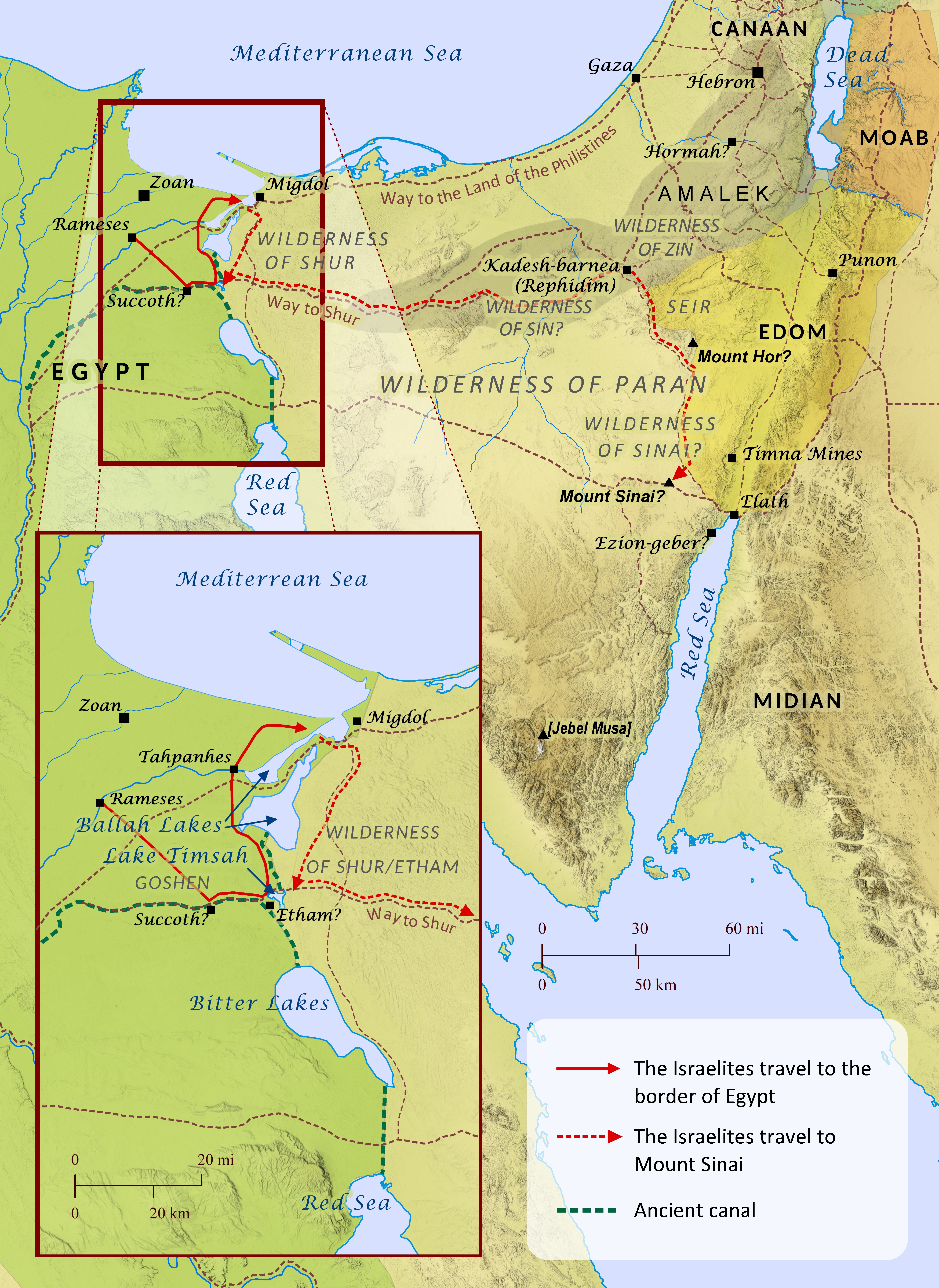
Exodus 13-19; Numbers 33
Like several other events recorded in Scripture, the Bible’s account of the Israelites’ journey from Egypt to Mount Sinai includes an abundance of geographical references, yet it remains one of the most hotly debated topics among scholars, and numerous theories have been offered. The vast majority of geographical references provided in the story are disputed, including the place where the Israelites crossed the Red Sea, the location of Mount Sinai (see Proposed Locations for Mount Sinai map), and the various stops along the Israelites’ journey. A few locations have been established with some degree of scholarly consensus, but even these are not without opposing viewpoints. Amidst this incredible diversity of opinion, however, a single verse provides one of the most helpful clues for weighing the merits of one viewpoint over another: “By the way of Mount Seir it takes eleven days to reach Kadesh-barnea from Horeb” (Deuteronomy 1:2). For those who assume the Bible’s account to be trustworthy, this verse appears to require the following for any theory to be considered viable: 1) Kadesh-barnea and Mount Sinai must have been located at a distance from each other that could reasonably have been expected to take eleven days for an entire nation of people with small children, flocks, equipment, and perhaps even elderly members to travel on foot; and 2) the pace established by this distance over eleven days should most likely be considered the typical pace for the Israelites as they traveled from place to place along the other parts of the journey. This two-pronged test clearly strains many of the theories put forth to this point, especially when one factors in the time references given for the start of the journey (Exodus 12:6; Numbers 33:3), the middle of the journey (Exodus 16:1; Numbers 33:8), and the end of the journey (Exodus 19:1). In short, the journey from Rameses to the Wilderness of Sin took 31 days, since it included the 15th day of the second month, and the rest of the journey took another 16 days, assuming they arrived at Mount Sinai on the 15th day (not the first day, etc.) of the third month. Along with these criteria, a theory’s overall congruence with other established geographical and archeological data should bolster its credibility over other proposals. Another consideration is the extreme similarity between the events at Rephidim (Exodus 17) and the events at Kadesh-barnea (Numbers 20:1-13; 27:12-14; Deuteronomy 32:51; Ezekiel 47:19; 48:28), raising the question of whether Rephidim (meaning “resting places”) is in fact Kadesh-barnea. With these things in mind, the map below proposes a route for the exodus that meets virtually all of these criteria. A careful analysis and explanation of all the elements of the map is far beyond the scope of this article, but a few key points should be noted. The term Red Sea, in addition to referring to what we now regard it, must have also applied to the interconnected lakes and marshlands that lay along what is now the Suez Canal. Also, the portion of the journey that passed through the wilderness for three days without water (Exodus 15:22; Numbers 33:8) may have been comprised of a partial first day, a full second day, and a partial third day, much like Jesus’ time in the tomb is reckoned as three days in Matthew 12:40. Most notably, Mount Sinai is placed on this map at Gebel Khashm et-Tarif, which is appropriately located near, but not in, Midian (Exodus 3:1; 18:5; Numbers 10:29-30). It is also located 89 miles from Kadesh-barnea (assuming Kadesh is at Tall al-Quderat), which establishes a reasonable pace of 7.6 miles (12.2 km) per day to travel between them in 11 days. This lines up well with several known sources of water along that route (e.g., `Ain Qedeis [Hazar-addar?], Tamilat Suwelima [Hor-haggiggad?], and the spring at Kuntillet al-Girafi [unknown ancient identification]). This general pace then synchronizes very well with the timetable and distances required by this map for the other parts of the journey. The distance from Rameses to the Wilderness of Sin (where it is located here) could be completed in under 26 days, leaving an acceptable buffer of about 5 days for the parting of the Red Sea and perhaps a slower pace through the Wilderness of Shur/Etham. The entire journey took about 60 days, and the journey from the Wilderness of Sin to Mount Sinai took about 29 days. This leaves an acceptable buffer of time to complete the rest of the journey (about 16 days of travel) with a very adequate two weeks of extra time for Jethro to visit Moses and the Israelites to do battle with the Amalekites (Exodus 17-18). It should be noted that this timetable generally assumes (but does not necessarily require) that travel continued on sabbath days, but Scripture does not make clear whether travel was prohibited as work prior to the giving of the law at Mount Sinai.
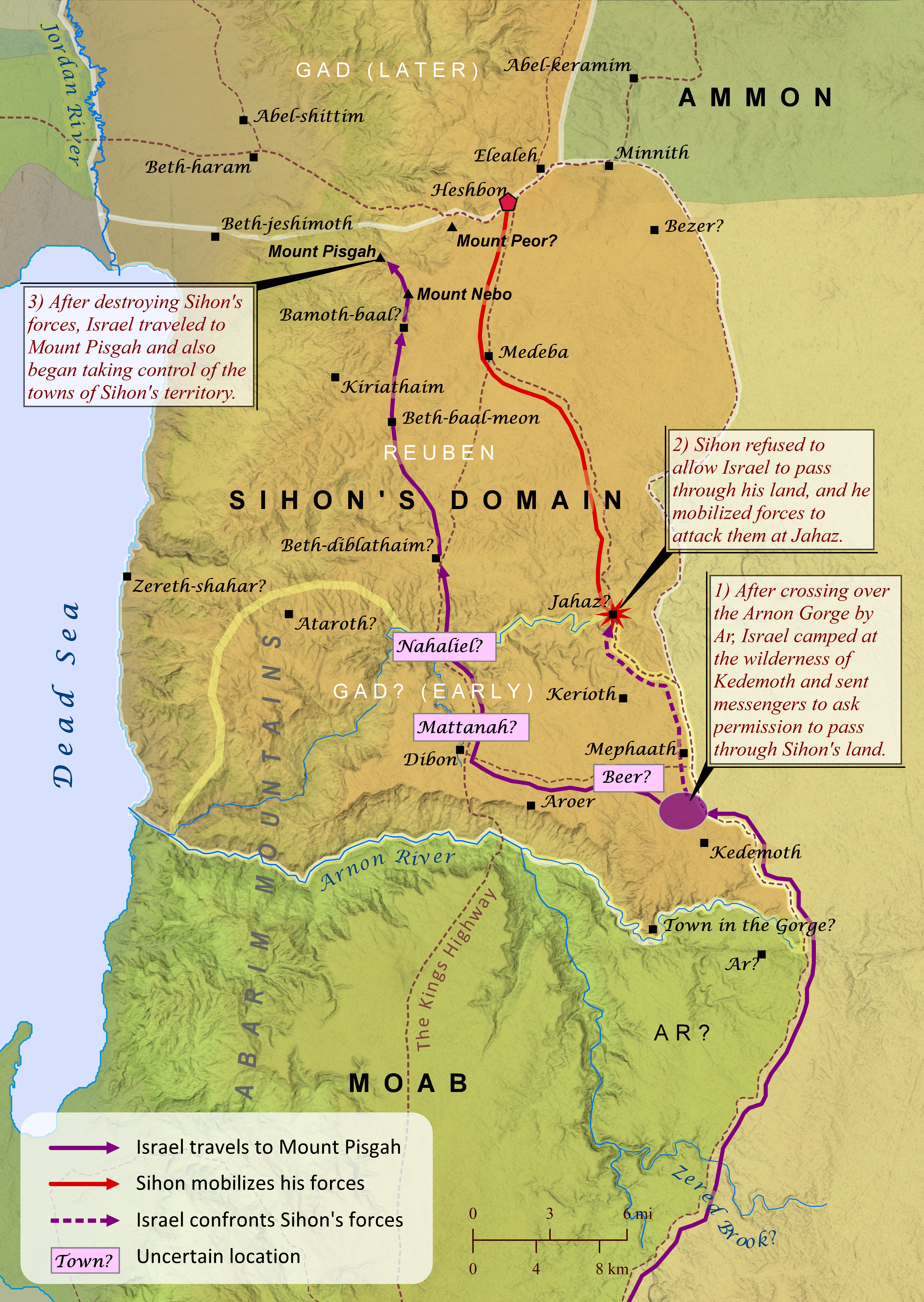
Numbers 21:12-26; 33:45-47; Deuteronomy 2:24-37; Judges 11:18-22
After passing along the eastern border of Moab’s territory, the Israelites camped in the wilderness of Kedemoth and sent messengers to King Sihon in Heshbon, asking permission to pass through his land. Sihon refused permission and instead mobilized his forces at Jahaz to attack the Israelites. It may be that during this time the main camp of the Israelites remained in the wilderness of Kedemoth while the fighting men confronted Sihon at or near Jahaz, because Numbers 33 notes that the Israelites eventually travelled to Dibon, and it seems unlikely that all the Israelites would have traveled south again to Dibon before traveling north to Almon-diblathaim (likely the same as Beth-diblathaim) and the the mountains of Abarim. The unknown locations of Beer, Mattanah, and Nahaliel (“river of God”), noted in Numbers 21 as waypoints on the Israelites’ journey, were likely also situated somewhere along this route. At Jahaz the Israelites completely destroyed Sihon and his forces, but it is unclear when they took control of all his land, which stretched from the Arnon River in the south to the Jabbok River in the north. Given the large amount of land they took from him, it seems likely this took place over a long stretch of time, perhaps beginning immediately after their victory at Jahaz (including the capture of Aroer and the “Town in the Gorge”) and continuing well after their arrival at Mount Pisgah. Nearly all the accounts, however, specially note that the Israelites did not encroach on the territory of the Ammonites, who occupied the land along the upper Jabbok River at this time. Additionally, it is interesting to note that Numbers 32:34 includes the southern towns of Dibon (also called Dibon-gad in Numbers 33:46), Ataroth, and Aroer among the towns built (or rebuilt) by the tribe of Gad, but elsewhere in Scripture these towns are included in the territory allotted to Reuben. Perhaps the reason for this may be that Gad was the tribe that first captured this region during the initial conquest of Sihon’s land, but later Gad was formally allotted the northern portion of Sihon’s former territory, and these towns were given to Reuben.
[Author’s Note: The final leg of the Israelites’ journey from Kadesh-barnea to Mount Pisgah (see “The Journey to Abel-Shittim” map)) is recounted in four separate passages of Scripture (Numbers 21:12-26; 33:45-47; Deuteronomy 2:24-37; Judges 11:18-22), but various aspects of the accounts can seem difficult to reconcile with each other. This map proposes a possible itinerary that I believe harmonizes well with all the accounts. Nevertheless, I openly acknowledge that other itineraries may harmonize with the accounts as well, and I encourage all readers to study the passages and geography carefully for themselves to determine what seems to be the best explanation.]
NUM Intro C1 C2 C3 C4 C5 C6 C7 C8 C9 C10 C11 C12 C13 C14 C15 C16 C17 C18 C19 C20 C21 C22 C23 C24 C25 C26 C27 C28 C29 C30 C31 C32 C33 C34 C35 C36