
OET OET-RV OET-LV GHT ULT UST BSB MSB BLB AICNT OEB WEBBE WMBB NET LSV FBV TCNT T4T LEB BBE Moff JPS Wymth ASV DRA YLT Drby RV SLT Wbstr KJB-1769 KJB-1611 Bshps Gnva Cvdl TNT Wycl SR-GNT UHB BrLXX BrTr Related Parallel Simple Interlinear Topics Reference Dictionary Search
OET By Document By Section By Chapter Details
OET INT FRT GEN EXO LEV NUM DEU JOB JOS JDG RUTH 1 SAM 2 SAM PSA AMOS HOS 1 KI 2 KI 1 CHR 2 CHR PROV ECC SNG JOEL MIC ISA ZEP HAB JER LAM YNA NAH OBA DAN EZE EZRA EST NEH HAG ZEC MAL GES LES ESG DNG 2 PS TOB JDT WIS SIR BAR MAN 1 MAC 2 MAC 3 MAC 4 MAC YHN MARK MAT LUKE ACTs YAC GAL 1 TH 2 TH 1 COR 2 COR ROM COL PHM EPH PHP 1 TIM TIT 1 PET 2 PET 2 TIM HEB YUD 1 YHN 2 YHN 3 YHN REV
1 SAM Intro C1 C2 C3 C4 C5 C6 C7 C8 C9 C10 C11 C12 C13 C14 C15 C16 C17 C18 C19 C20 C21 C22 C23 C24 C25 C26 C27 C28 C29 C30 C31
This is still an early look into the drafted text of the Open English Translation of the Bible. Please double-check the text in advance before using in public.
7:2 Shemuel guides Yisrael
2 The sacred chest ended up staying in Kiriat-Yearim for twenty years but the Israelis longed sadly for Yahweh.
3 Then Shemuel told all the Israelis, “If you all really want to return to Yahweh, remove the foreign gods and the Ashtorets from among you. Then decide firmly to serve Yahweh and no other, then he’ll rescue you from the Philistines’ oppression.” 4 So the Israelis removed the Baal and Ashtoret idols, and began to serve Yahweh only.
5 Then Shemuel called, “Gather all Yisrael to Mitspah, and I’ll pray to Yahweh for you all.” 6 So they gathered at Mitspah, and drew water and poured it out in front of Yahweh, and they fasted on that day and said there, “We have sinned against Yahweh.” And Shemuel guided the Israelis at Mitspah.
7 When the Philistines heard that the Israelis had gathered at Mitspah, the Philistine rulers decided to attack Yisrael. When the Israelis heard that, they were afraid of the Philistines 8 and begged Shemuel, “Don’t stop crying out to our god Yahweh, so that he’ll rescue us from the Philistines.” 9 So Shemuel got a young lamb and offered it up—a whole burnt up offering to Yahweh. And he cried out to Yahweh for Yisrael, and Yahweh answered him. 10 While Shemuel was offering up that burnt offering, the Philistines approached to battle against Yisrael. But that day Yahweh made an intense sound like thunder that confused the Philistines and the Israelis were able to defeat them. 11 The Israeli men ran out from Mitspah and chased the Philistines—killing them all the way to Beyt-Kar.
12 Shemuel took a single rock and stood it between Mitspah and Shen. He named it ‘Eben-Ezer’ (which means ‘stone of help’), saying, “Yahweh helped us all the way up to here.” 13 So the Philistines ended up being subdued and didn’t invade Yisrael’s border again, and Yahweh worked against the Philistines as long as Shemuel lived. 14 The cities that the Philistines had taken from Ekron and as far as Gat were returned to Yisrael. And so Yisrael rescued their territory from the Philistines, and there was peace between Yisrael and the Amorites.
15 So Shemuel guided Yisrael while he lived. 16 Every year he did the circuit around Beyt-El, Gilgal, and Mitspah, and he helped settled disputes for the people in all those places, 17 but he always returned to Ramah because his home was there. He would judge disputes there, and built an altar to Yahweh there.

7:9 OSHB variant note: ו/יעלה: (x-qere) ’וַ/יַּעֲלֵ֧/הוּ’: lemma_c/5927 morph_HC/Vhw3ms/Sp3ms id_09YS7 וַ/יַּעֲלֵ֧/הוּ
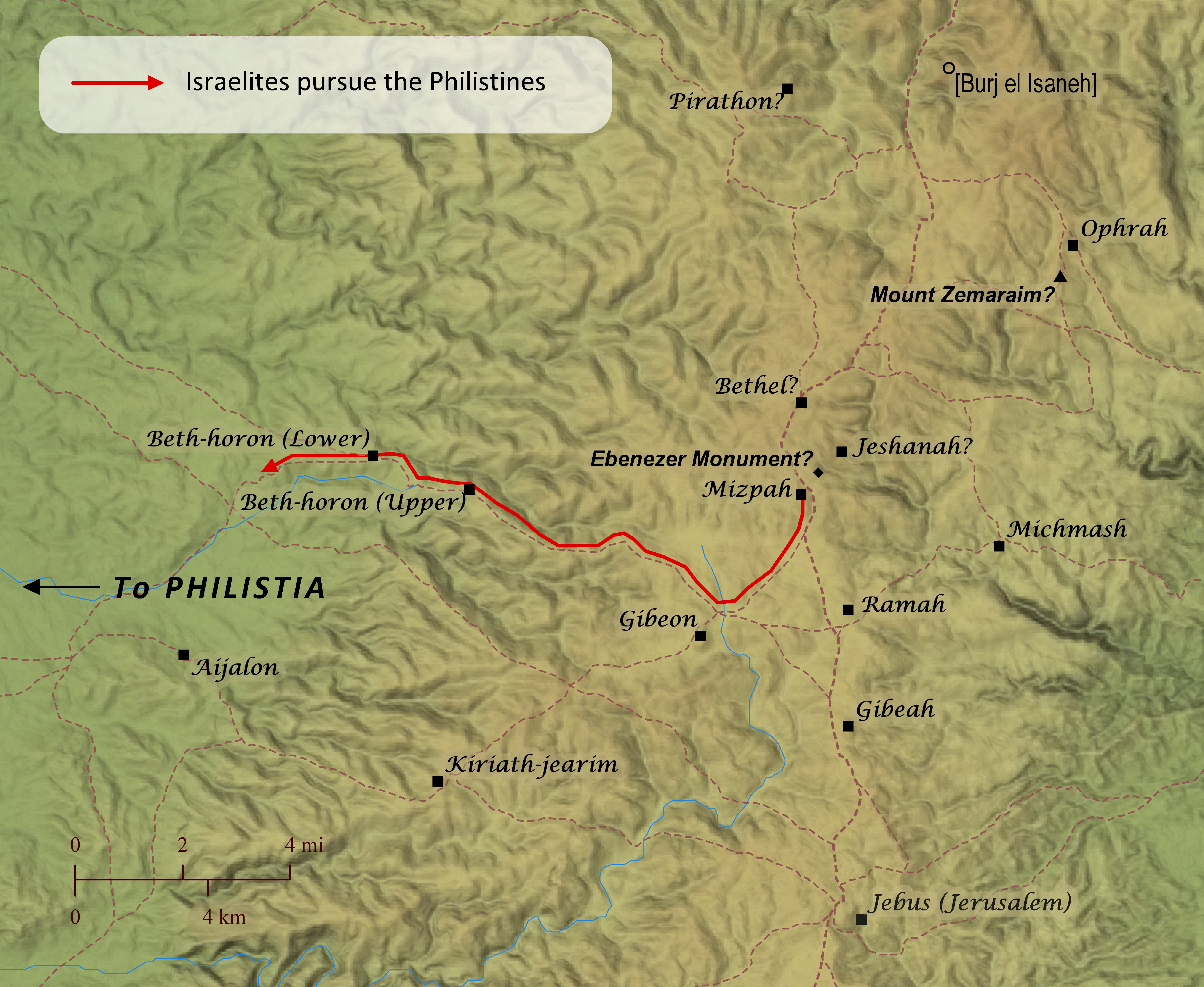
1 Samuel 7:3-14
Sometime after the ark of the covenant was returned to Israel from Philistia (1 Samuel 4-6; see “The Ark of the Covenant Is Captured And Returned” map), Samuel called upon the Israelites to put away their foreign idols and worship the Lord alone. He called the people to a dedication ceremony at Mizpah, and he set up his court there to perform his role as judge. When the Philistines heard that the Israelites were gathered at Mizpah, the Philistines prepared to attack them, and the Israelites became afraid. So they asked Samuel to pray for them. After Samuel prayed for them and offered a sacrifice to the Lord, the Lord thundered with a mighty voice and threw the Philistines into confusion. The Israelites chased the Philistines from Mizpah and struck them down as far as Beth-car. Then Samuel set up a stone monument between Mizpah and Jeshanah and named it Ebenezer, meaning, “stone of help.” The name Beth-car is mentioned nowhere else in scripture, but the context of the story and the spelling of the word make it likely that the town intended was actually the same as Beth-horon (technically pronounced more like “Beth-choron”), and the Greek translation of the Old Testament also reads “Bethchor.” Beth-horon was a town–actually twin towns–that stood along a key route leading westward from Gibeah and Gibeon to the land of Philistia. Similarly, the term Jeshanah, near which Samuel erected a stone monument, is mentioned only one other place in scripture (2 Chronicles 13:19; see “Abijah Attacks Jeroboam”), making it difficult to pinpoint the location intended. Virtually all scholars today identify modern Burj el Isaneh as Jeshanah, primarily based on the similarity of the spelling between the modern and ancient names. But this author regards this identification as very unlikely, because Burj el Isaneh seems too far removed to fit the setting of either story very well. In the case of Samuel’s monument, it seems unlikely that the author would use two locations so far apart to indicate where Samuel set up his monument, especially since the span between these two points also passed by Bethel–one of the most noteworthy and enduring locations in the Old Testament. Why wouldn’t the biblical writer have used Bethel instead to indicate to the reader where the monument was located? Rather than locating Jeshanah at Burj el Isaneh, however, this author has found that Khirbet Nisieh would be a much more fitting site for the location of Jeshanah. Khirbet Nisieh’s proximity to Mizpah fits the setting of the story well and makes it a much more helpful indicator to readers regarding where Samuel’s monument was erected. Likewise, the name Jeshanah is likely derived from the word for “crag,” which would be an apt description of the surroundings of Khirbet Nisieh. Finally, the spelling of the modern Arabic place name is similar to that of Jeshanah. Though the sounds that make up the two words are somewhat out of order from each other, such reordering was a common occurrence as place names were handed down from generation to generation throughout the centuries.
1 SAM Intro C1 C2 C3 C4 C5 C6 C7 C8 C9 C10 C11 C12 C13 C14 C15 C16 C17 C18 C19 C20 C21 C22 C23 C24 C25 C26 C27 C28 C29 C30 C31