
OET OET-RV OET-LV GHT ULT UST BSB MSB BLB AICNT OEB WEBBE WMBB NET LSV FBV TCNT T4T LEB BBE Moff JPS Wymth ASV DRA YLT Drby RV SLT Wbstr KJB-1769 KJB-1611 Bshps Gnva Cvdl TNT Wycl SR-GNT UHB BrLXX BrTr Related Parallel Simple Interlinear Topics Reference Dictionary Search
ParallelVerse GEN EXO LEV NUM DEU JOB JOS JDG RUTH 1 SAM 2 SAM PSA AMOS HOS 1 KI 2 KI 1 CHR 2 CHR PROV ECC SNG JOEL MIC ISA ZEP HAB JER LAM YNA (JNA) NAH OBA DAN EZE EZRA EST NEH HAG ZEC MAL LAO GES LES ESG DNG 2 PS TOB JDT WIS SIR BAR LJE PAZ SUS BEL MAN 1 MAC 2 MAC 3 MAC 4 MAC YHN (JHN) MARK MAT LUKE ACTs YAC (JAM) GAL 1 TH 2 TH 1 COR 2 COR ROM COL PHM EPH PHP 1 TIM TIT 1 PET 2 PET 2 TIM HEB YUD (JUD) 1 YHN (1 JHN) 2 YHN (2 JHN) 3 YHN (3 JHN) REV
1 Sam Intro C1 C2 C3 C4 C5 C6 C8 C9 C10 C11 C12 C13 C14 C15 C16 C17 C18 C19 C20 C21 C22 C23 C24 C25 C26 C27 C28 C29 C30 C31
1 Sam 7 V1 V2 V3 V4 V5 V6 V7 V8 V9 V10 V12 V13 V14 V15 V16 V17
Note: This view shows ‘verses’ which are not necessarily natural language units and hence sometimes only part of a sentence will be visible—click on any Bible version abbreviation down the left-hand side to see the verse in more of its context. Normally the OET discourages the reading of individual ‘verses’, but this view is only designed as a tool for Bible-translators and others doing comparisons of different translations—the older translations are further down the page (so you can read up from the bottom to trace the English translation history). The OET segments on this page are still early looks into the drafted texts of the Open English Translation of the Bible—please double-check these texts in advance before using in public.
B I ◄ ← 1 Sam 7:11 ↓ → ► ≡ ═ ©
Text critical issues=none Clarity of original=clear Importance to us=normal Speaker(s)=Narrator (All still tentative.)
OET (OET-RV) The Israeli men ran out from Mitspah and chased the Philistines—killing them all the way to Beyt-Kar.
OET-LV And_ the_men_of Yisrāʼēl/(Israel) _they_went_out from (the)_Miʦpāh and_they_pursued DOM the_Fəlishtiy and_they_defeated_them to from_under to_Bēyt- car.
UHB וַיֵּ֨צְא֜וּ אַנְשֵׁ֤י יִשְׂרָאֵל֙ מִן־הַמִּצְפָּ֔ה וַֽיִּרְדְּפ֖וּ אֶת־פְּלִשְׁתִּ֑ים וַיַּכּ֕וּם עַד־מִתַּ֖חַת לְבֵ֥ית כָּֽר׃ ‡
(vayyēʦəʼū ʼanshēy yisrāʼēl min-hammiʦpāh vayyirdəfū ʼet-pəlishtim vayyakkūm ˊad-mittaḩat ləⱱēyt kār.)
Key: khaki:verbs.
Note: Automatic aligning of the OET-RV to the LV is done by some temporary software, hence the OET-RV alignments are incomplete (and may occasionally be wrong).
BrLXX Καὶ ἐξῆλθον ἄνδρες Ἰσραὴλ ἐκ Μασσηφὰθ, καὶ κατεδίωξαν τοὺς ἀλλοφύλους, καὶ ἐπάταξαν αὐτοὺς ἕως ὑποκάτω τοῦ Βαιθχόρ.
(Kai exaʸlthon andres Israaʸl ek Massaʸfath, kai katediōxan tous allofulous, kai epataxan autous heōs hupokatō tou Baithⱪor.)
BrTr And the men of Israel went forth out of Massephath, and pursued the Philistines, and smote them to the parts under Bæthchor.
ULT For the men of Israel went out from Mizpah, and they pursued the Philistines, and they struck them unto below Beth Kar.
UST The Israelite men rushed out of Mizpah and killed many Philistine soldiers who were trying to run away. They chased them all the way to the bottom of the hill on which people had built the town of Beth Kar.
BSB & MSB Then the men of Israel charged out of Mizpah and pursued the Philistines, striking them down all the way to an area below Beth-car.
OEB No OEB SA1 7:11 book available
WEBBE & WMBB The men of Israel went out of Mizpah and pursued the Philistines, and struck them until they came under Beth Kar.
NET Then the men of Israel left Mizpah and chased the Philistines, striking them down all the way to an area below Beth Car.
LSV And the men of Israel go out from Mizpeh, and pursue the Philistines, and strike them to the place of Beth-Car.
FBV Then the men of Israel ran out from Mizpah and chased them, killing them all the way to a place near Beth-car.
T4T The Israeli men ran out of Mizpah and pursued the Philistia soldiers almost to Beth-Car town, and killed many Philistia soldiers while they were trying to run away.
LEB Then the men of Israel went out from Mizpah and pursued the Philistines and they struck them down as far as below Beth Car.
BBE And the men of Israel went out from Mizpah and went after the Philistines, attacking them till they came under Beth-car.
Moff No Moff SA1 7:11 book available
JPS And the men of Israel went out of Mizpah, and pursued the Philistines, and smote them, until they came under Beth-car.
ASV And the men of Israel went out of Mizpah, and pursued the Philistines, and smote them, until they came under Beth-car.
DRA And the men of Israel going out of Masphath pursued after the Philistines, and made slaughter of them till they came under Bethchar.
YLT And the men of Israel go out from Mizpeh, and pursue the Philistines, and smite them unto the place of Beth-Car.
Drby And the men of Israel went out of Mizpah, and pursued the Philistines, and smote them, as far as below Beth-car.
RV And the men of Israel went out of Mizpah, and pursued the Philistines, and smote them, until they came under Beth-car.
SLT And the men of Israel will go forth out of Mizpeh and they will pursue Philisteim, and they will strike them even from beneath to the House of Pasture.
Wbstr And the men of Israel went out of Mizpeh, and pursued the Philistines, and smote them, until they came under Beth-car.
KJB-1769 And the men of Israel went out of Mizpeh, and pursued the Philistines, and smote them, until they came under Beth-car.
KJB-1611 And the men of Israel went out of Mizpeh, and pursued the Philistines, and smote them, vntill they came vnder Bethcar.
(Modernised spelling is same as from KJB-1769 above, apart from punctuation)
Bshps And the men of Israel went out of Mispah, and pursued the Philistines, & smote the vntill they came vnder Bethchar.
(And the men of Israel went out of Mispah, and pursued the Philistines, and smote the until they came under Bethchar.)
Gnva And the men of Israel went from Mizpeh and pursued the Philistims, and smote them vntill they came vnder Beth-car.
(And the men of Israel went from Mizpeh and pursued the Philistines, and smote them until they came under Beth-car.)
Cvdl The wente ye men of Israel forth, & chaced ye Philistynes, & smote them till vnder BethCar.
(The went ye/you_all men of Israel forth, and chased ye/you_all Philistines, and smote them till under BethCar.)
Wycl And the sones of Israel yeden out of Masphat, and pursueden Filisteis, and smytiden hem `til to the place that was vndur Bethachar.
(And the sons of Israel went out of Masphat, and pursued Philistines, and smote hem till to the place that was under Bethachar.)
Luth Da zogen die Männer Israels aus von Mizpa und jagten die Philister und schlugen sie bis unter Beth-Kar.
(So pulled the men Israel’s out_of from Mizpah and hunted the Philistines and hit/beat(v) they/she/them until under Beth-car.)
ClVg Egressique viri Israël de Masphath, persecuti sunt Philisthæos, et percusserunt eos usque ad locum qui erat subter Bethchar.[fn]
(And_leaving men Israel from/about Mizpah, persecuted are Philistines, and they_struck them until to place who/which was underneath Bethchar.)
7.11 Betchar. ID. Domus agnitionis, vel domus agni.
7.11 Betchar. ID. House of_recognition, or home lamb.
Note 1 topic: figures-of-speech / explicit
וַיַּכּ֕וּם
(Some words not found in UHB: and=they_went_out men_of Yisrael from/more_than (the),Mizpah and,they_pursued DOM Pelishtim and,they,defeated_them until from=under to,Beth- -car )
See the discussion of the term struck in the Introduction to 1 Samuel, and see how you translated the term in [4:2](../04/02.md). Alternate translation: [and they killed them]
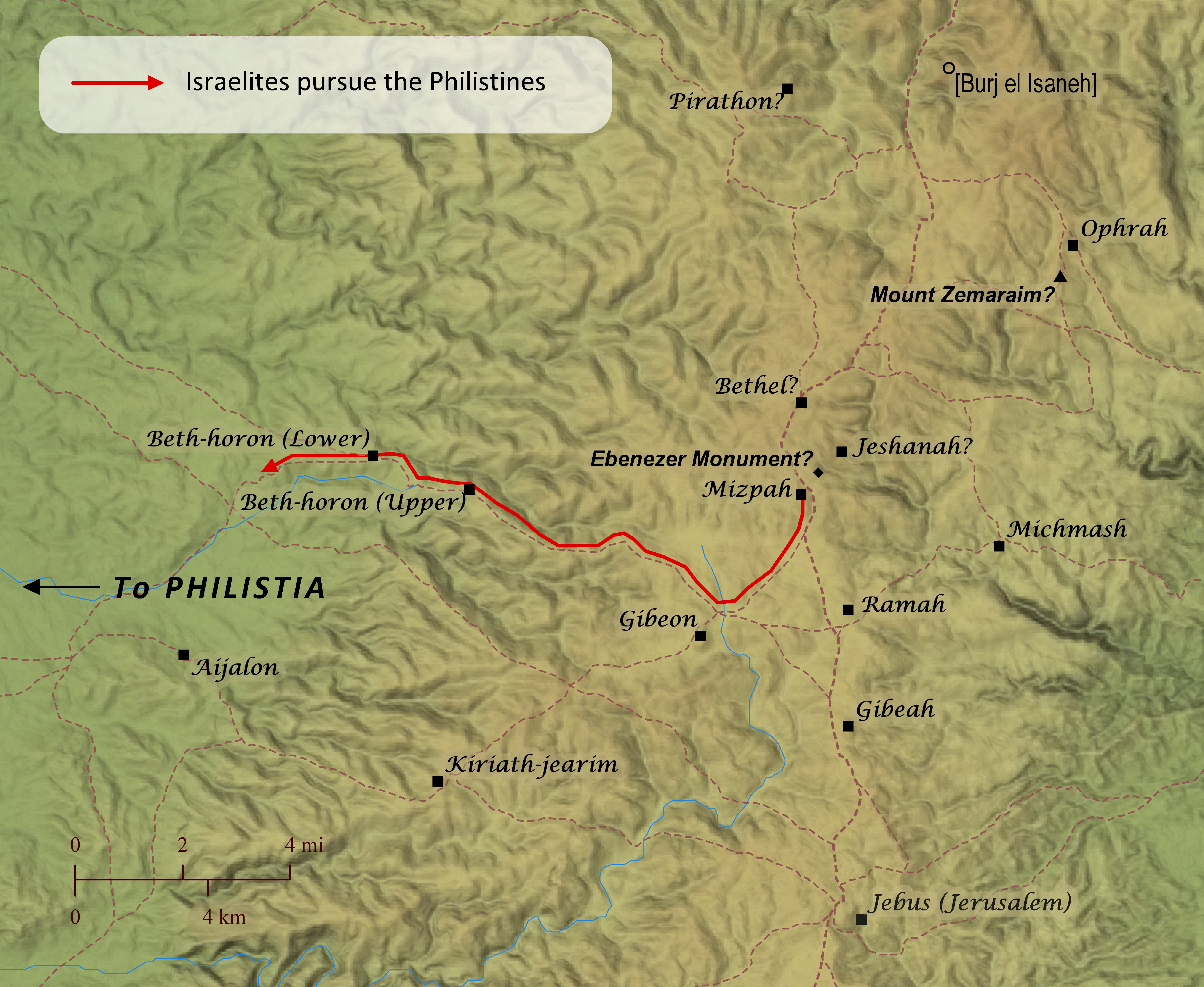
1 Samuel 7:3-14
Sometime after the ark of the covenant was returned to Israel from Philistia (1 Samuel 4-6; see “The Ark of the Covenant Is Captured And Returned” map), Samuel called upon the Israelites to put away their foreign idols and worship the Lord alone. He called the people to a dedication ceremony at Mizpah, and he set up his court there to perform his role as judge. When the Philistines heard that the Israelites were gathered at Mizpah, the Philistines prepared to attack them, and the Israelites became afraid. So they asked Samuel to pray for them. After Samuel prayed for them and offered a sacrifice to the Lord, the Lord thundered with a mighty voice and threw the Philistines into confusion. The Israelites chased the Philistines from Mizpah and struck them down as far as Beth-car. Then Samuel set up a stone monument between Mizpah and Jeshanah and named it Ebenezer, meaning, “stone of help.” The name Beth-car is mentioned nowhere else in scripture, but the context of the story and the spelling of the word make it likely that the town intended was actually the same as Beth-horon (technically pronounced more like “Beth-choron”), and the Greek translation of the Old Testament also reads “Bethchor.” Beth-horon was a town–actually twin towns–that stood along a key route leading westward from Gibeah and Gibeon to the land of Philistia. Similarly, the term Jeshanah, near which Samuel erected a stone monument, is mentioned only one other place in scripture (2 Chronicles 13:19; see “Abijah Attacks Jeroboam”), making it difficult to pinpoint the location intended. Virtually all scholars today identify modern Burj el Isaneh as Jeshanah, primarily based on the similarity of the spelling between the modern and ancient names. But this author regards this identification as very unlikely, because Burj el Isaneh seems too far removed to fit the setting of either story very well. In the case of Samuel’s monument, it seems unlikely that the author would use two locations so far apart to indicate where Samuel set up his monument, especially since the span between these two points also passed by Bethel–one of the most noteworthy and enduring locations in the Old Testament. Why wouldn’t the biblical writer have used Bethel instead to indicate to the reader where the monument was located? Rather than locating Jeshanah at Burj el Isaneh, however, this author has found that Khirbet Nisieh would be a much more fitting site for the location of Jeshanah. Khirbet Nisieh’s proximity to Mizpah fits the setting of the story well and makes it a much more helpful indicator to readers regarding where Samuel’s monument was erected. Likewise, the name Jeshanah is likely derived from the word for “crag,” which would be an apt description of the surroundings of Khirbet Nisieh. Finally, the spelling of the modern Arabic place name is similar to that of Jeshanah. Though the sounds that make up the two words are somewhat out of order from each other, such reordering was a common occurrence as place names were handed down from generation to generation throughout the centuries.
Open Bible Data site copyright © 2023–2026 Freely-Given.org.
Python source code for creating these static pages is available on GitHub under an open licence.
For Bible data copyrights, see the details for each displayed Bible version.
The Open English Translation (OET) main site is at OpenEnglishTranslation.Bible or OET.Bible.