
OET OET-RV OET-LV GHT ULT UST BSB MSB BLB AICNT OEB WEBBE WMBB NET LSV FBV TCNT T4T LEB BBE Moff JPS Wymth ASV DRA YLT Drby RV SLT Wbstr KJB-1769 KJB-1611 Bshps Gnva Cvdl TNT Wycl SR-GNT UHB BrLXX BrTr Related Parallel Simple Interlinear Topics Reference Dictionary Search
ParallelVerse GEN EXO LEV NUM DEU JOB JOS JDG RUTH 1 SAM 2 SAM PSA AMOS HOS 1 KI 2 KI 1 CHR 2 CHR PROV ECC SNG JOEL MIC ISA ZEP HAB JER LAM YNA (JNA) NAH OBA DAN EZE EZRA EST NEH HAG ZEC MAL LAO GES LES ESG DNG 2 PS TOB JDT WIS SIR BAR LJE PAZ SUS BEL MAN 1 MAC 2 MAC 3 MAC 4 MAC YHN (JHN) MARK MAT LUKE ACTs YAC (JAM) GAL 1 TH 2 TH 1 COR 2 COR ROM COL PHM EPH PHP 1 TIM TIT 1 PET 2 PET 2 TIM HEB YUD (JUD) 1 YHN (1 JHN) 2 YHN (2 JHN) 3 YHN (3 JHN) REV
1 Sam Intro C1 C2 C3 C4 C5 C6 C8 C9 C10 C11 C12 C13 C14 C15 C16 C17 C18 C19 C20 C21 C22 C23 C24 C25 C26 C27 C28 C29 C30 C31
1 Sam 7 V1 V2 V3 V5 V6 V7 V8 V9 V10 V11 V12 V13 V14 V15 V16 V17
Note: This view shows ‘verses’ which are not necessarily natural language units and hence sometimes only part of a sentence will be visible—click on any Bible version abbreviation down the left-hand side to see the verse in more of its context. Normally the OET discourages the reading of individual ‘verses’, but this view is only designed as a tool for Bible-translators and others doing comparisons of different translations—the older translations are further down the page (so you can read up from the bottom to trace the English translation history). The OET segments on this page are still early looks into the drafted texts of the Open English Translation of the Bible—please double-check these texts in advance before using in public.
Text critical issues=none Clarity of original=clear Importance to us=normal Speaker(s)=Narrator (All still tentative.)
OET (OET-RV) So the Israelis removed the Baal and Ashtoret idols, and began to serve Yahweh only.
OET-LV And_ the_people_of _they_removed of_Yisrāʼēl/(Israel) DOM the_Baˊal and_DOM the_ˊAshtārōt and_they_served DOM YHWH for_him/it_being_alone.
UHB וַיָּסִ֨ירוּ֙ בְּנֵ֣י יִשְׂרָאֵ֔ל אֶת־הַבְּעָלִ֖ים וְאֶת־הָעַשְׁתָּרֹ֑ת וַיַּעַבְד֥וּ אֶת־יְהוָ֖ה לְבַדּֽוֹ׃פ ‡
(vayyāşirū bənēy yisrāʼēl ʼet-habəˊālim vəʼet-hāˊashtārot vayyaˊaⱱdū ʼet-yhwh ləⱱaddō.◊)
Key: khaki:verbs.
Note: Automatic aligning of the OET-RV to the LV is done by some temporary software, hence the OET-RV alignments are incomplete (and may occasionally be wrong).
BrLXX Καὶ περιεῖλον οἱ υἱοὶ Ἰσραὴλ τὰς Βααλὶμ καὶ τὰ ἄλση ʼΑσταρὼθ, καὶ ἐδούλευσαν Κυρίῳ μόνῳ.
(Kai perieilon hoi huioi Israaʸl tas Baʼalim kai ta alsaʸ ʼAstarōth, kai edouleusan Kuriōi monōi.)
BrTr And the children of Israel took away Baalim and the groves of Astaroth, and served the Lord only.
ULT And the sons of Israel removed the Baals and the Ashtoreths, and they served Yahweh alone.
UST So the Israelites got rid of all their statues of the gods Baal and Ashtoreth, and they began to worship only Yahweh.
BSB & MSB So the Israelites put away the Baals and Ashtoreths and served only the LORD.
OEB No OEB SA1 7:4 book available
WEBBE & WMBB Then the children of Israel removed the Baals and the Ashtaroth, and served the LORD only.
NET So the Israelites removed the Baals and images of Ashtoreth. They served only the Lord.
LSV And the sons of Israel turn aside the Ba‘alim and Ashtaroth, and serve YHWH alone;
FBV The people of Israel got rid of their Baals and Ashtoreth images and worshiped only the Lord.
T4T So the Israelis got rid of all their statues of the gods Baal and Astarte, and they worshiped only Yahweh.
LEB So the ⌊Israelites⌋[fn] removed the Baals[fn] and the Ashtoreths, and they served Yahweh alone.
7:4 Literally “sons/children of Israel”
7:4 Hebrew plural “Be’alim” (Ba’al was a major Canaanite deity)
BBE So the children of Israel gave up the worship of Baal and Astarte, and became worshippers of the Lord only.
Moff No Moff SA1 7:4 book available
JPS Then the children of Israel did put away the Baalim and the Ashtaroth, and served the LORD only.
ASV Then the children of Israel did put away the Baalim and the Ashtaroth, and served Jehovah only.
DRA Then the children of Israel put away Baalim and Astaroth, and served the Lord only.
YLT And the sons of Israel turn aside the Baalim and Ashtaroth, and serve Jehovah alone;
Drby And the children of Israel put away the Baals and the Ashtoreths and served Jehovah only.
RV Then the children of Israel did put away the Baalim and the Ashtaroth, and served the LORD only.
(Then the children of Israel did put away the Baals and the Ashtaroth, and served the LORD only.)
SLT And the sons of Israel will put away the Baalims and Ashtaroth, and will serve Jehovah alone.
Wbstr Then the children of Israel put away Baalim, and Ashtaroth, and served the LORD only.
KJB-1769 Then the children of Israel did put away Baalim and Ashtaroth, and served the LORD only.
(Then the children of Israel did put away Baals and Ashtaroth, and served the LORD only.)
KJB-1611 Then the children of Israel did put away Baalim, and Ashtaroth, and serued the LORD onely.
(Modernised spelling is same as from KJB-1769 above, apart from punctuation)
Bshps Then the children of Israel dyd put away Baalim and Astaroth, and serued the Lorde onely.
(Then the children of Israel did put away Baals and Astaroth, and served the Lord only.)
Gnva Then the children of Israel did put away Baalim and Ashtaroth, and serued the Lord onely.
(Then the children of Israel did put away Baals and Ashtaroth, and served the Lord only.)
Cvdl Then the childre of Israel put awaye Baalim and Astaroth from them, and serued the LORDE onely.
(Then the children of Israel put away Baals and Astaroth from them, and served the LORD only.)
Wycl Therfor the sones of Israel diden awey Baalym and Astoroth, and serueden the Lord aloone.
(Therefore the sons of Israel did away Baals and Astoroth, and served the Lord alone.)
Luth Da taten die Kinder Israel von sich Baalim und Astharoth und dieneten dem HErr’s allein.
(So did the children Israel from itself/yourself/themselves Baalim and Ashtaroth and served to_him LORD’s alone/only.)
ClVg Abstulerunt ergo filii Israël Baalim et Astaroth, et servierunt Domino soli.
(They_took_away therefore children Israel Baalim and Astaroth, and they_served Master alone.)
Note 1 topic: figures-of-speech / metaphor
בְּנֵ֣י יִשְׂרָאֵ֔ל
(Some words not found in UHB: and,they_removed sons_of Yisrael DOM the,Baals and=DOM the,Ashtaroth and,they_served DOM YHWH for=him/it=being_alone )
See how you translated the similar expression in [2:28](../02/28.md). Alternate translation: [the Israelites]
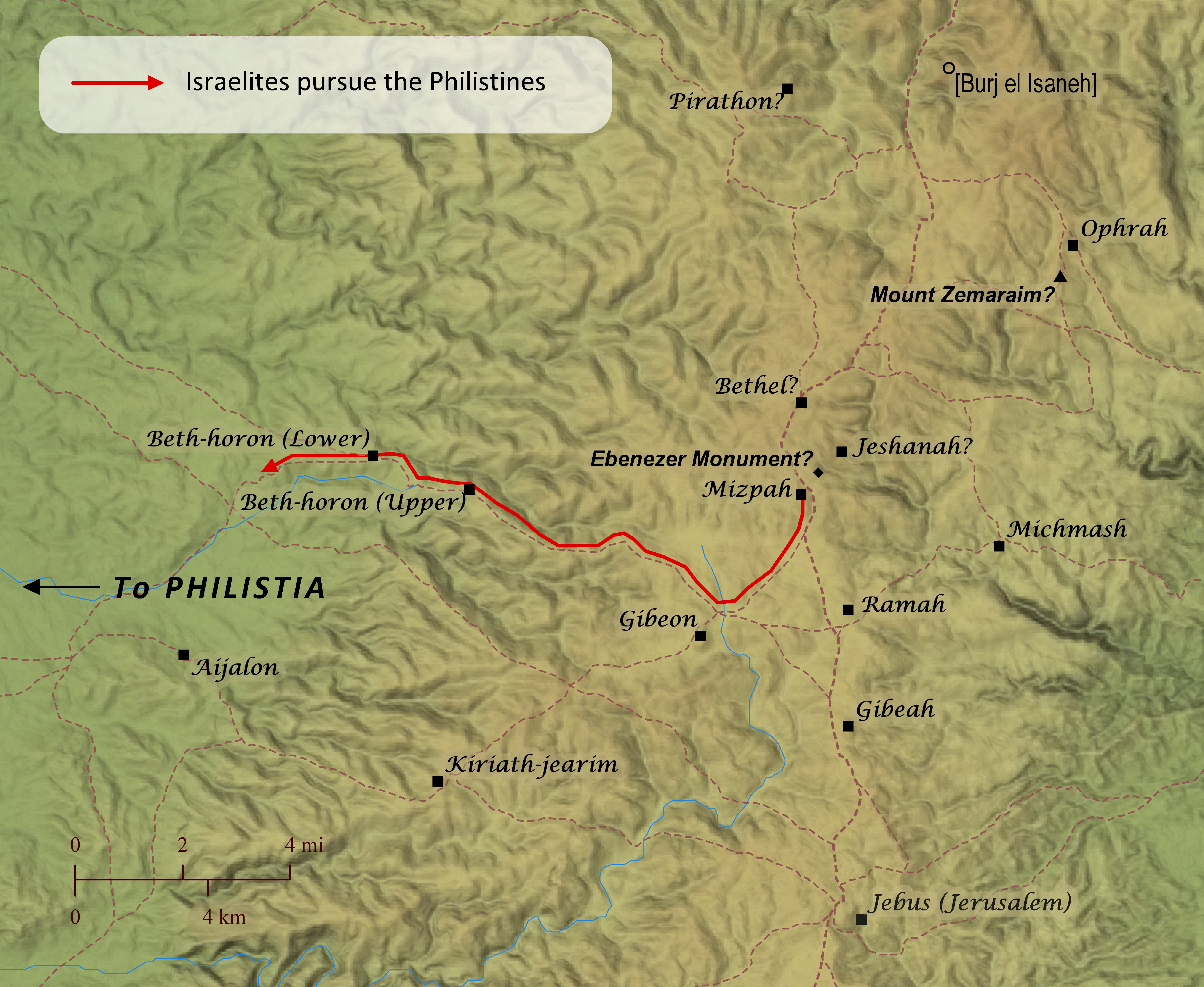
1 Samuel 7:3-14
Sometime after the ark of the covenant was returned to Israel from Philistia (1 Samuel 4-6; see “The Ark of the Covenant Is Captured And Returned” map), Samuel called upon the Israelites to put away their foreign idols and worship the Lord alone. He called the people to a dedication ceremony at Mizpah, and he set up his court there to perform his role as judge. When the Philistines heard that the Israelites were gathered at Mizpah, the Philistines prepared to attack them, and the Israelites became afraid. So they asked Samuel to pray for them. After Samuel prayed for them and offered a sacrifice to the Lord, the Lord thundered with a mighty voice and threw the Philistines into confusion. The Israelites chased the Philistines from Mizpah and struck them down as far as Beth-car. Then Samuel set up a stone monument between Mizpah and Jeshanah and named it Ebenezer, meaning, “stone of help.” The name Beth-car is mentioned nowhere else in scripture, but the context of the story and the spelling of the word make it likely that the town intended was actually the same as Beth-horon (technically pronounced more like “Beth-choron”), and the Greek translation of the Old Testament also reads “Bethchor.” Beth-horon was a town–actually twin towns–that stood along a key route leading westward from Gibeah and Gibeon to the land of Philistia. Similarly, the term Jeshanah, near which Samuel erected a stone monument, is mentioned only one other place in scripture (2 Chronicles 13:19; see “Abijah Attacks Jeroboam”), making it difficult to pinpoint the location intended. Virtually all scholars today identify modern Burj el Isaneh as Jeshanah, primarily based on the similarity of the spelling between the modern and ancient names. But this author regards this identification as very unlikely, because Burj el Isaneh seems too far removed to fit the setting of either story very well. In the case of Samuel’s monument, it seems unlikely that the author would use two locations so far apart to indicate where Samuel set up his monument, especially since the span between these two points also passed by Bethel–one of the most noteworthy and enduring locations in the Old Testament. Why wouldn’t the biblical writer have used Bethel instead to indicate to the reader where the monument was located? Rather than locating Jeshanah at Burj el Isaneh, however, this author has found that Khirbet Nisieh would be a much more fitting site for the location of Jeshanah. Khirbet Nisieh’s proximity to Mizpah fits the setting of the story well and makes it a much more helpful indicator to readers regarding where Samuel’s monument was erected. Likewise, the name Jeshanah is likely derived from the word for “crag,” which would be an apt description of the surroundings of Khirbet Nisieh. Finally, the spelling of the modern Arabic place name is similar to that of Jeshanah. Though the sounds that make up the two words are somewhat out of order from each other, such reordering was a common occurrence as place names were handed down from generation to generation throughout the centuries.
Open Bible Data site copyright © 2023–2026 Freely-Given.org.
Python source code for creating these static pages is available on GitHub under an open licence.
For Bible data copyrights, see the details for each displayed Bible version.
The Open English Translation (OET) main site is at OpenEnglishTranslation.Bible or OET.Bible.