
OET OET-RV OET-LV GHT ULT UST BSB MSB BLB AICNT OEB WEBBE WMBB NET LSV FBV TCNT T4T LEB BBE Moff JPS Wymth ASV DRA YLT Drby RV SLT Wbstr KJB-1769 KJB-1611 Bshps Gnva Cvdl TNT Wycl SR-GNT UHB BrLXX BrTr Related Parallel Simple Interlinear Topics Reference Dictionary Search
OET By Document By Section By Chapter Details
OET INT FRT GEN EXO LEV NUM DEU JOB JOS JDG RUTH 1 SAM 2 SAM PSA AMOS HOS 1 KI 2 KI 1 CHR 2 CHR PROV ECC SNG JOEL MIC ISA ZEP HAB JER LAM YNA NAH OBA DAN EZE EZRA EST NEH HAG ZEC MAL GES LES ESG DNG 2 PS TOB JDT WIS SIR BAR MAN 1 MAC 2 MAC 3 MAC 4 MAC YHN MARK MAT LUKE ACTs YAC GAL 1 TH 2 TH 1 COR 2 COR ROM COL PHM EPH PHP 1 TIM TIT 1 PET 2 PET 2 TIM HEB YUD 1 YHN 2 YHN 3 YHN REV
This is still an early look into the drafted text of the Open English Translation of the Bible. Please double-check the text in advance before using in public.
1 Back in the time when the tribal leaders ruled Yisrael (Israel), there was a drought which caused a shortage of food, so a man from the town of Beyt-Lehem (Bethlehem) in the Yehudah (Judah) region went to live in the country of Moab for a while, taking his wife and their two sons. 2 The man’s name was Elimelek and he was married to Naomi, and their sons’ names were Mahlon and Kilion. (They were part of the clan of Efratah from Beyt-Lehem in Yehudah.) They travelled to the Moab countryside and lived there. 3 Then Naomi’s husband Elimelek died, and she was left with her two sons. 4 Eventually they married women from there in Moab—Orpah and Ruth. But after Naomi and her sons had lived in Moab for about then years, 5 Mahlon and Kilion both also died, and Naomi was left without her husband or her two sons.
6 ⇔One day Naomi was in the countryside there in Moab when she heard someone telling about how Yahweh had helped his people in Yisrael and that now they had plenty of food, so she got ready to return to Beyt-Lehem with her two daughters-in-law. 7 The three of them left the place where they’d been living in Moab and started walking along the road back to Yehudah (Judah). 8 Then Naomi said to her two daughters-in-law, “Both of you should go back to your parents’ homes. I pray that Yahweh will treat you with the same faithfulness that you showed to your now-deceased husbands and to me. 9 May Yahweh enable both of you to find new husbands and find peace and happiness in your new homes with them.”
Then she kissed them as they all wept aloud. 10 But they both said, “No, we’ll go with you as you return to your relatives.”
11 But Naomi responded, “No, go back to your homes my daughters. Why would you bother coming with me? It’s not like I could still give birth to more sons to become your husbands. 12 Go on back, my daughters, because I’m too old to remarry. Even if I did hope for that and got married tonight and had some sons, 13 could you wait for them to grow up so you could be remarried? No, my daughters, what’s hard for me, even more than your hardships, is that Yahweh is using his power against me.”
14 Then they wailed and cried again, and Orpah kissed her mother-in-law goodbye and left, but Ruth stayed and clung to Naomi. 15 Naomi said, “Look, your sister-in-law is going back to her parents and to her religion. Go back with her.”
16 But Ruth replied, “Please don’t insist that I leave you and go back, because wherever you go, I’ll go with you and wherever you live, I’ll live there too. Your people are my people, and your god is my god. 17 Wherever you die, I’ll die there too and be buried there. May Yahweh punish me severely if anything other than death separates the two of us.”
18 When Naomi saw that Ruth was determined to go with her, she didn’t say any more.
19 So the two of them travelled on until they reached Beyt-Lehem (Bethlehem). When they entered Beyt-Lehem, the whole town was curious about them, and the women began asking, “Is that Naomi?”
20 But Naomi told them not to call her ‘Naomi’ (which means ‘pleasant’) but to call her ‘Mara’ (meaning ‘miserable’) because she said, “The almighty God has made my life very miserable. 21 I went away content with a family, but Yahweh has brought me back with a void. So why call me ‘Naomi’? You see, Yahweh has testified against me—the powerful God has brought misfortune on me.”

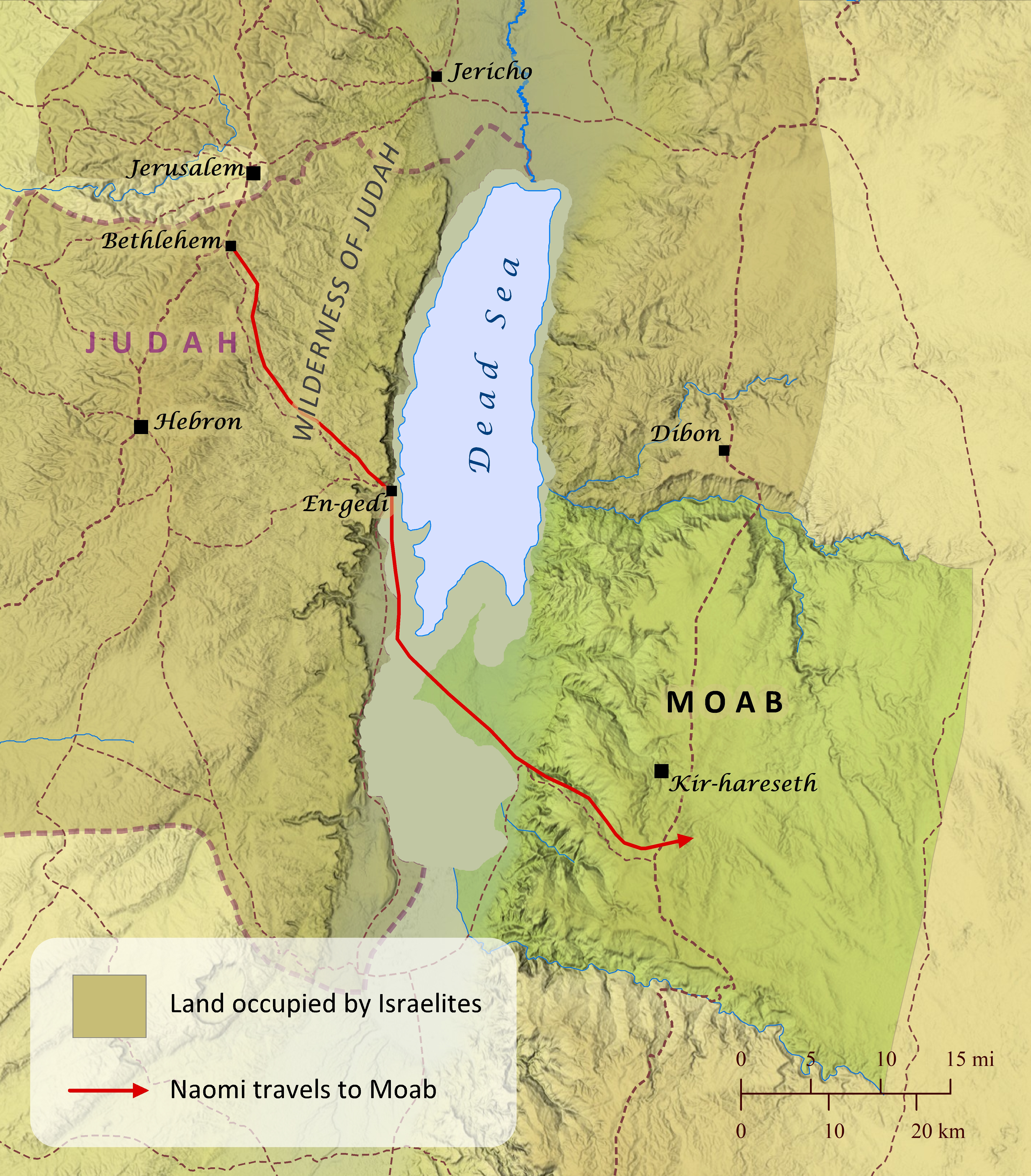
Ruth 1-4
The story of Ruth is set in the time of the Judges, a few generations before the birth of King David. While much animosity often existed between Israel and Moab (Judges 3:12-30; 10:6-12:7; 2 Samuel 8:2; 10; 2 Kings 3:4-27; 2 Chronicles 20; see also Nations across the Jordan River map), other times the two nations appear to have enjoyed a somewhat congenial relationship, as is demonstrated by Naomi’s willingness to relocate to Moab to seek relief from a famine. Later Naomi’s sons also marry Moabite women, and Ruth’s devotion to Naomi and her God no doubt speaks highly of the character of many Moabites. Many years later Ruth’s great-grandson David placed his parents in the care of the king of Moab while he was on the run from King Saul (1 Samuel 22:3-4).