
OET OET-RV OET-LV GHT ULT UST BSB MSB BLB AICNT OEB WEBBE WMBB NET LSV FBV TCNT T4T LEB BBE Moff JPS Wymth ASV DRA YLT Drby RV SLT Wbstr KJB-1769 KJB-1611 Bshps Gnva Cvdl TNT Wycl SR-GNT UHB BrLXX BrTr Related Parallel Simple Interlinear Topics Reference Dictionary Search
ParallelVerse GEN EXO LEV NUM DEU JOB JOS JDG RUTH 1 SAM 2 SAM PSA AMOS HOS 1 KI 2 KI 1 CHR 2 CHR PROV ECC SNG JOEL MIC ISA ZEP HAB JER LAM YNA (JNA) NAH OBA DAN EZE EZRA EST NEH HAG ZEC MAL LAO GES LES ESG DNG 2 PS TOB JDT WIS SIR BAR LJE PAZ SUS BEL MAN 1 MAC 2 MAC 3 MAC 4 MAC YHN (JHN) MARK MAT LUKE ACTs YAC (JAM) GAL 1 TH 2 TH 1 COR 2 COR ROM COL PHM EPH PHP 1 TIM TIT 1 PET 2 PET 2 TIM HEB YUD (JUD) 1 YHN (1 JHN) 2 YHN (2 JHN) 3 YHN (3 JHN) REV
Ruth 1 V1 V2 V3 V4 V5 V6 V7 V8 V9 V10 V11 V12 V13 V14 V15 V16 V17 V18 V19 V20 V22
Note: This view shows ‘verses’ which are not necessarily natural language units and hence sometimes only part of a sentence will be visible—click on any Bible version abbreviation down the left-hand side to see the verse in more of its context. Normally the OET discourages the reading of individual ‘verses’, but this view is only designed as a tool for Bible-translators and others doing comparisons of different translations—the older translations are further down the page (so you can read up from the bottom to trace the English translation history). The OET segments on this page are still early looks into the drafted texts of the Open English Translation of the Bible—please double-check these texts in advance before using in public.
Text critical issues=small word differences Clarity of original=clear Importance to us=normal Speaker(s)=Narrator (All still tentative.)
OET (OET-RV) I went away content with a family, but Yahweh has brought me back with a void. So why call me ‘Naomi’? You see, Yahweh has testified against me—the powerful God has brought misfortune on me.”
OET-LV I full I_went and_empty bring_back_me YHWH to/for_what do_you(pl)_call to_me Nāˊₒmī and_YHWH he_has_testified against_me and_the_almighty he_has_done_harm[fn][fn] to_me.
1:21 OSHB note: We read one or more accents in L differently from BHQ.
1:21 OSHB note: We read one or more accents in L differently than BHS. Often this notation indicates a typographical error in BHS.
UHB אֲנִי֙ מְלֵאָ֣ה הָלַ֔כְתִּי וְרֵיקָ֖ם הֱשִׁיבַ֣נִי יְהוָ֑ה לָ֣מָּה תִקְרֶ֤אנָה לִי֙ נָעֳמִ֔י וַֽיהוָה֙ עָ֣נָה בִ֔י וְשַׁדַּ֖י הֵ֥רַֽע לִֽי׃ ‡
(ʼₐnī məlēʼāh hālaktī vərēyqām hₑshīⱱanī yhwh lāmmāh tiqreʼnāh liy nāˊₒmiy vayhvāh ˊānāh ⱱiy vəshadday hēraˊ liy.)
Key: khaki:verbs.
Note: Automatic aligning of the OET-RV to the LV is done by some temporary software, hence the OET-RV alignments are incomplete (and may occasionally be wrong).
BrLXX Ἐγὼ πλήρης ἐπορεύθην, καὶ κενὴν ἀπέστρεψέ με ὁ Κύριος· καὶ ἱνατί καλεῖτέ με Νωεμὶν, καὶ Κύριος ἐταπείνωσέ με, καὶ ὁ ἱκανὸς ἐκάκωσέ με;
(Egō plaʸraʸs eporeuthaʸn, kai kenaʸn apestrepse me ho Kurios; kai hinati kaleite me Nōemin, kai Kurios etapeinōse me, kai ho hikanos ekakōse me;)
BrTr I went out full, and the Lord has brought me back empty: and why call ye me Noemin, whereas the Lord has humbled me, and the Mighty One has afflicted me?
ULT As for me, I went out full, but Yahweh has brought me back empty. Why would you call me Naomi? But as for Yahweh, he has testified against me, and the Almighty has done evil to me.”
UST When I left, I had everything I could want, but Yahweh has brought me back with nothing. Do not call me Naomi. Yahweh has opposed me. Almighty God has treated me badly.”
BSB & MSB I went away full, but the LORD has brought me back empty. Why call me Naomi? After all, the LORD has testified against me, and the Almighty has afflicted me.”
OEB I had plenty when I left, but the Lord has brought me back empty handed. Why should you call me Naomi, now that the Lord has afflicted me, and the Almighty has brought misfortune on me?’
WEBBE & WMBB I went out full, and the LORD has brought me home again empty. Why do you call me Naomi, since the LORD has testified against me, and the Almighty has afflicted me?”
NET I left here full, but the Lord has caused me to return empty-handed. Why do you call me ‘Naomi,’ seeing that the Lord has opposed me, and the Sovereign One has caused me to suffer?”
LSV I went out full, and YHWH has brought me back empty, why do you call me Naomi, and YHWH has testified against me, and the Almighty has done evil to me?”
FBV I left here full, but the Lord has brought me home empty. Why call me Naomi when the Lord has condemned me, when the Almighty has brought disaster on me?”
T4T When I left here, I felt rich, because I had a family. But Yahweh has brought me back here and now I feel poor, because I have no family. Do not call me Naomi [RHQ]. I feel as though Yahweh has spoken against (OR, afflicted) me. Almighty God has caused me to experience a great tragedy.”
LEB I went away full, but Yahweh brought me back empty-handed! Why call me Naomi ⌊when Yahweh has testified against me⌋[fn] and Shaddai[fn] has brought calamity upon me?”
BBE I went out full, and the Lord has sent me back again with nothing; why do you give me the name Naomi, seeing that the Lord has given witness against me, and the Ruler of all has sent sorrow on me?
Moff No Moff RUT 1:21 book available
JPS I went out full, and the LORD hath brought me back home empty; why call ye me Naomi, seeing the LORD hath testified against me, and the Almighty hath afflicted me?'
ASV I went out full, and Jehovah hath brought me home again empty; why call ye me Naomi, seeing Jehovah hath testified against me, and the Almighty hath afflicted me?
DRA I went out full, and the Lord hath brought me back empty. Why then do you call me Noemi, whom the Lord hath humbled and the Almighty hath afflicted?
YLT I went out full, and empty hath Jehovah brought me back, why do ye call me Naomi, and Jehovah hath testified against me, and the Almighty hath done evil to me?'
Drby I went out full, and Jehovah has brought me home again empty. Why do ye call me Naomi, seeing Jehovah has brought me low, and the Almighty has afflicted me?
RV I went out full, and the LORD hath brought me home again empty: why call ye me Naomi, seeing the LORD hath testified against me, and the Almighty hath afflicted me?
(I went out full, and the LORD hath/has brought me home again empty: why call ye/you_all me Naomi, seeing the LORD hath/has testified against me, and the Almighty hath/has afflicted me?)
SLT I went away full, and Jehovah turned me back empty; wherefore will ye call to me Naomi, and Jehovah humbled me, and the Almighty did evil to me?
Wbstr I went out full, and the LORD hath brought me home again empty: why then call ye me Naomi, seeing the LORD hath testified against me, and the Almighty hath afflicted me?
KJB-1769 I went out full, and the LORD hath brought me home again empty: why then call ye me Naomi, seeing the LORD hath testified against me, and the Almighty hath afflicted me?
(I went out full, and the LORD hath/has brought me home again empty: why then call ye/you_all me Naomi, seeing the LORD hath/has testified against me, and the Almighty hath/has afflicted me?)
KJB-1611 I went out full, and the LORD hath bought me home againe emptie: Why then call ye me Naomi, seeing the LORD hath testified against me, and the Almighty hath afflicted me?
(I went out full, and the LORD hath/has bought me home again empty: Why then call ye/you_all me Naomi, seeing the LORD hath/has testified against me, and the Almighty hath/has afflicted me?)
Bshps I went out full, and the Lorde hath brought me home agayne emptie: Why then call ye me Naomi, seying, the Lord hath humbled me, & the almightie hath brought me vnto aduersite?
(I went out full, and the Lord hath/has brought me home again empty: Why then call ye/you_all me Naomi, saying, the Lord hath/has humbled me, and the almighty hath/has brought me unto adversity?)
Gnva I went out full, and the Lord hath caused me to returne emptie: why call ye me Naomi, seeing the Lord hath humbled me, and the Almightie hath brought me vnto aduersitie?
(I went out full, and the Lord hath/has caused me to return empty: why call ye/you_all me Naomi, seeing the Lord hath/has humbled me, and the Almighty hath/has brought me unto adversity?)
Cvdl I departed full, but the LORDE hath brought me home agayne emptye. Why call ye me then Naemi? wha the LORDE hath broughte me lowe, and the Allmightie hath made me sory?
(I departed full, but the LORD hath/has brought me home again empty. Why call ye/you_all me then Naomi? when the LORD hath/has brought me low, and the Almighty hath/has made me sorry?)
Wycl Y yede out ful, and the Lord ledde me ayen voide; whi therfor clepen ye me Noemy, whom the Lord hath `maad low, and Almyyti God hath turmentid?
(I went out full, and the Lord led me again void; why therefore call ye/you_all me Noemy, whom the Lord hath/has made low, and Almighty God hath/has tormented?)
Luth Voll zog ich aus, aber leer hat mich der HErr wieder heimgebracht. Warum heißet ihr mich denn Naemi, so mich doch der HErr gedemütiget und der Allmächtige betrübet hat?
(Full/whole pulled I out, but empty has me the/of_the LORD again brought_home. Why means you(pl)/their/her me because/than Naemi, so me though/but the/of_the LORD humiliated and the/of_the Almighty saddened has?)
ClVg Egressa sum plena, et vacuam reduxit me Dominus. Cur ergo vocatis me Noëmi, quam Dominus humiliavit, et afflixit Omnipotens?
(Gone_out I_am full, and empty brought_back me Master. Cur therefore called me Naomi, how Master he_humbled, and afflicted Omnipotent/Almighty?)
This section talks about the next main event of the story, which is Naomi’s return to Bethlehem, accompanied by her daughter-in-law, Ruth.
Many scholars agree that verses 1:7–21 describe this event in detail, and that verse 1:22 is the closing verse of this section, which summarizes the event.
However, scholars do not agree about the function of verse 1:6. Some scholars believe that verse 1:6 is a summary introduction. It says that Naomi arose (she and her daughters-in-law) and returned from the region of Moab. Thus, this section begins and ends with a summary description of the main event.NICOT (pages 99–100 ): The common Hebrew idiom qûm plus a verb of motion (šûḇ) also signals the start of the story’s main action: Then she…returned. Structurally, the idiom is a summary-introduction to the following events (vv. 7–21) and forms an inclusio with the chapter’s summary-conclusion (cf. wattāšāḇ, v. 22). Further, it sounds the chapter’s main theme, namely, the return of Naomi.
Some other scholars do not believe that verse 1:6 is a summary introduction. Rather 1:6 describes the first part of the action. It says that she arose (she and her daughters-in-law) and prepared to return from the region of Moab.
The majority of versions follow the second suggestion. However, the first suggestion follows a pattern that is also in some other Hebrew narratives. An event is introduced by a summary statement, and the verses after it describe that event in detail.For example: Genesis 1:1 introduces the creation account of 1:2–31. Genesis 6:7 introduces the flood account of Genesis 6–9. Ruth 1:1–2 introduces the first section in Ruth 1:3–5. See the Note on 1:6b for more information.
Here are some other examples of section headings:
Naomi and Ruth Return to Bethlehem (NIV)
Naomi and Ruth Return (NLT)
Departure from Moab (GW)
I went away full, but the LORD has brought me back empty.
I had much when I left here, but Yahweh has brought me back with nothing.
When I left here, I was rich with a family. But Yahweh has caused me to return poor, with no family.
I went away full, but the LORD has brought me back empty: The words full and empty are a figure of speech. Naomi was full when she left Bethlehem in the sense that she had a husband and two sons. When she returned to Bethlehem, she was empty because they were dead. In some languages, it will not be possible to use the words full and empty in this way.
Here are some other ways to translate this:
When I left, I had all I wanted, but now, the Lord has brought me home with nothing. (NCV)
I left here with everything that I needed. Now the Lord has brought me back here with nothing. (EASY)
Why call me Naomi?
Is there any reason to call me Naomi? No.
Do not call me Naomi any more.
Why call me Naomi?: This is a rhetorical question. It functions as a rebuke. Naomi had already said in 1:20a that the name Naomi did not fit her current bitter situation.
Here are some other ways to translate this:
There is no reason to call me Naomi.
Do not call me Naomi any more.
After all, the LORD has testified against me,
Yahweh has spoken/testified against me.
Yahweh has turned against me.
the LORD has testified against me: There is a textual issue with the Hebrew verb phrase that the BSB translates as testified against me:
The Masoretic Text says Yahweh has testified against me. It means “to testify against,” as in a court case. For example:
the Lord has testified against me (ESV)
the Lord has spoken against me (NCV) (BSB, CEV, ESV, GNT, KJV, NABRE, NASB, NET, NJB, REB)
The Septuagint says Yahweh has afflicted me. For example:
the Lord has dealt harshly with me (NRSV) (GW, NIV, NJPS, NLT, NRSV)
It is recommended that you follow option (1) along with many versions and commentaries.UBS, WBC, NICOT. It is also recommended by HOTTP.
Here are some other ways to translate this verse part:
The Lord Almighty has condemned me (GNT)
The Almighty Lord has turned against me (EASY)
the Lord has opposed me (CSB)
and the Almighty has afflicted me.”
The All-powerful one has caused me to suffer.”
The Almighty God has brought disaster on me.”
the Almighty has afflicted me: The Hebrew word that the BSB translates as afflicted can also be translated as “cause suffering,” “cause evil,” or “cause trouble.”
Here are some other ways to translate this phrase:
has caused me to suffer (NET)
and made my life so hard (CEV)
has given much trouble to me (ERV)
the Almighty: The term the Almighty is the same name for God that Naomi used in 1:20b. You should translate it the same way in both places.
Note 1 topic: figures-of-speech / metaphor
אֲנִי֙ מְלֵאָ֣ה הָלַ֔כְתִּי וְרֵיקָ֖ם הֱשִׁיבַ֣נִי יְהוָ֑ה
I full (Some words not found in UHB: I full went_away and,empty bring back,me YHWH to/for=what call to=me Nāˊₒmī and=YHWH testified against,me and_[the],Almighty brought_calamity to=me )
Here, Naomi is speaking of herself as a container that can be full or empty. If it would be helpful in your language, you could state the meaning plainly. Alternate translation: [As for me, I went out with a complete family, but Yahweh has brought me back with no one]
Note 2 topic: figures-of-speech / rquestion
לָ֣מָּה תִקְרֶ֤אנָה לִי֙ נָעֳמִ֔י
(Some words not found in UHB: I full went_away and,empty bring back,me YHWH to/for=what call to=me Nāˊₒmī and=YHWH testified against,me and_[the],Almighty brought_calamity to=me )
Naomi is using the question form to emphasize that there is no reason to call her Naomi. If you would not use the question form for this purpose in your language, you could translate this as a statement or an exclamation. Alternate translation: [There is no reason to call me Naomi!]
Note 3 topic: figures-of-speech / parallelism
וַֽיהוָה֙ עָ֣נָה בִ֔י וְשַׁדַּ֖י הֵ֥רַֽע לִֽי
and=YHWH testified against,me (Some words not found in UHB: I full went_away and,empty bring back,me YHWH to/for=what call to=me Nāˊₒmī and=YHWH testified against,me and_[the],Almighty brought_calamity to=me )
These two statements say the same thing using different words to emphasize the idea that God has made Naomi’s life very hard. Both Yahweh and the Almighty refer to God. If it would be helpful to your readers, you could combine the statements to show that the second statement is not saying a new thing. Alternate translation: [But as for Yahweh, the Almighty God, he has opposed me and treated me badly.]
Note 4 topic: figures-of-speech / metaphor
עָ֣נָה בִ֔י
testified against,me
Here Naomi is speaking of Yahweh as if he were a witness who caused her to be punished for a crime. If it would be helpful in your language, you could state the meaning plainly. Alternate translation: [he has brought punishment on me]
הֵ֥רַֽע לִֽי
brought_calamity to=me
Alternate translation: [has brought calamity on me] or [has brought tragedy to me]
Ruth 1-4
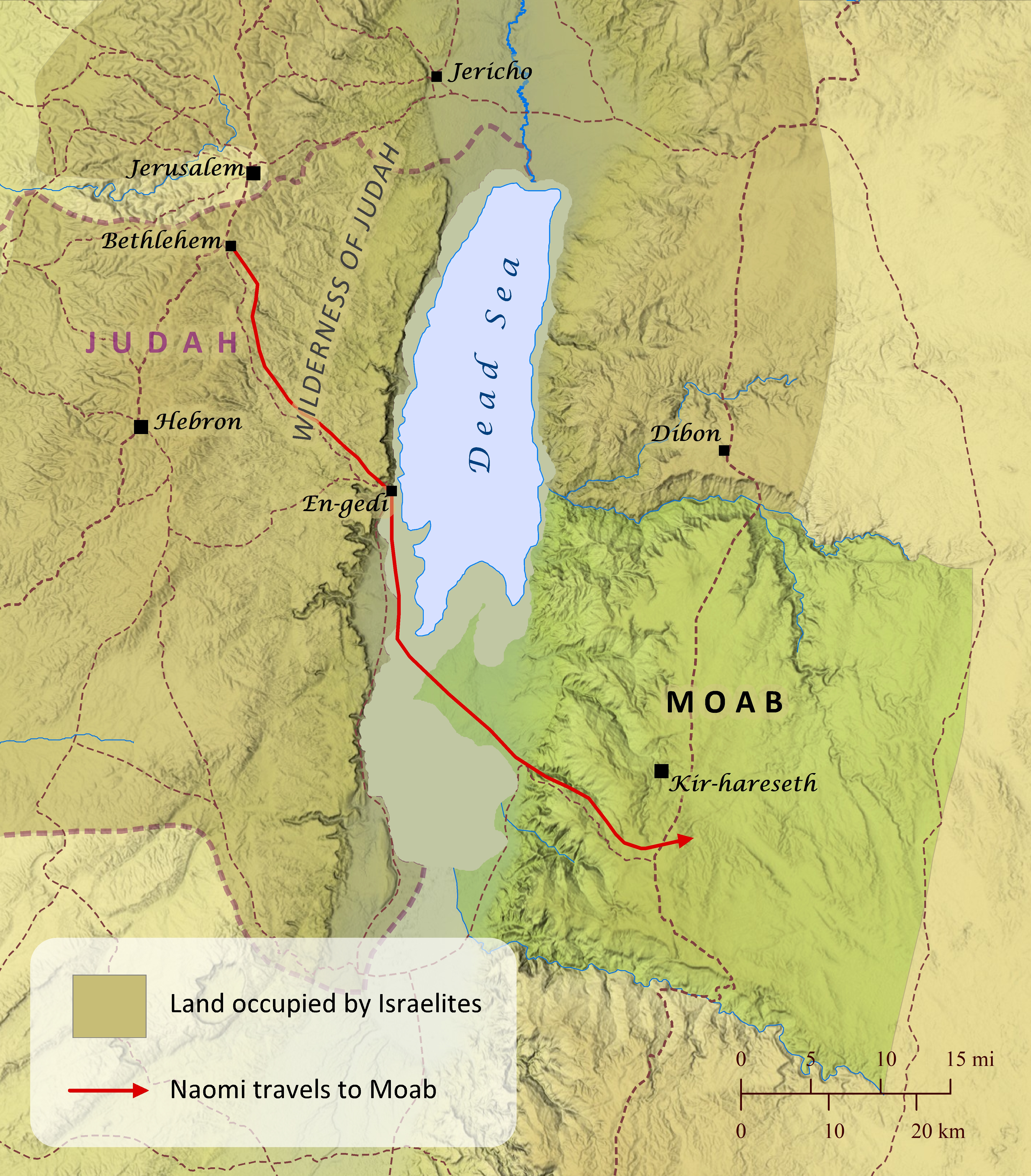
The story of Ruth is set in the time of the Judges, a few generations before the birth of King David. While much animosity often existed between Israel and Moab (Judges 3:12-30; 10:6-12:7; 2 Samuel 8:2; 10; 2 Kings 3:4-27; 2 Chronicles 20; see also Nations across the Jordan River map), other times the two nations appear to have enjoyed a somewhat congenial relationship, as is demonstrated by Naomi’s willingness to relocate to Moab to seek relief from a famine. Later Naomi’s sons also marry Moabite women, and Ruth’s devotion to Naomi and her God no doubt speaks highly of the character of many Moabites. Many years later Ruth’s great-grandson David placed his parents in the care of the king of Moab while he was on the run from King Saul (1 Samuel 22:3-4).
Open Bible Data site copyright © 2023–2026 Freely-Given.org.
Python source code for creating these static pages is available on GitHub under an open licence.
For Bible data copyrights, see the details for each displayed Bible version.
The Open English Translation (OET) main site is at OpenEnglishTranslation.Bible or OET.Bible.