
OET OET-RV OET-LV GHT ULT UST BSB MSB BLB AICNT OEB WEBBE WMBB NET LSV FBV TCNT T4T LEB BBE Moff JPS Wymth ASV DRA YLT Drby RV SLT Wbstr KJB-1769 KJB-1611 Bshps Gnva Cvdl TNT Wycl SR-GNT UHB BrLXX BrTr Related Parallel Simple Interlinear Topics Reference Dictionary Search
ParallelVerse GEN EXO LEV NUM DEU JOB JOS JDG RUTH 1 SAM 2 SAM PSA AMOS HOS 1 KI 2 KI 1 CHR 2 CHR PROV ECC SNG JOEL MIC ISA ZEP HAB JER LAM YNA (JNA) NAH OBA DAN EZE EZRA EST NEH HAG ZEC MAL LAO GES LES ESG DNG 2 PS TOB JDT WIS SIR BAR LJE PAZ SUS BEL MAN 1 MAC 2 MAC 3 MAC 4 MAC YHN (JHN) MARK MAT LUKE ACTs YAC (JAM) GAL 1 TH 2 TH 1 COR 2 COR ROM COL PHM EPH PHP 1 TIM TIT 1 PET 2 PET 2 TIM HEB YUD (JUD) 1 YHN (1 JHN) 2 YHN (2 JHN) 3 YHN (3 JHN) REV
Ruth 1 V1 V2 V3 V4 V5 V6 V8 V9 V10 V11 V12 V13 V14 V15 V16 V17 V18 V19 V20 V21 V22
Note: This view shows ‘verses’ which are not necessarily natural language units and hence sometimes only part of a sentence will be visible—click on any Bible version abbreviation down the left-hand side to see the verse in more of its context. Normally the OET discourages the reading of individual ‘verses’, but this view is only designed as a tool for Bible-translators and others doing comparisons of different translations—the older translations are further down the page (so you can read up from the bottom to trace the English translation history). The OET segments on this page are still early looks into the drafted texts of the Open English Translation of the Bible—please double-check these texts in advance before using in public.
Text critical issues=none Clarity of original=clear Importance to us=normal Speaker(s)=Narrator (All still tentative.)
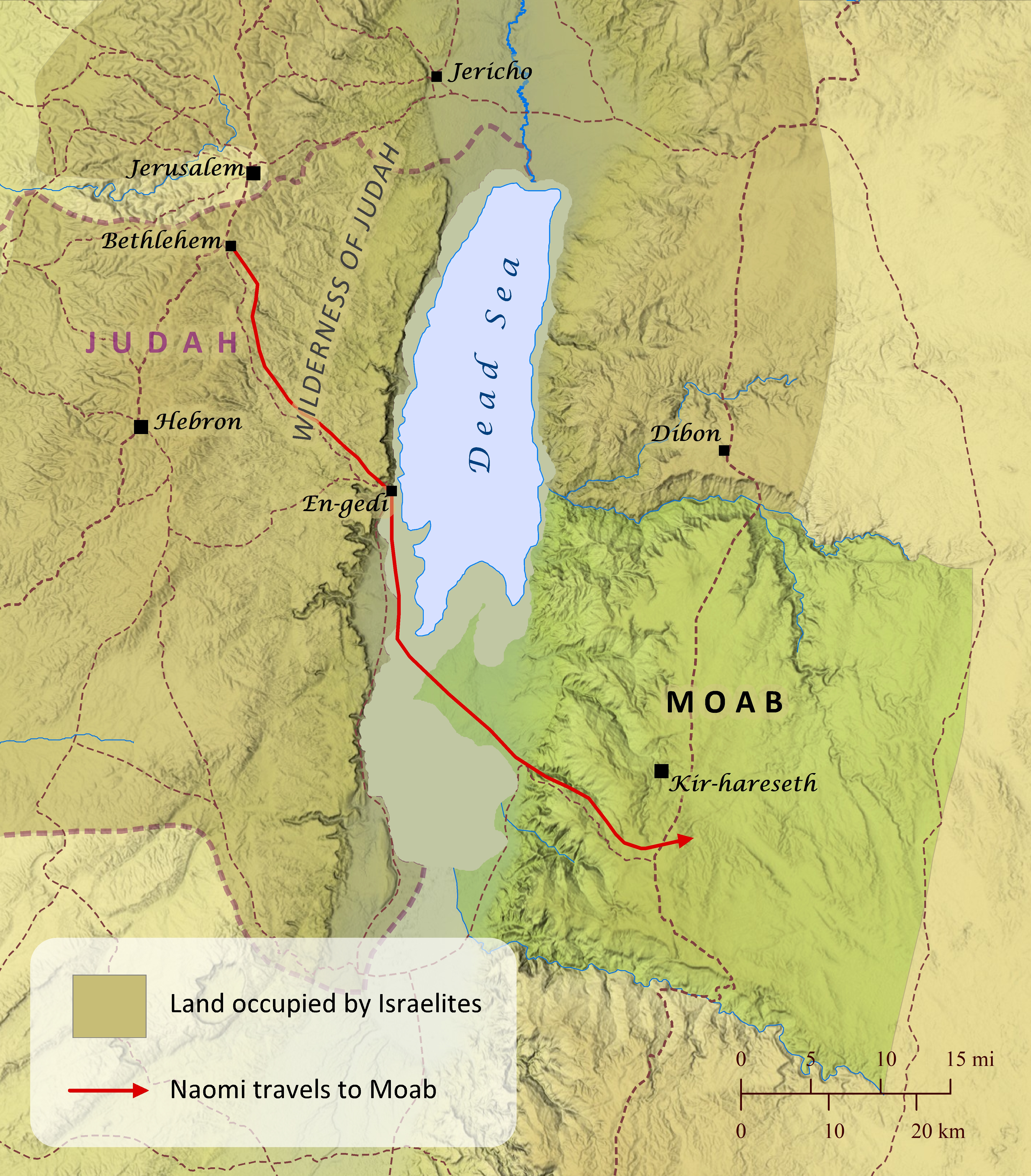
OET (OET-RV) The three of them left the place where they’d been living in Moab and started walking along the road back to Yehudah (Judah).
OET-LV And_she_went_out from the_place where she_had_been there_(to) and_the_two_of daughters-in-law_of_her with_her/it and_they_went on_way to_return to the_land_of Yəhūdāh/(Judah).
UHB וַתֵּצֵ֗א מִן־הַמָּקוֹם֙ אֲשֶׁ֣ר הָיְתָה־שָׁ֔מָּה וּשְׁתֵּ֥י כַלֹּתֶ֖יהָ עִמָּ֑הּ וַתֵּלַ֣כְנָה בַדֶּ֔רֶךְ לָשׁ֖וּב אֶל־אֶ֥רֶץ יְהוּדָֽה׃ ‡
(vattēʦēʼ min-hammāqōm ʼₐsher hāyətāh-shāmmāh ūshəttēy kalloteyhā ˊimmāh vattēlaknāh ⱱadderek lāshūⱱ ʼel-ʼereʦ yəhūdāh.)
Key: khaki:verbs.
Note: Automatic aligning of the OET-RV to the LV is done by some temporary software, hence the OET-RV alignments are incomplete (and may occasionally be wrong).
BrLXX Καὶ ἐξῆλθεν ἐκ τοῦ τόπου οὗ ἦν ἐκεῖ, καὶ αἱ δύο νύμφαι αὐτῆς μετʼ αὐτῆς· καὶ ἐπορεύοντο ἐν τῇ ὁδῷ τοῦ ἐπιστρέψαι εἰς τὴν γῆν Ἰούδα.
(Kai exaʸlthen ek tou topou hou aʸn ekei, kai hai duo numfai autaʸs metʼ autaʸs; kai eporeuonto en taʸ hodōi tou epistrepsai eis taʸn gaʸn Youda.)
BrTr And she went forth out of the place where she was, and her two daughters-in-law with her: and they went by the way to return to the land of Juda.
ULT So she went out from the place where she had been, living there, and her two daughters-in-law, were with her. And they traveled on the road to return to the land of Judah.
UST She and her two daughters-in-law left the place where she had been living and they started to walk along the road back to Judah.
BSB & MSB Accompanied by her two daughters-in-law, she left the place where she had been [living] and set out on the road leading back to the land of Judah.
OEB As they were setting out together on the journey to Judah,
WEBBE & WMBB She went out of the place where she was, and her two daughters-in-law with her. They went on the way to return to the land of Judah.
NET Now as she and her two daughters-in-law began to leave the place where she had been living to return to the land of Judah,
LSV And she goes out from the place where she has been, and her two daughters-in-law with her, and they go in the way to return to the land of Judah.
FBV She left the place where she had been living and with her two daughters-in-law set out on the road back to the land of Judah.
T4T She left the place where she had been living and started to walk with her daughters-in-law along the road back to Judah.
LEB So she set out from the place ⌊where she was⌋[fn] and her two daughters-in-law with her, and they went on the way to return to the land of Judah.
1:7 Literally “which she was there”
BBE And she went out of the place where she was, and her two daughters-in-law with her; and they went on their way to go back to the land of Judah.
Moff No Moff RUT 1:7 book available
JPS And she went forth out of the place where she was, and her two daughters-in-law with her; and they went on the way to return unto the land of Judah.
ASV And she went forth out of the place where she was, and her two daughters-in-law with her; and they went on the way to return unto the land of Judah.
DRA Wherefore she went forth out of the place of her sojournment, with both her daughters in law: and being now in the way to return into the land of Juda,
YLT And she goeth out from the place where she hath been, and her two daughters-in-law with her, and they go in the way to turn back unto the land of Judah.
Drby Wherefore she went forth out of the place where she had been, and her two daughters-in-law with her; and they went on the way to return to the land of Judah.
RV And she went forth out of the place where she was, and her two daughters in law with her; and they went on the way to return unto the land of Judah.
(And she went forth out of the place where she was, and her two daughters in law with her; and they went on the way to return unto the land of Yudah.)
SLT And she will go forth from the place where she was there, and her two daughters-in-law with her; and they will go in the way to turn back to the land of Judah.
Wbstr Wherefore she went forth from the place where she was, and her two daughters-in-law with her; and they went on the way to return to the land of Judah.
KJB-1769 Wherefore she went forth out of the place where she was, and her two daughters in law with her; and they went on the way to return unto the land of Judah.
(Wherefore she went forth out of the place where she was, and her two daughters in law with her; and they went on the way to return unto the land of Yudah.)
KJB-1611 Wherefore she went foorth out of the place where she was, and her two daughters in law with her: and they went on the way to returne vnto the land of Iudah.
(Modernised spelling is same as from KJB-1769 above, apart from punctuation)
Bshps Wherfore she departed out of the place where she was, and her two daughters in lawe with her: And they went on their way to returne vnto the lande of Iuda.
(Wherefore she departed out of the place where she was, and her two daughters in law with her: And they went on their way to return unto the land of Yuda.)
Gnva Wherefore shee departed out of the place where she was, and her two daughters in law with her, and they went on their way to returne vnto the land of Iudah.
(Wherefore she departed out of the place where she was, and her two daughters in law with her, and they went on their way to return unto the land of Yudah.)
Cvdl & so she departed from ye place where she was, & both hir sonnes wyues wt her. And as they wete by the waye to come agayne into the londe of Iuda,
(and so she departed from ye/you_all place where she was, and both her sons wives with her. And as they went by the way to come again into the land of Yuda,)
Wycl Therfor sche yede out of the place of hir pilgrymage with euer either wijf of hir sones; and now sche was set in the weie of turnyng ayen in to the lond of Juda,
(Therefore she went out of the place of her pilgrimage with ever either wife of her sons; and now she was set in the way of turning again in to the land of Yuda,)
Luth Und ging aus von dem Ort, da sie gewesen war, und ihre beiden Schnüre mit ihr. Und da sie ging auf dem Wege, daß sie wiederkäme ins Land Juda,
(And went out_of from to_him place/location, there they/she/them been was, and their/her both cords with you(pl)/their/her. And there they/she/them went on/in/to to_him ways, that they/she/them would_return into_the country Yuda,)
ClVg Egressa est itaque de loco peregrinationis suæ, cum utraque nuru: et jam in via revertendi posita in terram Juda,[fn]
(Gone_out it_is therefore from/about instead of_pilgrimage his/her_own(pl), when/with both daughter-in-law: and already in/into/on way/road to_be_returned placed in/into/on the_earth/land Yuda,)
1.7 Egressa est, etc., utraque. Studiose satagit Ecclesia, ut plebes quas Apostoli et prophetæ tempore suo instruxerunt, perducat ad unitatem fidei et societatem Christianæ religionis: quæ Scriptura referente didicit, quia justus non derelinquetur, nec semen ejus quærens panem, qui de cœlo descendit Psal. 36..
1.7 Gone_out it_is, etc., both. Diligently/eagerly endeavours Assembly/Church, as plebes which Apostles and prophets at_the_time his_own they_instructed, lead(v) to unity of_faith and society Christian religion: which Scripture/Writing reporting learnt, because just not/no will_be_forsaken, but_not seed his/her seeking bread/food, who/which from/about sky came_down Psal. 36..
This section talks about the next main event of the story, which is Naomi’s return to Bethlehem, accompanied by her daughter-in-law, Ruth.
Many scholars agree that verses 1:7–21 describe this event in detail, and that verse 1:22 is the closing verse of this section, which summarizes the event.
However, scholars do not agree about the function of verse 1:6. Some scholars believe that verse 1:6 is a summary introduction. It says that Naomi arose (she and her daughters-in-law) and returned from the region of Moab. Thus, this section begins and ends with a summary description of the main event.NICOT (pages 99–100 ): The common Hebrew idiom qûm plus a verb of motion (šûḇ) also signals the start of the story’s main action: Then she…returned. Structurally, the idiom is a summary-introduction to the following events (vv. 7–21) and forms an inclusio with the chapter’s summary-conclusion (cf. wattāšāḇ, v. 22). Further, it sounds the chapter’s main theme, namely, the return of Naomi.
Some other scholars do not believe that verse 1:6 is a summary introduction. Rather 1:6 describes the first part of the action. It says that she arose (she and her daughters-in-law) and prepared to return from the region of Moab.
The majority of versions follow the second suggestion. However, the first suggestion follows a pattern that is also in some other Hebrew narratives. An event is introduced by a summary statement, and the verses after it describe that event in detail.For example: Genesis 1:1 introduces the creation account of 1:2–31. Genesis 6:7 introduces the flood account of Genesis 6–9. Ruth 1:1–2 introduces the first section in Ruth 1:3–5. See the Note on 1:6b for more information.
Here are some other examples of section headings:
Naomi and Ruth Return to Bethlehem (NIV)
Naomi and Ruth Return (NLT)
Departure from Moab (GW)
Accompanied by her two daughters-in-law, she left the place where she had been living
Naomi left the place where she had been living, and took her two daughters-in-law with her.
So she and her two daughters-in-law left their home,
This is how it happened. She departed from her home in Moab, accompanied by her two daughters-in-law.
Accompanied by her two daughters-in-law, she left the place where she had been living: This clause is more literally “and she went out from the place where she had been there and her two daughters-in-law [were] with her.”
The BSB and some other versions have reordered the clause parts. The Hebrew order first indicates Naomi’s action, and then indicates that her daughters-in-law were with her. In some languages, it may be more natural to follow the Hebrew order. For example:
So she departed from the place where she was, and her two daughters-in-law with her (NASB)
Here are some ways to indicate the connection of this clause to the previous clause. Any of these options is acceptable:
Indicate that this clause talks about the result/consequence of the news that the LORD had come to the aid of his people. For example:
So she set out from the place where she had been living, she and her two daughters-in-law (NRSV)
Indicate that this clause begins to give the details of Naomi’s return home.This kind of connection regards 1:6 to be an introduction to the event, and 1:7–21 to give a detailed description of it. For example:
This is how it happened. She departed from the place where she had been living, accompanied by her two daughters-in-law
Leave implied the connection of this clause to the previous clause. For example:
Accompanied by her two daughters-in-law, she left the place where she had been living (NJPS)
The Hebrew verbs that the BSB translates as left and had been living are singular, with Naomi as the subject. However, in some languages it may be more natural to translate these verbs as plural, since the two daughters-in-law were accompanying Naomi. For example:
They started out together to go back (GNT)
Translate these verbs in a natural way in your language when one person is in focus, but more than one person is doing the same action.
the place where she had been living: This phrase refers to Naomi’s home in Moab.
and set out on the road leading back to the land of Judah.
They started traveling on the road that led back to the land of Judah.
taking the path that would bring them to the land of Judah.
They traveled on the road that led back to Naomi’s home in the land of Judah.
and set out on the road leading back to the land of Judah: This clause is more literally “and they went on the way to return to the land of Judah.” There are two ways to interpret the referent of the Hebrew word “to return” that the BSB translates as leading back:
It refers to the noun “way.” It was the way/road that would return them to the land of Judah. For example:
and they set out on the road back to the land of Judah (NJPS) (BSB, GW, NABRE, NIV, NJB, NJPS, NLT, REB)
It refers to the verb “went.” The reason they went was to return to the land of Judah. For example:
began to leave the place where she had been living to return to the land of Judah (NET) (GNT, NET)
Some versions are ambiguous as to the interpretation that they follow. It is recommended that you follow interpretation (1) along with the majority of versions.
In this verse part, the Hebrew word “to return” may cause confusion if translated literally. All three women were traveling together. However, only Naomi would actually “return” to Judah, since Orpah and Ruth had not been there before.
In some languages, it may be more natural to translate this verse part differently. For example:
Use a phrase other than leading back or “return.” For example:
they went on the road that led to Judah
Translate in a way that the phrase leading back or “return” refers only to Naomi. For example:
They traveled on the road that led back to Naomi’s home in the land of Judah.
וַתֵּלַ֣כְנָה בַדֶּ֔רֶךְ
(Some words not found in UHB: and,she_went_out from/more_than the,place which/who she/it_was there,(to) and,the_two_of daughters-in-law_of,her with=her/it and,they_went on,way to,return to/towards earth/land Yehuda )
Alternate translation: [And they walked along the road]
Ruth 1-4
The story of Ruth is set in the time of the Judges, a few generations before the birth of King David. While much animosity often existed between Israel and Moab (Judges 3:12-30; 10:6-12:7; 2 Samuel 8:2; 10; 2 Kings 3:4-27; 2 Chronicles 20; see also Nations across the Jordan River map), other times the two nations appear to have enjoyed a somewhat congenial relationship, as is demonstrated by Naomi’s willingness to relocate to Moab to seek relief from a famine. Later Naomi’s sons also marry Moabite women, and Ruth’s devotion to Naomi and her God no doubt speaks highly of the character of many Moabites. Many years later Ruth’s great-grandson David placed his parents in the care of the king of Moab while he was on the run from King Saul (1 Samuel 22:3-4).
Open Bible Data site copyright © 2023–2026 Freely-Given.org.
Python source code for creating these static pages is available on GitHub under an open licence.
For Bible data copyrights, see the details for each displayed Bible version.
The Open English Translation (OET) main site is at OpenEnglishTranslation.Bible or OET.Bible.