
OET OET-RV OET-LV GHT ULT UST BSB MSB BLB AICNT OEB WEBBE WMBB NET LSV FBV TCNT T4T LEB BBE Moff JPS Wymth ASV DRA YLT Drby RV SLT Wbstr KJB-1769 KJB-1611 Bshps Gnva Cvdl TNT Wycl SR-GNT UHB BrLXX BrTr Related Parallel Simple Interlinear Topics Reference Dictionary Search
ParallelVerse GEN EXO LEV NUM DEU JOB JOS JDG RUTH 1 SAM 2 SAM PSA AMOS HOS 1 KI 2 KI 1 CHR 2 CHR PROV ECC SNG JOEL MIC ISA ZEP HAB JER LAM YNA (JNA) NAH OBA DAN EZE EZRA EST NEH HAG ZEC MAL LAO GES LES ESG DNG 2 PS TOB JDT WIS SIR BAR LJE PAZ SUS BEL MAN 1 MAC 2 MAC 3 MAC 4 MAC YHN (JHN) MARK MAT LUKE ACTs YAC (JAM) GAL 1 TH 2 TH 1 COR 2 COR ROM COL PHM EPH PHP 1 TIM TIT 1 PET 2 PET 2 TIM HEB YUD (JUD) 1 YHN (1 JHN) 2 YHN (2 JHN) 3 YHN (3 JHN) REV
Ruth 1 V1 V2 V3 V4 V5 V6 V7 V8 V9 V10 V11 V12 V13 V14 V15 V17 V18 V19 V20 V21 V22
Note: This view shows ‘verses’ which are not necessarily natural language units and hence sometimes only part of a sentence will be visible—click on any Bible version abbreviation down the left-hand side to see the verse in more of its context. Normally the OET discourages the reading of individual ‘verses’, but this view is only designed as a tool for Bible-translators and others doing comparisons of different translations—the older translations are further down the page (so you can read up from the bottom to trace the English translation history). The OET segments on this page are still early looks into the drafted texts of the Open English Translation of the Bible—please double-check these texts in advance before using in public.
Text critical issues=none Clarity of original=clear Importance to us=normal Speaker(s)=Narrator,Ruth (All still tentative.)
OET (OET-RV) But Ruth replied, “Please don’t insist that I leave you and go back, because wherever you go, I’ll go with you and wherever you live, I’ll live there too. Your people are my people, and your god is my god.
OET-LV And_ Rūt _she/it_said do_not entreat (on)_me to_abandon_you to_turn_back from_after_you if/because to where you_will_go I_will_go and_at_where you_will_lodge I_will_lodge people_of_your people_of_my and_god_of_your god_of_my.
UHB וַתֹּ֤אמֶר רוּת֙ אַל־תִּפְגְּעִי־בִ֔י לְעָזְבֵ֖ךְ לָשׁ֣וּב מֵאַחֲרָ֑יִךְ כִּ֠י אֶל־אֲשֶׁ֨ר תֵּלְכִ֜י אֵלֵ֗ךְ וּבַאֲשֶׁ֤ר תָּלִ֨ינִי֙ אָלִ֔ין עַמֵּ֣ךְ עַמִּ֔י וֵאלֹהַ֖יִךְ אֱלֹהָֽי׃ ‡
(vattoʼmer rūt ʼal-tifgəˊī-ⱱiy ləˊāzəⱱēk lāshūⱱ mēʼaḩₐrāyik kiy ʼel-ʼₐsher tēləkiy ʼēlēk ūⱱaʼₐsher tālinī ʼālin ˊammēk ˊammiy vēʼlohayik ʼₑlohāy.)
Key: khaki:verbs.
Note: Automatic aligning of the OET-RV to the LV is done by some temporary software, hence the OET-RV alignments are incomplete (and may occasionally be wrong).
BrLXX Εἶπε δὴ Ῥοῦθ, μὴ ἀπάντησαί μοι τοῦ καταλιπεῖν σε, ἢ ἀποστρέψαι ὄπισθέν σου, ὅτι σὺ ὅπου ἐὰν πορευθῇς, πορεύσομαι, καὶ οὗ ἐὰν αὐλισθῇς, αὐλισθήσομαι· ὁ λαός σου, λαός μου, καὶ ὁ Θεός σου, Θεός μου·
(Eipe daʸ Ɽouth, maʸ apantaʸsai moi tou katalipein se, aʸ apostrepsai opisthen sou, hoti su hopou ean poreuthaʸs, poreusomai, kai hou ean aulisthaʸs, aulisthaʸsomai; ho laos sou, laos mou, kai ho Theos sou, Theos mou;)
BrTr And Ruth said, Intreat me not to leave thee, or to return from following thee; for whithersoever thou goest, I will go, and wheresoever thou lodgest, I will lodge; thy people shall be my people, and thy God my God.
ULT But Ruth said, “Do not press me to forsake you, to turn back from behind you. For to where you go, I will go, and in where you stay, I will stay. Your people, are my people, and your God, is my God.
UST But Ruth replied, “No! Please do not insist that I abandon you and stop taking care of you! Wherever you travel, I will travel too. Wherever you live, I will live too. Your relatives will be my relatives, and I will worship the God whom you worship.
BSB & MSB But Ruth replied:
⇔ “Do not urge me to leave you
⇔ [or] to turn from following you.
⇔ For wherever you go, I will go,
⇔ and wherever you live, I will live;
⇔ your people will be my people,
⇔ and your God will be my God.
OEB But Ruth answered, ‘Do not urge me to leave you or to go back. I will go where you go, and I will stay wherever you stay. Your people will be my people, and your God my God;
CSB But Ruth replied: Don’t plead with me to abandon you or to return and not follow you. For wherever you go, I will go, and wherever you live, I will live; your people will be my people, and your God will be my God.
NLT But Ruth replied, “Don’t ask me to leave you and turn back. Wherever you go, I will go; wherever you live, I will live. Your people will be my people, and your God will be my God.
NIV But Ruth replied, “Don’t urge me to leave you or to turn back from you. Where you go I will go, and where you stay I will stay. Your people will be my people and your God my God.
CEV Ruth answered, "Please don't tell me to leave you and return home! I will go where you go, I will live where you live; your people will be my people, your God will be my God.
ESV But Ruth said, “Do not urge me to leave you or to return from following you. For where you go I will go, and where you lodge I will lodge. Your people shall be my people, and your God my God.
NASB But Ruth said, “Do not urge me to leave you or turn back from following you; for where you go, I will go, and where you lodge, I will lodge. Your people shall be my people, and your God, my God.
LSB But Ruth said, “Do not press me to forsake you in turning back from following you; for where you go, I will go, and where you lodge, I will lodge. Your people shall be my people, and your God, my God.
WEBBE & WMBB Ruth said, “Don’t urge me to leave you, and to return from following you, for where you go, I will go; and where you stay, I will stay. Your people will be my people, and your God[fn] my God.
1:16 The Hebrew word rendered “God” is “אֱלֹהִ֑ים” (Elohim).
MSG (16-17)But Ruth said, “Don’t force me to leave you; don’t make me go home. Where you go, I go; and where you live, I’ll live. Your people are my people, your God is my god; where you die, I’ll die, and that’s where I’ll be buried, so help me God—not even death itself is going to come between us!”
NET But Ruth replied,
⇔ “Stop urging me to abandon you!
⇔ For wherever you go, I will go.
⇔ Wherever you live, I will live.
⇔ Your people will become my people,
⇔ and your God will become my God.
LSV And Ruth says, “Do not urge me to leave you—to turn back from after you; for to where you go I go, and where you lodge I lodge; your people [is] my people, and your God my God.
FBV But Ruth replied, “Please don't keep on telling me to leave you and go back. Where you go, I will go. Where you live, I will live. Your people will be my people. Your God will be my God.
T4T But Ruth replied, “No! Don’t urge me to leave you! I want to go with you. Where you go, I will go. Where you stay, I will stay. Your relatives will be my relatives, and the God you worship will be the God I worship.
LEB But Ruth said, “⌊Do not urge⌋[fn] me to leave you or to return from ⌊following you⌋![fn] For where you go, I will go, and where you lodge, I will lodge. Your people will be my people and your God will be my God.
NRSV But Ruth said, “Do not press me to leave you or to turn back from following you! Where you go, I will go; where you lodge, I will lodge; your people shall be my people, and your God my God.
NKJV But Ruth said: “Entreat me not to leave you, Or to turn back from following after you; For wherever you go, I will go; And wherever you lodge, I will lodge; Your people shall be my people, And your God, my God.
NAB But Ruth said, “Do not press me to go back and abandon you! Wherever you go I will go, wherever you lodge I will lodge. Your people shall be my people and your God, my God.
BBE But Ruth said, Give up requesting me to go away from you, or to go back without you: for where you go I will go; and where you take your rest I will take my rest; your people will be my people, and your God my God.
Moff No Moff RUT 1:16 book available
JPS And Ruth said: 'Entreat me not to leave thee, and to return from following after thee; for whither thou goest, I will go; and where thou lodgest, I will lodge; thy people shall be my people, and thy God my God;
ASV And Ruth said, Entreat me not to leave thee, and to return from following after thee, for whither thou goest, I will go; and where thou lodgest, I will lodge; thy people shall be my people, and thy God my God;
DRA She answered: Be not against me, to desire that I should leave thee and depart: for whithersoever thou shalt go, I will go: and where thou shalt dwell, I also will dwell. Thy people shall be my people, and thy God my God.
YLT And Ruth saith, 'Urge me not to leave thee — to turn back from after thee; for whither thou goest I go, and where thou lodgest I lodge; thy people [is] my people, and thy God my God.
Drby And Ruth said, Do not intreat me to leave thee, to return from [following] after thee; for whither thou goest I will go, and where thou lodgest I will lodge: thy people shall be my people, and thy [fn]God my [fn]God;
RV And Ruth said, Entreat me not to leave thee, and to return from following after thee: for whither thou goest, I will go; and where thou lodgest, I will lodge: thy people shall be my people, and thy God my God:
(And Ruth said, Entreat me not to leave thee/you, and to return from following after thee/you: for whither/where thou/you goest/go, I will go; and where thou/you lodgest, I will lodge: thy/your people shall be my people, and thy/your God my God:)
SLT And Ruth will say, Thou shalt not urge upon me to forsake thee, to turn back from after thee: for where thou shalt go, I will go; and where thou shalt lodge, I will lodge: thy people my people, and thy God my God:
Wbstr And Ruth said, Entreat me not to leave thee, or to return from following thee: for whither thou goest, I will go; and where thou lodgest, I will lodge: thy people shall be my people, and thy God my God:
KJB-1769 And Ruth said, Intreat me not to leave thee, or to return from following after thee: for whither thou goest, I will go; and where thou lodgest, I will lodge: thy people shall be my people, and thy God my God:[fn]
(And Ruth said, Entreat me not to leave thee/you, or to return from following after thee/you: for whither/where thou/you goest/go, I will go; and where thou/you lodgest, I will lodge: thy/your people shall be my people, and thy/your God my God:)
1.16 Intreat…: or, Be not against me
KJB-1611 And Ruth said, [fn]Intreate mee not to leaue thee, or to returne from following after thee: for whither thou goest, I will goe; and where thou lodgest, I will lodge: thy people shall be my people, and thy God my God:
(Modernised spelling is same as from KJB-1769 above apart from footnotes)
1:16 Or, be not against me.
Bshps And Ruth aunswered: Entreat me not to leaue thee, and to returne from after thee: for whyther thou goest, I will go also, & where thou dwellest, there I wil dwell: Thy people shalbe my people, and thy god my god:
(And Ruth answered: Entreat me not to leave thee/you, and to return from after thee/you: for whither/where thou/you goest/go, I will go also, and where thou/you dwellest/dwell, there I will dwell: Thy/Your people shall be my people, and thy/your god my god:)
Gnva And Ruth answered, Intreate mee not to leaue thee, nor to depart from thee: for whither thou goest, I will goe: and where thou dwellest, I will dwell: thy people shall be my people, and thy God my God.
(And Ruth answered, Entreat me not to leave thee/you, nor to depart from thee/you: for whither/where thou/you goest/go, I will go: and where thou/you dwellest/dwell, I will dwell: thy/your people shall be my people, and thy/your God my God.)
Cvdl Ruth answered: Speake not to me therof, that I shulde forsake the, and turne backe from the: whithersoeuer thou goest, thither wil I go also: and loke where thou abydest, there wil I abide also: Thy people is my people, & thy God is my God.
(Ruth answered: Speak not to me thereof, that I should forsake them, and turn back from them: whithersoever/wherever thou/you goest/go, thither/there will I go also: and look where thou/you abidest/abide, there will I abide also: Thy/Your people is my people, and thy/your God is my God.)
Wycl And sche answeride, Be thou not `aduersarye to me, that Y forsake thee, and go awei; whidur euer thou schalt go, Y schal go, and where thou schalt dwelle, and Y schal dwelle togidere; thi puple is my puple, and thi God is my God;
(And she answered, Be thou/you not adversary to me, that I forsake thee/you, and go away; whither/where ever thou/you shalt/shall go, I shall go, and where thou/you shalt/shall dwell, and I shall dwell together; thy/your people is my people, and thy/your God is my God;)
Luth Ruth antwortete: Rede mir nicht darein, daß ich dich verlassen sollte und von dir umkehren. Wo du hingehest, da will ich auch hingehen; wo du bleibest, da bleibe ich auch. Dein Volk ist mein Volk und dein GOtt ist mein GOtt.
(Ruth replied: speech to_me not in_it/in_there, that I you/yourself leave should and from you/to_you(sg) reverse/inverse. Where you(sg) go_there, there will I also go_there; where you(sg) stay/remain, there would_remain I also. Your people is my people and your(s) God is my God.)
ClVg Quæ respondit: Ne adverseris mihi ut relinquam te et abeam: quocumque enim perrexeris, pergam, et ubi morata fueris, et ego pariter morabor. Populus tuus populus meus, et Deus tuus Deus meus.[fn]
(Which answered: Don’t you_may_be_against to_me as I_will_leave you(sg) and abeam: wherever because you_may_have_gone, I_will_go, and where staid you_were, and I as_well I_will_stay. People your(sg) the_people mine, and God your(sg) God mine.)
1.16 Quocunque. Sic Ecclesia de gentibus vocata, relicta patria, id est idololatria omissa, carnali conversatione et desideriis, profitetur Deum suum esse in quem crediderunt sancti, et ituram quo caro Christi ascendit, et pro ejus nomine in hoc sæculo pati usque ad mortem, et cum populo sanctorum et prophetarum et patriarcharum; unde: Lætamini gentes cum plebe ejus Rom. 15..
1.16 Wherever. So Assembly/Church from/about nations called, abandoned fatherland, that it_is idolatry omitted, carnal conversation and desires, declares God his_own to_be in/into/on which they_believed holy, and about_to_go where flesh/meat of_Christ went_up, and for his/her by_name in/into/on this forever to_suffer until to death, and when/with to_the_people holy_place and of_the_prophets and patriarchs; from_where/who: You(pl)_rejoice people/nations when/with plebe his/her Rom. 15..
This section talks about the next main event of the story, which is Naomi’s return to Bethlehem, accompanied by her daughter-in-law, Ruth.
Many scholars agree that verses 1:7–21 describe this event in detail, and that verse 1:22 is the closing verse of this section, which summarizes the event.
However, scholars do not agree about the function of verse 1:6. Some scholars believe that verse 1:6 is a summary introduction. It says that Naomi arose (she and her daughters-in-law) and returned from the region of Moab. Thus, this section begins and ends with a summary description of the main event.NICOT (pages 99–100 ): The common Hebrew idiom qûm plus a verb of motion (šûḇ) also signals the start of the story’s main action: Then she…returned. Structurally, the idiom is a summary-introduction to the following events (vv. 7–21) and forms an inclusio with the chapter’s summary-conclusion (cf. wattāšāḇ, v. 22). Further, it sounds the chapter’s main theme, namely, the return of Naomi.
Some other scholars do not believe that verse 1:6 is a summary introduction. Rather 1:6 describes the first part of the action. It says that she arose (she and her daughters-in-law) and prepared to return from the region of Moab.
The majority of versions follow the second suggestion. However, the first suggestion follows a pattern that is also in some other Hebrew narratives. An event is introduced by a summary statement, and the verses after it describe that event in detail.For example: Genesis 1:1 introduces the creation account of 1:2–31. Genesis 6:7 introduces the flood account of Genesis 6–9. Ruth 1:1–2 introduces the first section in Ruth 1:3–5. See the Note on 1:6b for more information.
Here are some other examples of section headings:
Naomi and Ruth Return to Bethlehem (NIV)
Naomi and Ruth Return (NLT)
Departure from Moab (GW)
Ruth’s answer in verses 16–17 is in the form of parallel lines. Poetry in Hebrew consists of parallel lines. In these verses, the same meaning is stated twice in a similar way. It is recommended that you keep the form of the lines parallel if it is possible.
But Ruth replied: “Do not urge me to leave you or to turn from following you.
¶ But Ruth said, “Do not beg me to separate from you or to turn back from accompanying you.
¶ But Ruth answered, “Please stop asking me to leave you. Stop asking me to turn away from you and go back to my family.
But Ruth replied: The Hebrew conjunction that the BSB translates as But introduces a contrast between what Naomi said and Ruth’s reply.
Do not urge me to leave you: The Hebrew word that the BSB translates as urge means “to request something strongly.” Naomi had been asking Ruth to go home for quite some time.
Here are some other ways to translate this:
Don’t plead with me to abandon you (CSB)
Do not keep begging me to leave you.
or to turn from following you: The clause turn from following you indicates leaving Naomi and returning to Moab. Here is another way to translate this clause:
Don’t tell me to go back to Moab.
The clause turn from following you means the same as the clause “Don’t urge me to leave you.” Ruth said the same thing in two different ways for emphasis.
Here are some other ways to translate these two clauses:
Don’t force me to leave you. Don’t make me turn back from following you. (GW)
Don’t ask me to leave you! Let me go with you! (GNT)
Stop urging me to abandon you! (NET)
For wherever you go, I will go, and wherever you live, I will live;
Wherever you(sing) go, I will go, and wherever you settle, I will settle.
If you go somewhere, I will go there too. If you live somewhere, I will live there too.
For wherever you go, I will go, and wherever you live, I will live: The Hebrew conjunction that the BSB translates as For can also be translated as “because.” Ruth made it clear that she intended to go anywhere that Naomi went.
Here is another way to translate this Hebrew conjunction:
For where you go I will go (ESV)
Here are some other ways to translate this verse part:
Where you go I will go and where you stay I will stay; (NIV)
Wherever you go, I will go. Wherever you sleep, I will sleep. (ERV)
your people will be my people, and your God will be my God.
Your people will become my people, and your God will become my God.
I will belong to your clan, and I will worship the God that you worship.
your people will be my people, and your God will be my God: The Hebrew word that the BSB translates as people was used in verses 10 and 15. This Hebrew word could mean “her family,” “her clan,” or “her nation.” You should translate this word the same way in all three places.
Here are some other ways to translate this verse part:
Your relatives will be my relatives, and the God you worship will be the God I worship (T4T)
Your clan will be my clan. I will obey the same God that you obey.
וּבַאֲשֶׁ֤ר תָּלִ֨ינִי֙
(Some words not found in UHB: and=she/it_said Rūt not urge (on),me to,abandon,you to,turn_back from,after,you that/for/because/then/when to/towards which/who go go and,at,where lodge lodge people_of,your people_of,my and,God_of,your God_of,my )
Alternate translation: [and where you live]
Note 1 topic: figures-of-speech / doublet
לְעָזְבֵ֖ךְ לָשׁ֣וּב מֵאַחֲרָ֑יִךְ
to,abandon,you to,turn_back from,after,you
The phrase turn back from behind you further defines the phrase forsake you. Ruth is using the two phrases together for emphasis. If it would be clearer for your readers, you could use a single phrase and express the emphasis in another way. Alternate translation: [to forget my commitment to remain loyal to you]
Note 2 topic: figures-of-speech / ellipsis
עַמֵּ֣ךְ עַמִּ֔י וֵאלֹהַ֖יִךְ אֱלֹהָֽי
(Some words not found in UHB: and=she/it_said Rūt not urge (on),me to,abandon,you to,turn_back from,after,you that/for/because/then/when to/towards which/who go go and,at,where lodge lodge people_of,your people_of,my and,God_of,your God_of,my )
With these phrases, Ruth completely identifies herself with the culture and religion of Naomi, an Israelite. The original does not have any verbs, so if your language requires verbs here, choose the ones that best communicate this. Alternate translation: [Your people will be my people, and your God will be my God]
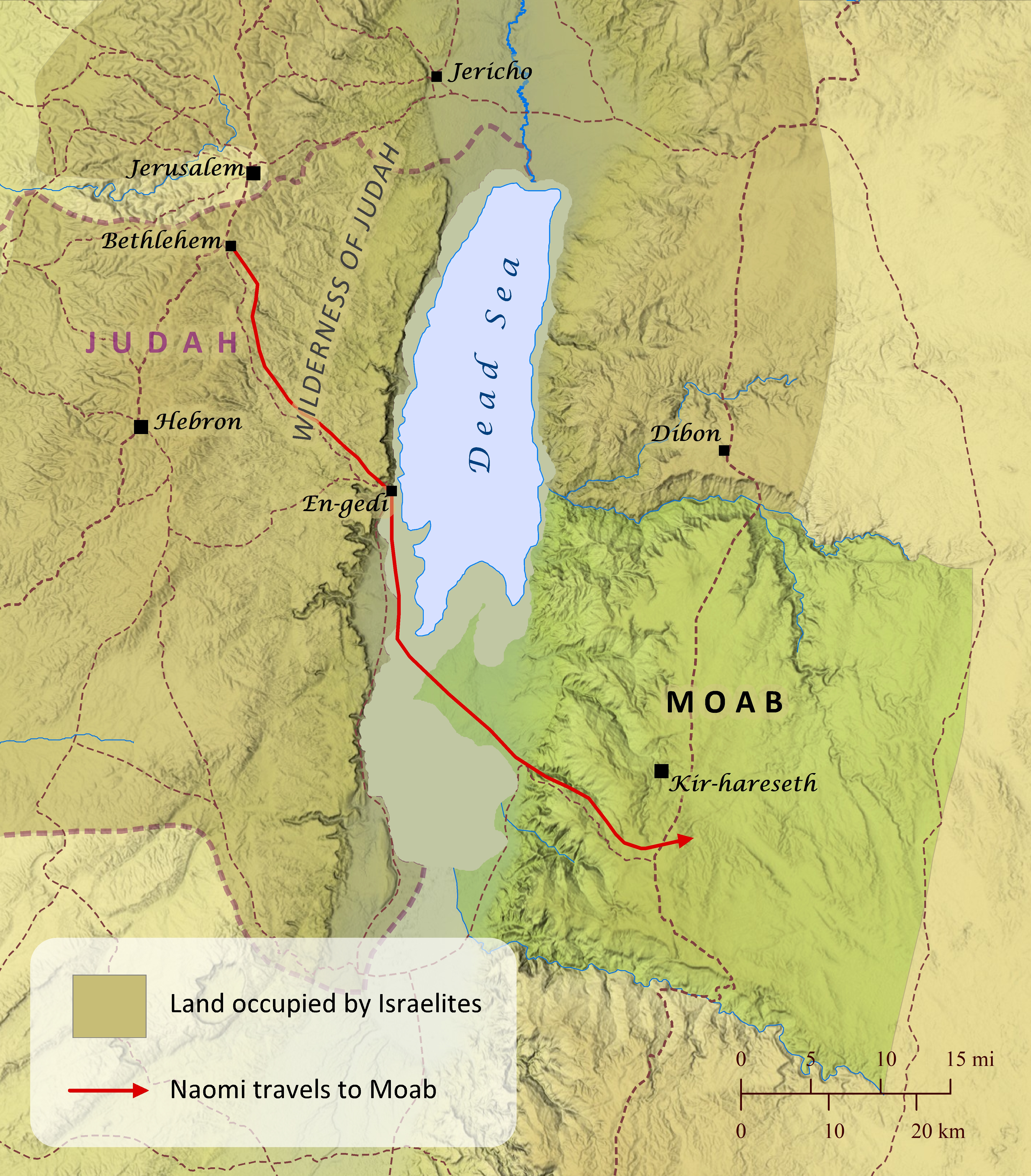
Ruth 1-4
The story of Ruth is set in the time of the Judges, a few generations before the birth of King David. While much animosity often existed between Israel and Moab (Judges 3:12-30; 10:6-12:7; 2 Samuel 8:2; 10; 2 Kings 3:4-27; 2 Chronicles 20; see also Nations across the Jordan River map), other times the two nations appear to have enjoyed a somewhat congenial relationship, as is demonstrated by Naomi’s willingness to relocate to Moab to seek relief from a famine. Later Naomi’s sons also marry Moabite women, and Ruth’s devotion to Naomi and her God no doubt speaks highly of the character of many Moabites. Many years later Ruth’s great-grandson David placed his parents in the care of the king of Moab while he was on the run from King Saul (1 Samuel 22:3-4).
Open Bible Data site copyright © 2023–2026 Freely-Given.org.
Python source code for creating these static pages is available on GitHub under an open licence.
For Bible data copyrights, see the details for each displayed Bible version.
The Open English Translation (OET) main site is at OpenEnglishTranslation.Bible or OET.Bible.