¶ Then she kissed them as they all wept aloud.

OET OET-RV OET-LV GHT ULT UST BSB MSB BLB AICNT OEB WEBBE WMBB NET LSV FBV TCNT T4T LEB BBE Moff JPS Wymth ASV DRA YLT Drby RV SLT Wbstr KJB-1769 KJB-1611 Bshps Gnva Cvdl TNT Wycl SR-GNT UHB BrLXX BrTr Related Parallel Simple Interlinear Topics Reference Dictionary Search
ParallelVerse GEN EXO LEV NUM DEU JOB JOS JDG RUTH 1 SAM 2 SAM PSA AMOS HOS 1 KI 2 KI 1 CHR 2 CHR PROV ECC SNG JOEL MIC ISA ZEP HAB JER LAM YNA (JNA) NAH OBA DAN EZE EZRA EST NEH HAG ZEC MAL LAO GES LES ESG DNG 2 PS TOB JDT WIS SIR BAR LJE PAZ SUS BEL MAN 1 MAC 2 MAC 3 MAC 4 MAC YHN (JHN) MARK MAT LUKE ACTs YAC (JAM) GAL 1 TH 2 TH 1 COR 2 COR ROM COL PHM EPH PHP 1 TIM TIT 1 PET 2 PET 2 TIM HEB YUD (JUD) 1 YHN (1 JHN) 2 YHN (2 JHN) 3 YHN (3 JHN) REV
Ruth 1 V1 V2 V3 V4 V5 V6 V7 V8 V10 V11 V12 V13 V14 V15 V16 V17 V18 V19 V20 V21 V22
Note: This view shows ‘verses’ which are not necessarily natural language units and hence sometimes only part of a sentence will be visible—click on any Bible version abbreviation down the left-hand side to see the verse in more of its context. Normally the OET discourages the reading of individual ‘verses’, but this view is only designed as a tool for Bible-translators and others doing comparisons of different translations—the older translations are further down the page (so you can read up from the bottom to trace the English translation history). The OET segments on this page are still early looks into the drafted texts of the Open English Translation of the Bible—please double-check these texts in advance before using in public.
Text critical issues=none Clarity of original=clear Importance to us=normal Speaker(s)=Narrator (All still tentative.)
OET (OET-RV) May Yahweh enable both of you to find new husbands and find peace and happiness in your new homes with them.”
¶ Then she kissed them as they all wept aloud.
OET-LV YHWH may_he_give to/for_you(pl) and_find rest each_woman the_house_of her/its_husband/man and_she_kissed (to)_them and_they_raised voice_of_their and_they_wept.
UHB יִתֵּ֤ן יְהוָה֙ לָכֶ֔ם וּמְצֶ֣אןָ מְנוּחָ֔ה אִשָּׁ֖ה בֵּ֣ית אִישָׁ֑הּ וַתִּשַּׁ֣ק לָהֶ֔ן וַתִּשֶּׂ֥אנָה קוֹלָ֖ן וַתִּבְכֶּֽינָה׃ ‡
(yittēn yhwh lākem ūməʦeʼnā mənūḩāh ʼishshāh bēyt ʼīshāh vattishshaq lāhen vattisseʼnāh qōlān vattiⱱkeynāh.)
Key: khaki:verbs.
Note: Automatic aligning of the OET-RV to the LV is done by some temporary software, hence the OET-RV alignments are incomplete (and may occasionally be wrong).
BrLXX Δῴη Κύριος ὑμῖν καὶ εὕρητε ἀνάπαυσιν ἑκάστη ἐν οἴκῳ ἀνδρὸς αὐτῆς· καὶ κατεφίλησεν αὐτάς· καὶ ἐπῇραν τὴν φωνὴν αὐτῶν, καὶ ἔλαυσαν.
(Dōaʸ Kurios humin kai heuraʸte anapausin hekastaʸ en oikōi andros autaʸs; kai katefilaʸsen autas; kai epaʸran taʸn fōnaʸn autōn, kai elausan.)
BrTr The Lord grant you that ye may find rest each of you in the house of her husband: and she kissed them; and they lifted up their voice, and wept.
ULT May Yahweh grant to you that you shall find rest, each woman in the house of her husband.” Then she kissed them, and they lifted up their voices and cried.
UST I am asking Yahweh to allow each of you to have another husband with whom you will have a secure home.” Then she kissed each of them, and they cried aloud.
BSB & MSB May the LORD enable each of you to find rest in the home of your new husband.”
§ And she kissed them as they wept aloud
OEB The Lord grant that each of you may find peace and happiness in the house of a new husband.’
¶ Then she kissed them; but they began to weep aloud
WEBBE & WMBB May the LORD grant you that you may find rest, each of you in the house of her husband.”
¶ Then she kissed them, and they lifted up their voices, and wept.
NET May the Lord enable each of you to find security in the home of a new husband!” Then she kissed them goodbye and they wept loudly.
LSV YHWH grants to you, and you find rest each in the house of her husband”; and she kisses them, and they lift up their voice and weep.
FBV May the Lord give you a good home with another husband.” She kissed them, and they all started to cry loudly.
T4T Now I desire that Yahweh will enable each of you to have another husband in whose home you will feel secure.” Then she kissed both of them, and they cried aloud.
LEB May Yahweh ⌊grant that you⌋[fn] find a resting place, each in the house of her husband.” And she kissed them, and they lifted up their voices and cried.
1:9 Literally “give to you”
BBE May the Lord give you rest in the houses of your husbands. Then she gave them a kiss; and they were weeping bitterly.
Moff No Moff RUT 1:9 book available
JPS The LORD grant you that ye may find rest, each of you in the house of her husband.' Then she kissed them; and they lifted up their voice, and wept.
ASV Jehovah grant you that ye may find rest, each of you in the house of her husband. Then she kissed them, and they lifted up their voice, and wept.
DRA May he grant you to find rest in the houses of the husbands which you shall take. And she kissed them. And they lifted up their voice and began to weep,
YLT Jehovah doth grant to you, and find ye rest each in the house of her husband;' and she kisseth them, and they lift up their voice and weep.
Drby Jehovah grant you that ye may find rest, each in the house of her husband. And she kissed them; and they lifted up their voice and wept.
RV The LORD grant you that ye may find rest, each of you in the house of her husband. Then she kissed them; and they lifted up their voice, and wept.
(The LORD grant you that ye/you_all may find rest, each of you in the house of her husband. Then she kissed them; and they lifted up their voice, and wept.)
SLT Jehovah will give to you, and find ye rest, each in the house of her husband And she will kiss to them, and they will lift up their voice and weep.
Wbstr The LORD grant you that ye may find rest, each of you in the house of her husband. Then she kissed them; and they lifted up their voice, and wept.
KJB-1769 The LORD grant you that ye may find rest, each of you in the house of her husband. Then she kissed them; and they lifted up their voice, and wept.
(The LORD grant you that ye/you_all may find rest, each of you in the house of her husband. Then she kissed them; and they lifted up their voice, and wept.)
KJB-1611 The LORD graunt you, that you may finde rest each of you in the house of her husband. Then she kissed them, and they lift vp their voyce and wept.
(The LORD grant you, that you may find rest each of you in the house of her husband. Then she kissed them, and they lift up their voice and wept.)
Bshps And the Lord geue you, that you may fynde rest, either of you in the house of her husbande. And when she kyssed them, they lift vp their voyce and wept,
(And the Lord give you, that you may find rest, either of you in the house of her husband. And when she kissed them, they lift up their voice and wept,)
Gnva The Lord graunt you, that you may finde rest, either of you in the house of her husband. And when she kissed them, they lift vp their voice and wept.
(The Lord grant you, that you may find rest, either of you in the house of her husband. And when she kissed them, they lift up their voice and wept.)
Cvdl The LORDE graunte you, yt ye maie fynde rest ether of you in hir husbades house (whom ye shal get) and she kyssed them. Then lift they vp their voyce, and wepte,
(The LORD grant you, it ye/you_all may find rest either of you in her husbands house (whom ye/you_all shall get) and she kissed them. Then lift they up their voice, and wept,)
Wycl the Lord yyue to you to fynde reste in the howsis of hosebondis, whiche ye schulen take. And sche kiste hem. Whiche bigunnen to wepe with `vois reisid,
(the Lord give to you to find rest in the houses of husbands, which ye/you_all should take. And she kissed hem. Which began to weep with voice raised,)
Luth Der HErr gebe euch, daß ihr Ruhe findet, eine jegliche in ihres Mannes Hause! Und küssete sie. Da huben sie ihre Stimme auf und weineten.
(The LORD give you, that you(pl)/their/her rest/silence finds, a/one any in theirs/hers man’s house(n)! And kissed they/she/them. So lift/raise they/she/them their/her voice(n) on/in/to and cried.)
ClVg Det vobis invenire requiem in domibus virorum quos sortituræ estis. Et osculata est eas. Quæ elevata voce flere cœperunt,
(Give to_you(pl) to_find rest/repose in/into/on houses of_men which about_to_obtain_by_lot you_are. And kissed it_is them. Which elevated voice cry they_began,)
This section talks about the next main event of the story, which is Naomi’s return to Bethlehem, accompanied by her daughter-in-law, Ruth.
Many scholars agree that verses 1:7–21 describe this event in detail, and that verse 1:22 is the closing verse of this section, which summarizes the event.
However, scholars do not agree about the function of verse 1:6. Some scholars believe that verse 1:6 is a summary introduction. It says that Naomi arose (she and her daughters-in-law) and returned from the region of Moab. Thus, this section begins and ends with a summary description of the main event.NICOT (pages 99–100 ): The common Hebrew idiom qûm plus a verb of motion (šûḇ) also signals the start of the story’s main action: Then she…returned. Structurally, the idiom is a summary-introduction to the following events (vv. 7–21) and forms an inclusio with the chapter’s summary-conclusion (cf. wattāšāḇ, v. 22). Further, it sounds the chapter’s main theme, namely, the return of Naomi.
Some other scholars do not believe that verse 1:6 is a summary introduction. Rather 1:6 describes the first part of the action. It says that she arose (she and her daughters-in-law) and prepared to return from the region of Moab.
The majority of versions follow the second suggestion. However, the first suggestion follows a pattern that is also in some other Hebrew narratives. An event is introduced by a summary statement, and the verses after it describe that event in detail.For example: Genesis 1:1 introduces the creation account of 1:2–31. Genesis 6:7 introduces the flood account of Genesis 6–9. Ruth 1:1–2 introduces the first section in Ruth 1:3–5. See the Note on 1:6b for more information.
Here are some other examples of section headings:
Naomi and Ruth Return to Bethlehem (NIV)
Naomi and Ruth Return (NLT)
Departure from Moab (GW)
May the LORD enable each of you to find rest in the home of your new husband.”
I pray that Yahweh will give both of you(dual) security, each of you(sing) in the home of your(sing) husband.”
May Yahweh enable each of you(sing) to remarry and to have a happy home with your husband.”
May Yahweh bless you(plural) with new husbands. And may you have peace in your new homes.”
May the LORD enable each of you to find rest: This clause is a continuation of the blessing from 1:8b. The clause is more literally “May Yahweh give to you and find rest [each] woman.” The syntax is unusual. In Hebrew, the wish/prayer “May Yahweh give to you” has no object. Also, the verb find is a command form. There are two main interpretations of this clause:
The phrase “and find rest” is not a command. Rather, it is the object of the prayer “May Yahweh give to you.” For example:
May the Lord grant that each of you find security. (NJPS) (BSB, CEV, ESV, GNT, KJV, NABRE, NASB, NCV, NET, NIV, NJB, NJPS, NLT, NRSV, REB)
The phrase “and find rest” is the consequence of the prayer “May Yahweh give to you.” For example:
May the Lord repay each of you so that you may find security. (GW) (GW)
It is recommended that you follow interpretation (1) along with most versions.
May the LORD enable: This phrase is a wish/prayer of Naomi. Here are some other ways to translate it:
May the Lord give (NCV)
May the Lord grant (NIV)
May the Lord bless you (NLT)
And may the Lord make it possible (GNT)
each of you: This phrase makes explicit that Naomi’s wish/prayer is for the benefit of both of her daughters-in-law. For example:
for each of you (GNT)
Some versions leave the phrase each of implied. For example:
May the Lord give you (NCV)
rest: In Hebrew, this word means either “rest” or “resting place.”TWOT #1323f. Here it refers to a situation that is secure and free from anxiety “after wandering, uncertainty, and pain.”NICOT (page 105).
Here are some other ways to translate this phrase:
that you may each find happiness (NJB)
the security (NET)
in the home of your new husband: This phrase describes the kind of rest that Naomi wants for her daughters-in-law. The best way for a young widow to have security was to marry another husband.
to marry again and have a home (GNT)
with a husband! (NJB)
And she kissed them as they wept aloud
Then Naomi kissed them farewell. And Orpah and Ruth began to cry loudly
And when she gave each one a parting kiss on the cheek, they wailed with many tears.
And she kissed them as they wept aloud: This clause describes Naomi’s gesture of farewell to her daughters-in-law before they parted ways.
Here are some ways to indicate the connection of 1:9b to the previous clauses. Either of these options is acceptable:
Indicate that this clause talks about the next action in the story. For example:
And she kissed them farewell. (NJPS)
Then she kissed them goodbye (NET)
Indicate that this clause talks about the result of Naomi urging Orpah and Ruth to return to Moab and blessing them. For example:
So Naomi kissed them good-bye. (GNT)
And she kissed them: This clause describes a leave-taking custom. She probably kissed them on both cheeks. This was a proper gesture of farewell in that culture. However, in some cultures, this kind of kiss may be considered to be improper or unusual.
Here are some other ways to translate this gesture:
Add a footnote to explain the meaning. Here is a possible footnote example:
In that culture, a proper leave-taking gesture was to give a small kiss on both cheeks.
Make explicit the purpose of the gesture in a general way. For example:
Then Naomi expressed a fond farewell to them
Substitute a different gesture that has the same function in your language. For example:
Then they embraced in farewell
as they wept aloud: This clause describes what happened when Naomi kissed them goodbye. The phrase wept aloud means that they wept/cried loudly.
There are two ways to interpret the referents of the pronoun they in this clause:
Orpah and Ruth wept aloud. For example:
but they began weeping loudly, 10and said, ‘No, we shall go back with you…” (NJB) (BSB, CEV, GNT, NABRE, NIV, NJB, NJPS, REB)
All three women wept aloud. For example:
and they all broke down and wept (NLT) (NLT)
Some versions are ambiguous as to the interpretation that they follow. It is recommended that you follow interpretation (1) along with the majority of versions. Orpah and Ruth were distressed when Naomi kissed them good-bye, so they cried and told Naomi that they wanted to stay with her.
Note 1 topic: translate-blessing
יִתֵּ֤ן יְהוָה֙ לָכֶ֔ם וּמְצֶ֣אןָ
(Some words not found in UHB: he/it_gave YHWH to/for=you(pl) and,find rest woman/wife house_of her/its=husband/man and,she_kissed (to),them and,they_raised voice_of,their and,they_wept )
Here, Naomi continues her blessing. Use a natural form for a blessing in your language. Alternate translation: [May Yahweh give you] or [I pray that Yahweh will allow you to have]
Note 2 topic: figures-of-speech / metaphor
וּמְצֶ֣אןָ מְנוּחָ֔ה
and,find rest
The word rest here does not refer to sitting down to rest. It means a place where these women would belong, a home for them, which would include the security that comes through marriage. Alternate translation: [a safe and stable home]
Note 3 topic: figures-of-speech / metonymy
בֵּ֣ית אִישָׁ֑הּ
(Some words not found in UHB: he/it_gave YHWH to/for=you(pl) and,find rest woman/wife house_of her/its=husband/man and,she_kissed (to),them and,they_raised voice_of,their and,they_wept )
This means with new husbands, not with their previous husbands, who died, or with someone else’s husband. The word house refers to both a physical house that belongs to the husband and to the protection from shame and poverty that a husband provides. Alternate translation: [in her own husband’s household]
Note 4 topic: figures-of-speech / idiom
וַתִּשֶּׂ֥אנָה קוֹלָ֖ן וַתִּבְכֶּֽינָה
(Some words not found in UHB: he/it_gave YHWH to/for=you(pl) and,find rest woman/wife house_of her/its=husband/man and,she_kissed (to),them and,they_raised voice_of,their and,they_wept )
To lift up the voice is an idiom for speaking or crying loudly. Alternate translation: [and they cried loudly] or [and they wept bitterly]
Ruth 1-4
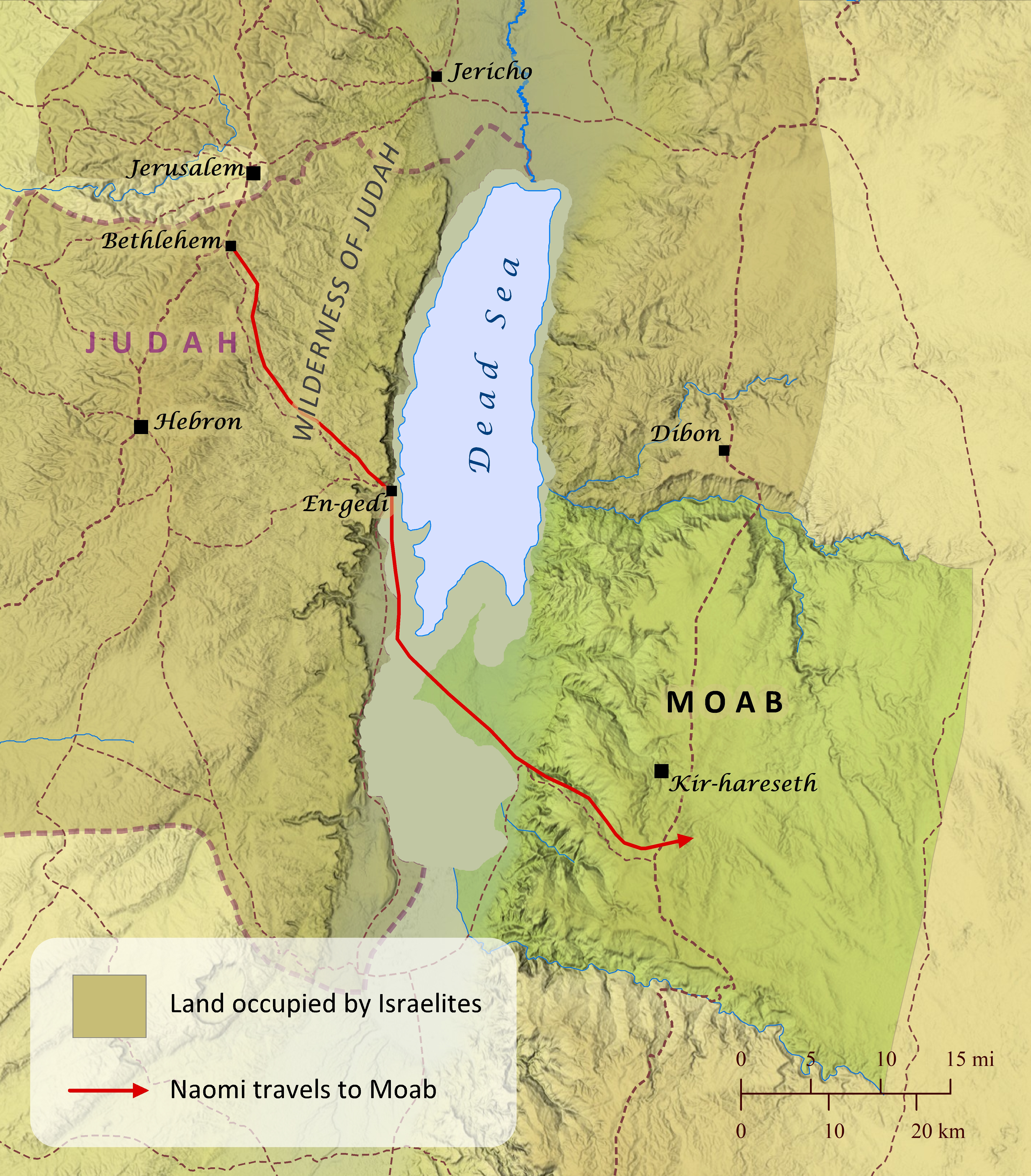
The story of Ruth is set in the time of the Judges, a few generations before the birth of King David. While much animosity often existed between Israel and Moab (Judges 3:12-30; 10:6-12:7; 2 Samuel 8:2; 10; 2 Kings 3:4-27; 2 Chronicles 20; see also Nations across the Jordan River map), other times the two nations appear to have enjoyed a somewhat congenial relationship, as is demonstrated by Naomi’s willingness to relocate to Moab to seek relief from a famine. Later Naomi’s sons also marry Moabite women, and Ruth’s devotion to Naomi and her God no doubt speaks highly of the character of many Moabites. Many years later Ruth’s great-grandson David placed his parents in the care of the king of Moab while he was on the run from King Saul (1 Samuel 22:3-4).
Open Bible Data site copyright © 2023–2026 Freely-Given.org.
Python source code for creating these static pages is available on GitHub under an open licence.
For Bible data copyrights, see the details for each displayed Bible version.
The Open English Translation (OET) main site is at OpenEnglishTranslation.Bible or OET.Bible.