
OET OET-RV OET-LV GHT ULT UST BSB MSB BLB AICNT OEB WEBBE WMBB NET LSV FBV TCNT T4T LEB BBE Moff JPS Wymth ASV DRA YLT Drby RV SLT Wbstr KJB-1769 KJB-1611 Bshps Gnva Cvdl TNT Wycl SR-GNT UHB BrLXX BrTr Related Parallel Simple Interlinear Topics Reference Dictionary Search
ParallelVerse GEN EXO LEV NUM DEU JOB JOS JDG RUTH 1 SAM 2 SAM PSA AMOS HOS 1 KI 2 KI 1 CHR 2 CHR PROV ECC SNG JOEL MIC ISA ZEP HAB JER LAM YNA (JNA) NAH OBA DAN EZE EZRA EST NEH HAG ZEC MAL LAO GES LES ESG DNG 2 PS TOB JDT WIS SIR BAR LJE PAZ SUS BEL MAN 1 MAC 2 MAC 3 MAC 4 MAC YHN (JHN) MARK MAT LUKE ACTs YAC (JAM) GAL 1 TH 2 TH 1 COR 2 COR ROM COL PHM EPH PHP 1 TIM TIT 1 PET 2 PET 2 TIM HEB YUD (JUD) 1 YHN (1 JHN) 2 YHN (2 JHN) 3 YHN (3 JHN) REV
Ruth 1 V1 V2 V4 V5 V6 V7 V8 V9 V10 V11 V12 V13 V14 V15 V16 V17 V18 V19 V20 V21 V22
Note: This view shows ‘verses’ which are not necessarily natural language units and hence sometimes only part of a sentence will be visible—click on any Bible version abbreviation down the left-hand side to see the verse in more of its context. Normally the OET discourages the reading of individual ‘verses’, but this view is only designed as a tool for Bible-translators and others doing comparisons of different translations—the older translations are further down the page (so you can read up from the bottom to trace the English translation history). The OET segments on this page are still early looks into the drafted texts of the Open English Translation of the Bible—please double-check these texts in advance before using in public.
Text critical issues=none Clarity of original=clear Importance to us=normal Speaker(s)=Narrator (All still tentative.)
OET (OET-RV) Then Naomi’s husband Elimelek died, and she was left with her two sons.
OET-LV And_ ʼElīmelek _he/it_died the_husband_of Nāˊₒmī and_she_was_left she and_the_two_of sons_of_her.
UHB וַיָּ֥מָת אֱלִימֶ֖לֶךְ אִ֣ישׁ נָעֳמִ֑י וַתִּשָּׁאֵ֥ר הִ֖יא וּשְׁנֵ֥י בָנֶֽיהָ׃ ‡
(vayyāmāt ʼₑlīmelek ʼiysh nāˊₒmiy vattishshāʼēr hiyʼ ūshənēy ⱱāneyhā.)
Key: khaki:verbs.
Note: Automatic aligning of the OET-RV to the LV is done by some temporary software, hence the OET-RV alignments are incomplete (and may occasionally be wrong).
BrLXX Καὶ ἀπέθανεν Ἐλιμέλεχ ὁ ἀνὴρ τῆς Νωεμὶν, καὶ κατελείφθη αὕτη καὶ οἱ δύο υἱοὶ αὐτῆς.
(Kai apethanen Elimeleⱪ ho anaʸr taʸs Nōemin, kai kateleifthaʸ hautaʸ kai hoi duo huioi autaʸs.)
BrTr And Elimelech the husband of Noemin died; and she was left, and her two sons.
NETS And Abimelech, the husband of Noemin, died, and she was left, she and her two sons.
ULT Then Elimelech, the husband of Naomi, died. And she was left, she and her two sons.
UST Then Naomi’s husband, Elimelech, died, and Naomi had only her two sons with her.
BSB & MSB Then Naomi’s husband Elimelech died, and she was left with her two sons,
OEB Elimelech died, and Naomi was left with her two sons,
WEBBE & WMBB Elimelech, Naomi’s husband, died; and she was left with her two sons.
NET Sometime later Naomi’s husband Elimelech died, so she and her two sons were left alone.
LSV And Elimelech husband of Naomi dies, and she is left, she and her two sons;
FBV However, Elimelech, Naomi's husband, died, and she was left with her two sons.
T4T While they were there, Elimelech died, and Naomi had only her two sons with her.
LEB But Elimelech the husband of Naomi died and she was left behind with ⌊her two sons⌋.[fn]
1:3 Literally “she and her two sons”
BBE And Elimelech, Naomi's husband, came to his end; and only her two sons were with her.
Moff No Moff RUT 1:3 book available
JPS And Elimelech Naomi's husband died; and she was left, and her two sons.
ASV And Elimelech, Naomi’s husband, died; and she was left, and her two sons.
DRA And Elimelech the husband of Noemi died: and she remained with her sons.
YLT And Elimelech husband of Naomi dieth, and she is left, she and her two sons;
Drby And Elimelech Naomi's husband died; and she was left, and her two sons.
RV And Elimelech Naomi’s husband died; and she was left, and her two sons.
SLT And Elimelech will die, the husband of Naomi; and she will be left, and her two sons.
Wbstr And Elimelech Naomi's husband died; and she was left, and her two sons.
KJB-1769 And Elimelech Naomi’s husband died; and she was left, and her two sons.
KJB-1611 And Elimelech Naomies husband died, and shee was left, and her two sonnes;
(And Elimelech Naomies husband died, and she was left, and her two sons;)
Bshps And Elimelech Naomies husbande died, and she remayned with her two sonnes.
(And Elimelech Naomies husband died, and she remained with her two sons.)
Gnva Then Elimelech the husband of Naomi died, and she remayned with her two sonnes,
(Then Elimelech the husband of Naomi died, and she remained with her two sons,)
Cvdl And Eli Melech Naemis husbande dyed, & she was left behinde wt hir two sonnes,
(And Eli Melech Naomis husband died, and she was left behind with her two sons,)
Wycl And Elymelech, the hosebonde of Noemy, diede, and sche lefte with the sones;
(And Elymelech, the husband of Noemy, died, and she left with the sons;)
Luth Und Elimelech, der Naemi Mann, starb, und sie blieb übrig mit ihren zween Söhnen.
(And Elimelech, the/of_the Naomi man, died, and they/she/them stayed left-over with your(pl) two sons.)
ClVg Et mortuus est Elimelech maritus Noëmi: remansitque ipsa cum filiis.
(And dead it_is Elimelech husband Naomi: and_remained herself when/with to_the_children.)
A note on the spelling of Elimelech. Most versions, like the BSB spell the name as Elimelech. The NIV (2011) spells the name with a final k (Elimelek). The Notes will follow the spelling used by any quoted versions.
This section contains the first main event of the story. An Israelite named Elimelech moved to the neighboring country of Moab with his wife, Naomi, and their two sons because there was famine in Israel. Elimelech died in Moab. His two sons later married women from Moab, Ruth and Orpah. Both of the sons then also died.
This section has two paragraphs:
Paragraph 1:1–2 gives an introduction. Verse 1 gives the setting of the story and introduces the main characters in this event.
Paragraph 1:3–5 describes the event in detail. Verse 1:5b summarizes the section that refers to Naomi but does not use her name.
Here are some other examples of section headings:
Naomi Loses Her Husband and Sons (NIV)
Naomi Widowed (ESV)
Elimelech and His Family Move to Moab (GNT)
The Move to Moab and Tragedy (GW)
It is important to translate this book in a way that indicates the story is true. Follow a natural way that storytellers in your language use to tell true events.
This paragraph gives the details of Naomi’s situation. After Elimelech and his family went to Moab, Naomi’s husband and her two sons died. She became a widow with no male family members to provide for her and protect her. This crisis is the main problem of the story. The rest of the story tells how this crisis is resolved.
Then Naomi’s husband Elimelech died,
¶ But Naomi’s husband, Elimelech, died,
¶ Some time later Elimelech died.
Then Naomi’s husband Elimelech died: Here are some ways to indicate the connection of this clause to the previous clause. Any of these options is acceptable:
Indicate that this clause is the next event in the story. The BSB and some other versions translate this function with a word like Then or “And.” Here this word introduces the next event. For example:
Now Naomi’s husband Elimelech died. (GW)
And Elimelech Naomi’s husband died; and she was left, and her two sons. (KJV)
Indicate that this clause talks about an event that occurred at an unspecified time after their arrival in Moab. For example:
Sometime later Naomi’s husband Elimelech died, so she and her two sons were left alone. (NET)
While they were living there, Elimelech died, and Naomi was left alone with her two sons (GNT)
Indicate that this clause talks about an event that was not expected. For example:
But Elimelech, the husband of Naomi, died, and she was left with her two sons. (ESV)
Leave the connection to the previous clause implied. For example:
Elimelech, Naomi’s husband, died; and she was left with her two sons. (NJPS)
This clause refers to Elimelech as Naomi’s husband. In Hebrew, it is unusual to refer to a man in relation to a woman. However, by referring to Elimelech as Naomi’s husband, the author is giving attention to Naomi as the main character of this part of the story.
It is recommended that you translate this clause in a natural way in your language to indicate that Naomi is now the main character in the story. Here are two examples:
Translate literally. Keep the reference to Elimelech as Naomi’s husband. For example:
But Elimelech, the husband of Naomi, died (ESV)
Translate that Elimelech died. In 1:3b remind the readers that his wife’s (widow’s) name was Naomi by making her name explicit. For example:
Elimelech died, 3bleaving Naomi with only her two sons (CEV)
and she was left with her two sons,
and Naomi was left alone with her two sons.
So Naomi no longer had a husband. She only had her two sons.
and she was left with her two sons: Here are some ways to indicate the connection of this clause to the previous clause. Either of these options is acceptable:
Indicate that this clause talks about the result of the death of Elimelech. For example:
So she and her two sons were left alone. (NET)
Indicate that this clause talks about the next situation in the story. For example:
and Naomi was left with her two sons (NJPS)
The Hebrew verb that the BSB translates as was left means “left behind.”TWOT #2307. In this clause, the word refers to Naomi losing her husband. She needed to care for her two sons alone, as a single mother.
Here are some other ways to translate this clause:
Naomi was left a widow with her two sons. (REB)
Naomi no longer had a husband, only her two sons.Suggested by UBS (page 8).
Note 1 topic: figures-of-speech / activepassive
וַתִּשָּׁאֵ֥ר הִ֖יא וּשְׁנֵ֥י בָנֶֽיהָ
(Some words not found in UHB: and=he/it_died ʼElīmelek (a)_man Nāˊₒmī's and,she_was_left she/it and,the_two_of sons_of,her )
If your language does not use this passive form, you could express the idea in active form or in another way that is natural in your language. Alternate translation: [Naomi and her two sons remained in Moab without him]
Ruth 1-4
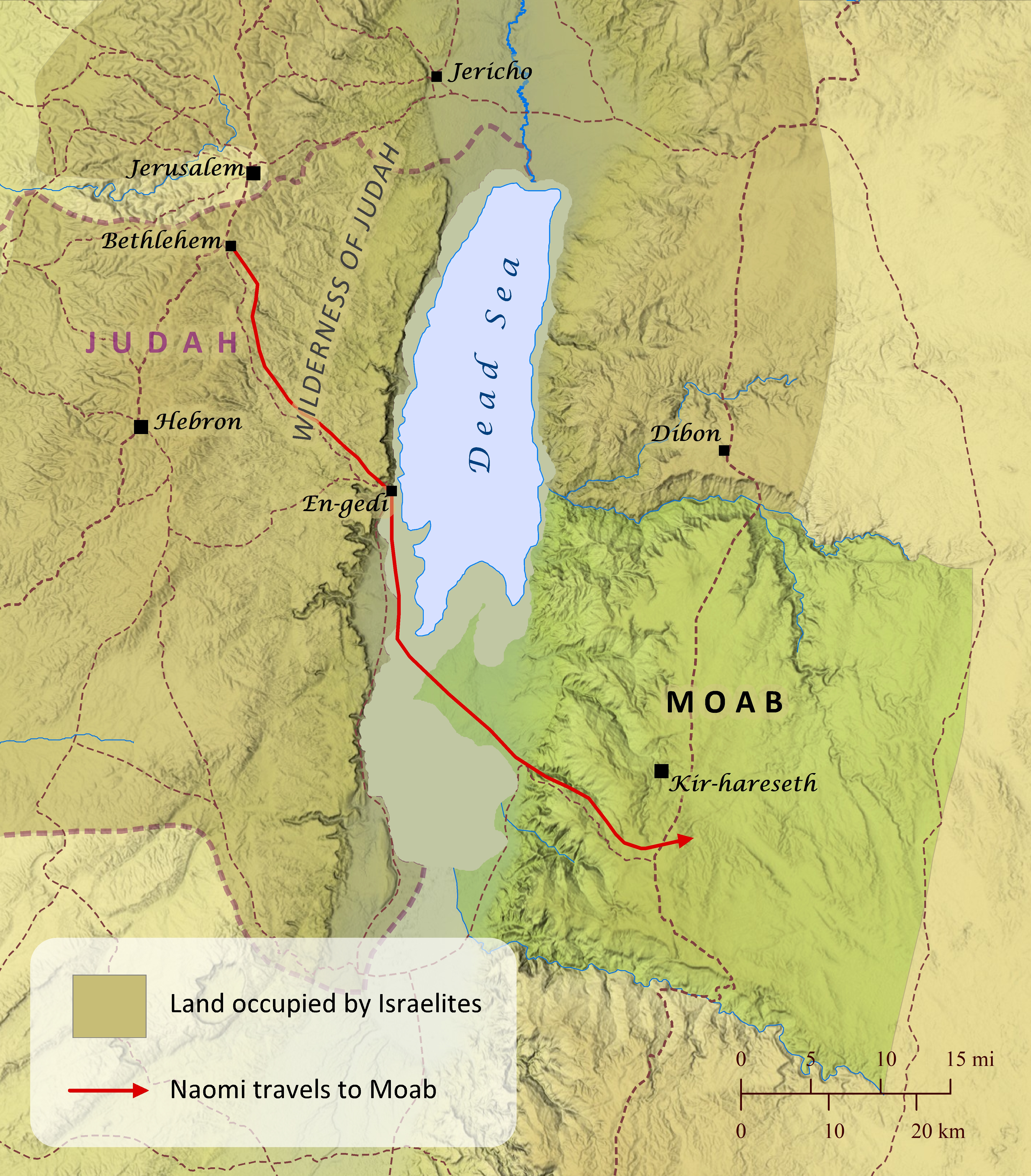
The story of Ruth is set in the time of the Judges, a few generations before the birth of King David. While much animosity often existed between Israel and Moab (Judges 3:12-30; 10:6-12:7; 2 Samuel 8:2; 10; 2 Kings 3:4-27; 2 Chronicles 20; see also Nations across the Jordan River map), other times the two nations appear to have enjoyed a somewhat congenial relationship, as is demonstrated by Naomi’s willingness to relocate to Moab to seek relief from a famine. Later Naomi’s sons also marry Moabite women, and Ruth’s devotion to Naomi and her God no doubt speaks highly of the character of many Moabites. Many years later Ruth’s great-grandson David placed his parents in the care of the king of Moab while he was on the run from King Saul (1 Samuel 22:3-4).
Open Bible Data site copyright © 2023–2026 Freely-Given.org.
Python source code for creating these static pages is available on GitHub under an open licence.
For Bible data copyrights, see the details for each displayed Bible version.
The Open English Translation (OET) main site is at OpenEnglishTranslation.Bible or OET.Bible.