
OET OET-RV OET-LV GHT ULT UST BSB MSB BLB AICNT OEB WEBBE WMBB NET LSV FBV TCNT T4T LEB BBE Moff JPS Wymth ASV DRA YLT Drby RV SLT Wbstr KJB-1769 KJB-1611 Bshps Gnva Cvdl TNT Wycl SR-GNT UHB BrLXX BrTr Related Parallel Simple Interlinear Topics Reference Dictionary Search
ParallelVerse GEN EXO LEV NUM DEU JOB JOS JDG RUTH 1 SAM 2 SAM PSA AMOS HOS 1 KI 2 KI 1 CHR 2 CHR PROV ECC SNG JOEL MIC ISA ZEP HAB JER LAM YNA (JNA) NAH OBA DAN EZE EZRA EST NEH HAG ZEC MAL LAO GES LES ESG DNG 2 PS TOB JDT WIS SIR BAR LJE PAZ SUS BEL MAN 1 MAC 2 MAC 3 MAC 4 MAC YHN (JHN) MARK MAT LUKE ACTs YAC (JAM) GAL 1 TH 2 TH 1 COR 2 COR ROM COL PHM EPH PHP 1 TIM TIT 1 PET 2 PET 2 TIM HEB YUD (JUD) 1 YHN (1 JHN) 2 YHN (2 JHN) 3 YHN (3 JHN) REV
Ruth 1 V1 V2 V3 V4 V5 V6 V7 V8 V9 V10 V11 V12 V14 V15 V16 V17 V18 V19 V20 V21 V22
Note: This view shows ‘verses’ which are not necessarily natural language units and hence sometimes only part of a sentence will be visible—click on any Bible version abbreviation down the left-hand side to see the verse in more of its context. Normally the OET discourages the reading of individual ‘verses’, but this view is only designed as a tool for Bible-translators and others doing comparisons of different translations—the older translations are further down the page (so you can read up from the bottom to trace the English translation history). The OET segments on this page are still early looks into the drafted texts of the Open English Translation of the Bible—please double-check these texts in advance before using in public.
Text critical issues=none Clarity of original=clear Importance to us=normal Speaker(s)=Narrator (All still tentative.)
OET (OET-RV) could you wait for them to grow up so you could be remarried? No, my daughters, what’s hard for me, even more than your hardships, is that Yahweh is using his power against me.”
OET-LV Therefore will_you(pl)_wait until that they_will_grow_up therefore will_you_shut_yourselves_off to_not to_belong to_a_husband no my_daughters_of_my if/because it_is_bitter to_me very more_than_you(pl) if/because it_has_gone_forth on_me the_hand_of YHWH.
UHB הֲלָהֵ֣ן ׀ תְּשַׂבֵּ֗רְנָה עַ֚ד אֲשֶׁ֣ר יִגְדָּ֔לוּ הֲלָהֵן֙ תֵּֽעָגֵ֔נָה לְבִלְתִּ֖י הֱי֣וֹת לְאִ֑ישׁ אַ֣ל בְּנֹתַ֗י כִּֽי־מַר־לִ֤י מְאֹד֙ מִכֶּ֔ם כִּֽי־יָצְאָ֥ה בִ֖י יַד־יְהוָֽה׃ ‡
(hₐlāhēn təsabērənāh ˊad ʼₐsher yigdālū hₐlāhēn tēˊāgēnāh ləⱱiltiy hₑyōt ləʼiysh ʼal bənotay kiy-mar-liy məʼod mikkem kiy-yāʦəʼāh ⱱiy yad-yhwh.)
Key: khaki:verbs.
Note: Automatic aligning of the OET-RV to the LV is done by some temporary software, hence the OET-RV alignments are incomplete (and may occasionally be wrong).
BrLXX Μὴ αὐτοὺς προσδέξεσθε ἕως οὗ ἁδρυνθώσιν; ἢ αὐτοῖς κατασχεθήσεσθε τοῦ μὴ γενέσθαι ἀνδρί; μὴ δὴ θυγατέρες μου, ὅτι ἐπικράνθη μοι ὑπὲρ ὑμᾶς, ὅτι ἐξῆλθεν ἐν ἐμοὶ χεὶρ Κυρίου.
(Maʸ autous prosdexesthe heōs hou hadrunthōsin; aʸ autois katasⱪethaʸsesthe tou maʸ genesthai andri; maʸ daʸ thugateres mou, hoti epikranthaʸ moi huper humas, hoti exaʸlthen en emoi ⱪeir Kuriou.)
BrTr would ye wait for them till they should be grown? or would ye refrain from being married for their sakes? Not so, my daughters; for I am grieved for you, that the hand of the Lord has gone forth against me.
ULT would you therefore wait until the time when they are grown? Would you for this reason keep yourselves from belonging to a husband? No, my daughters! For it is exceedingly bitter for me, more than for you, that the hand of Yahweh has gone out against me.”
UST you would not wait until they grew up! You could not remain unmarried until then! No, my daughters, Yahweh has done very bad things to me, causing me to grieve very much. But your lives do not need to be as bad as mine.”
BSB & MSB would you wait for them to grow up? Would you refrain from having husbands? No, my daughters, it is much more bitter for me than for you, because the hand of the LORD has gone out against me.”
OEB would you wait for them until they were grown up? Would you remain single for them? No, my daughters! My heart grieves for you, for the Lord has sent me adversity.’
WEBBE & WMBB would you then wait until they were grown? Would you then refrain from having husbands? No, my daughters, for it grieves me seriously for your sakes, for the LORD’s hand has gone out against me.”
NET surely you would not want to wait until they were old enough to marry! Surely you would not remain unmarried all that time! No, my daughters, you must not return with me. For my intense suffering is too much for you to bear. For the Lord is afflicting me!”
LSV do you wait for them until they grow up? Do you shut yourselves up for them, not to be to a husband? No, my daughters, for more bitter to me than to you, for the hand of YHWH has gone out against me.”
FBV would you wait for them to grow up? Would you decide you weren't going to marry anyone else? No. The whole situation is more bitter for me than it is for you, for the Lord has turned against me!”[fn]
1:13 “The Lord has turned against me”: literally, “the hand of the Lord has gone against me.”
T4T would you remain single/unmarried until they grew up and became old enough for you to marry? No, my daughters, you would not do that. Your situations are bad because your husbands have died, but it is possible that you will each marry again. My situation is much worse, because Yahweh [SYN] has opposed me, and now I am too old to get married again.”
LEB would you therefore wait until they were grown? Would you therefore ⌊refrain from marrying⌋?[fn] No, my daughters, for it is far more bitter to me than to you. For the hand of Yahweh has gone out against me.”
1:13 Literally “Would you therefore let yourself be hindered to not belong to a man?”
BBE Would you keep yourselves till they were old enough? would you keep from having husbands for them? No, my daughters; but I am very sad for you that the hand of the Lord is against me.
Moff No Moff RUT 1:13 book available
JPS would ye tarry for them till they were grown? would ye shut yourselves off for them and have no husbands? nay, my daughters; for it grieveth me much for your sakes, for the hand of the LORD is gone forth against me.'
ASV would ye therefore tarry till they were grown? would ye therefore stay from having husbands? nay, my daughters, for it grieveth me much for your sakes, for the hand of Jehovah is gone forth against me.
DRA If you would wait till they were grown up, and come to man’s estate, you would be old women before you marry. Do not so, my daughters, I beseech you: for I am grieved the more for your distress, and the hand of the Lord is gone out against me.
YLT for them do ye wait till that they grow up? for them do ye shut yourselves up, not to be to a husband? nay, my daughters, for more bitter to me than to you, for the hand of Jehovah hath gone out against me.'
Drby would ye wait on that account till they were grown? Would ye stay on that account from having husbands? No, my daughters, for I am in much more bitterness than you; for the hand of Jehovah is gone out against me.
RV would ye therefore tarry till they were grown? would ye therefore stay from having husbands? nay, my daughters; for it grieveth me much for your sakes, for the hand of the LORD is gone forth against me.
(would ye/you_all therefore tarry/wait till they were grown? would ye/you_all therefore stay from having husbands? nay, my daughters; for it grieveth me much for your sakes, for the hand of the LORD is gone forth against me.)
SLT Will ye wait for them till they shall grow? Will remain shut up for them not to be for a husband? Nay, my daughters, for it is bitter to me greatly for you, that the hand of Jehovah will go forth against me.
Wbstr Would ye wait for them till they should be grown? would ye stay for them from having husbands? nay, my daughters; for it grieveth me much for your sakes, that the hand of the LORD has gone out against me.
KJB-1769 Would ye tarry for them till they were grown? would ye stay for them from having husbands? nay, my daughters; for it grieveth me much for your sakes that the hand of the LORD is gone out against me.[fn][fn]
(Would ye/you_all tarry/wait for them till they were grown? would ye/you_all stay for them from having husbands? nay, my daughters; for it grieveth me much for your sakes that the hand of the LORD is gone out against me.)
KJB-1611 Would ye [fn]tary for them till they were growen? would ye stay for them from hauing husbands? nay my daughters: for [fn]it grieueth me much for your sakes, that the hand of the LORD is gone out against me.
(Modernised spelling is same as from KJB-1769 above, apart from punctuation and footnotes)
Bshps Would ye tary after them, till they were of age? or woulde ye for them so long refrayne from taking of husbandes? Not so my daughters: for it greeueth me muche for your sakes, that the hand of the Lorde is gone out against me.
(Would ye/you_all tarry/wait after them, till they were of age? or would ye/you_all for them so long refrain from taking of husbands? Not so my daughters: for it grieveth/grieves me much for your sakes, that the hand of the Lord is gone out against me.)
Gnva Would yee tarie for them, till they were of age? would ye be deferred for them from taking of husbands? nay my daughters: for it grieueth me much for your sakes that the hand of the Lord is gone out against me.
(Would ye/you_all tarry/wait for them, till they were of age? would ye/you_all be deferred for them from taking of husbands? nay my daughters: for it grieveth me much for your sakes that the hand of the Lord is gone out against me.)
Cvdl yet coulde ye not tary tlll they were growne vp: for ye shulde be to olde, so that ye coulde haue no husbandes. No my doughters, therfore am I sory for you, for ye hade of the LORDE is gone forth ouer me.
(yet could ye/you_all not tarry/wait tlll they were grown up: for ye/you_all should be to old, so that ye/you_all could have no husbands. No my daughters, therefore am I sorry for you, for ye/you_all hand of the LORD is gone forth over me.)
Wycl and bere sones, if ye wolen abide til thei wexen, and fillen the yeris of mariage, `ye schulen sunner be eld wymmen than ye schulen be weddid; I biseche, `nyle ye, my douytris, for youre angwische oppressith me more, and the hond of the Lord yede out ayens me.
(and bear sons, if ye/you_all woollen abide till they waxing/growing, and fill the years of marriage, ye/you_all should sooner be old women than ye/you_all should be wedded; I beseech/implore, will_note ye/you_all, my daughters, for your(pl) anguish oppresses me more, and the hand of the Lord went out against me.)
Luth wie könnet ihr doch harren, bis sie groß würden? Wie wollt ihr verziehen, daß ihr nicht Männer solltet nehmen? Nicht, meine Töchter; denn mich jammert euer sehr, denn des HErr’s Hand ist über mich ausgegangen.
(as/like could you(pl)/their/her though/but wait, until they/she/them large would? How wanted you(pl)/their/her forgiven, that you(pl)/their/her not men should take? Not, my daughters; because/than me laments your(pl) very, because/than the LORD’s hand is above me assumed.)
ClVg si eos expectare velitis donec crescant, et annos pubertatis impleant, ante eritis vetulæ quam nubatis. Nolite, quæso, filiæ meæ: quia vestra angustia magis me premit, et egressa est manus Domini contra me.
(when/but_if them to_await you_wish until they_may_grow, and years puberty they_may_fill, before you(pl)_will_be elderly how you(pl)_may_marry. Don’t, I_beg, daughters my: because your distress more me presses, and gone_out it_is hands Master on_the_contrary me.)
This section talks about the next main event of the story, which is Naomi’s return to Bethlehem, accompanied by her daughter-in-law, Ruth.
Many scholars agree that verses 1:7–21 describe this event in detail, and that verse 1:22 is the closing verse of this section, which summarizes the event.
However, scholars do not agree about the function of verse 1:6. Some scholars believe that verse 1:6 is a summary introduction. It says that Naomi arose (she and her daughters-in-law) and returned from the region of Moab. Thus, this section begins and ends with a summary description of the main event.NICOT (pages 99–100 ): The common Hebrew idiom qûm plus a verb of motion (šûḇ) also signals the start of the story’s main action: Then she…returned. Structurally, the idiom is a summary-introduction to the following events (vv. 7–21) and forms an inclusio with the chapter’s summary-conclusion (cf. wattāšāḇ, v. 22). Further, it sounds the chapter’s main theme, namely, the return of Naomi.
Some other scholars do not believe that verse 1:6 is a summary introduction. Rather 1:6 describes the first part of the action. It says that she arose (she and her daughters-in-law) and prepared to return from the region of Moab.
The majority of versions follow the second suggestion. However, the first suggestion follows a pattern that is also in some other Hebrew narratives. An event is introduced by a summary statement, and the verses after it describe that event in detail.For example: Genesis 1:1 introduces the creation account of 1:2–31. Genesis 6:7 introduces the flood account of Genesis 6–9. Ruth 1:1–2 introduces the first section in Ruth 1:3–5. See the Note on 1:6b for more information.
Here are some other examples of section headings:
Naomi and Ruth Return to Bethlehem (NIV)
Naomi and Ruth Return (NLT)
Departure from Moab (GW)
would you wait for them to grow up?
Would you(dual) wait for them to grow up so you could marry them? No.
you would not wait for them to grow up.
would you wait for them to grow up?: This is a rhetorical question. It is used for emphasis. Naomi’s daughters-in-law would certainly not wait for any sons she might have to grow up. Her new sons would be too young to marry Ruth and Orpah.
There are two ways to translate this rhetorical question:
Use a rhetorical question. For example:
Would you wait for them until they become old enough to marry? (CEV)
Use a statement. For example:
Surely you would not want to wait until they were old enough to marry! (NET)
Would you refrain from having husbands?
Would you(dual) stay single/alone until you could marry them? No.
Surely you would not refuse to marry while you waited for them to grow up.
Would you refrain from having husbands?: This is another rhetorical question. It emphasizes again that Orpah and Ruth had no reason to go with Naomi. They would not turn down other opportunities to get married, and to wait until Naomi’s sons became old enough to marry.
There are two ways to translate this rhetorical question:
Use a rhetorical question. For example:
Would you…and stay single just for them? (GW)
Would you…refuse to marry someone else? (NLT)
Use a statement. For example:
Surely you would not remain unmarried all that time! (NET)
No, my daughters, it grieves me very much for your sakes
No, my daughters. What has happened to me is even worse than what has happened to you(dual),
No, dear daughters-in-law, you know I will not have any more sons. My life has been much harder than yours,
No, my daughters: There are two ways to interpret the word No:
Naomi said No to the idea that Ruth and Orpah could expect her to have more sons. For example:
No, my daughters, you know that’s impossible. (GNT) (GNT, NLT, NCV)
Naomi said No to Ruth and Orpah’s proposal to accompany her. For example:
No, my daughters, you must not return with me. (NET) (NET)
It is recommended that you follow interpretation (1). This is supported by some commentariesUBS, WBC, NICOT. and some English versions. Most versions, including the BSB, are ambiguous.
it grieves me very much for your sakes: There are three ways to interpret the phrase it grieves me very much:
It means that the situation grieves Naomi more than her daughters-in-law. For example:
My bitterness is much worse than yours (GW) (CEV, GW, NASB, NIV, NLT, NRSV)
It means that the situation grieves Naomi on account of her daughters-in-law. She felt sorry for them. For example:
For your sakes I feel bitter that the Lord has inflicted such misfortune on me (REB) (BSB, ESV, GNT, KJV, NJB, REB, RSV)
It means that the situation grieves Naomi too much to share her grief with her daughters-in-law. For example:
For my intense suffering is too much for you to bear. (NET) (NABRE, NCV, NET)
It is recommended that you follow interpretation (1). This interpretation is followed by many English versions and fits the context well.
grieves me: The Hebrew phrase that the BSB translates as grieves me is more literally “bitter to me.” The word “bitter” refers to an irritating, pungent taste. It is used figuratively to refer to an unpleasant experience.
Here are some other ways to translate this clause:
My bitterness is much worse than yours (GW)
Life is harder for me than it is for you (CEV)
Your situations are bad…my situation is much worse (T4T)
that the hand of the LORD has gone out against me.”
for Yahweh has turned against me.”
because Yahweh has opposed me.”
the hand of the LORD has gone out against me: The phrase the hand of the LORD is a figure of speech. It indicates the power or ability of Yahweh to perform some action. Naomi was accusing the LORD of taking action against her, or at least using others to cause her difficulty.
Here are some ways to translate this clause:
Keep the figure of speech. For example:
because the Lord himself has raised his fist against me (NLT)
Translate the meaning without the figure of speech. For example:
The Lord has turned against me (GNT)
because the Lord has been against me (NCV)
because the Lord has sent me so much trouble (GW)
In some languages, it may be best to reverse the order of 1:13c and 1:13d. Here is one way to do this:
The LORD himself has turned against me, so what has happened to me is even worse than what has happened to you.
Note 1 topic: figures-of-speech / rquestion
הֲלָהֵ֣ן ׀ תְּשַׂבֵּ֗רְנָה עַ֚ד אֲשֶׁ֣ר יִגְדָּ֔לוּ הֲלָהֵן֙ תֵּֽעָגֵ֔נָה לְבִלְתִּ֖י הֱי֣וֹת לְאִ֑ישׁ
?,therefore (Some words not found in UHB: ?,therefore wait until which/who grown ?,therefore refrain to=not to_be to,a_husband not my_daughters_of,my that/for/because/then/when bitter to=me very more,than_you(pl) that/for/because/then/when gone_out on,me hand_of YHWH )
Naomi completes the rhetorical question she began in the previous verse and immediately asks another rhetorical question which emphasizes the same meaning. Alternate translation: [you would not wait until they were grown up so that you could marry them. You would need to marry a husband before then.]
הֲלָהֵ֣ן ׀ תְּשַׂבֵּ֗רְנָה עַ֚ד אֲשֶׁ֣ר יִגְדָּ֔לוּ הֲלָהֵן֙ תֵּֽעָגֵ֔נָה לְבִלְתִּ֖י הֱי֣וֹת לְאִ֑ישׁ
?,therefore (Some words not found in UHB: ?,therefore wait until which/who grown ?,therefore refrain to=not to_be to,a_husband not my_daughters_of,my that/for/because/then/when bitter to=me very more,than_you(pl) that/for/because/then/when gone_out on,me hand_of YHWH )
This idea refers to the custom among the ancient Hebrews that, if a married man died, one of his brothers would marry the man’s widow. See the book introduction for more explanation. If it would be helpful, you could put some of this information in a footnote.
Note 2 topic: figures-of-speech / metaphor
מַר־לִ֤י מְאֹד֙
bitter to=me very
Here, bitterness is a metaphor for grief. Alternate translation: [it is a great grief for me]
Note 3 topic: figures-of-speech / metonymy
יָצְאָ֥ה בִ֖י יַד־יְהוָֽה
gone_out on,me hand_of YHWH
Here, hand represents the power of God. If it would be helpful in your language, you could use an equivalent expression from your language or state the meaning plainly. Alternate translation: [the power of Yahweh has caused terrible things to happen to me]
Note 4 topic: figures-of-speech / explicit
יָצְאָ֥ה בִ֖י יַד־יְהוָֽה
gone_out on,me hand_of YHWH
The implication is that Yahweh caused the deaths of Naomi’s family. You could include this information if that would be helpful to your readers. Alternate translation: [Yahweh has taken away our husbands]
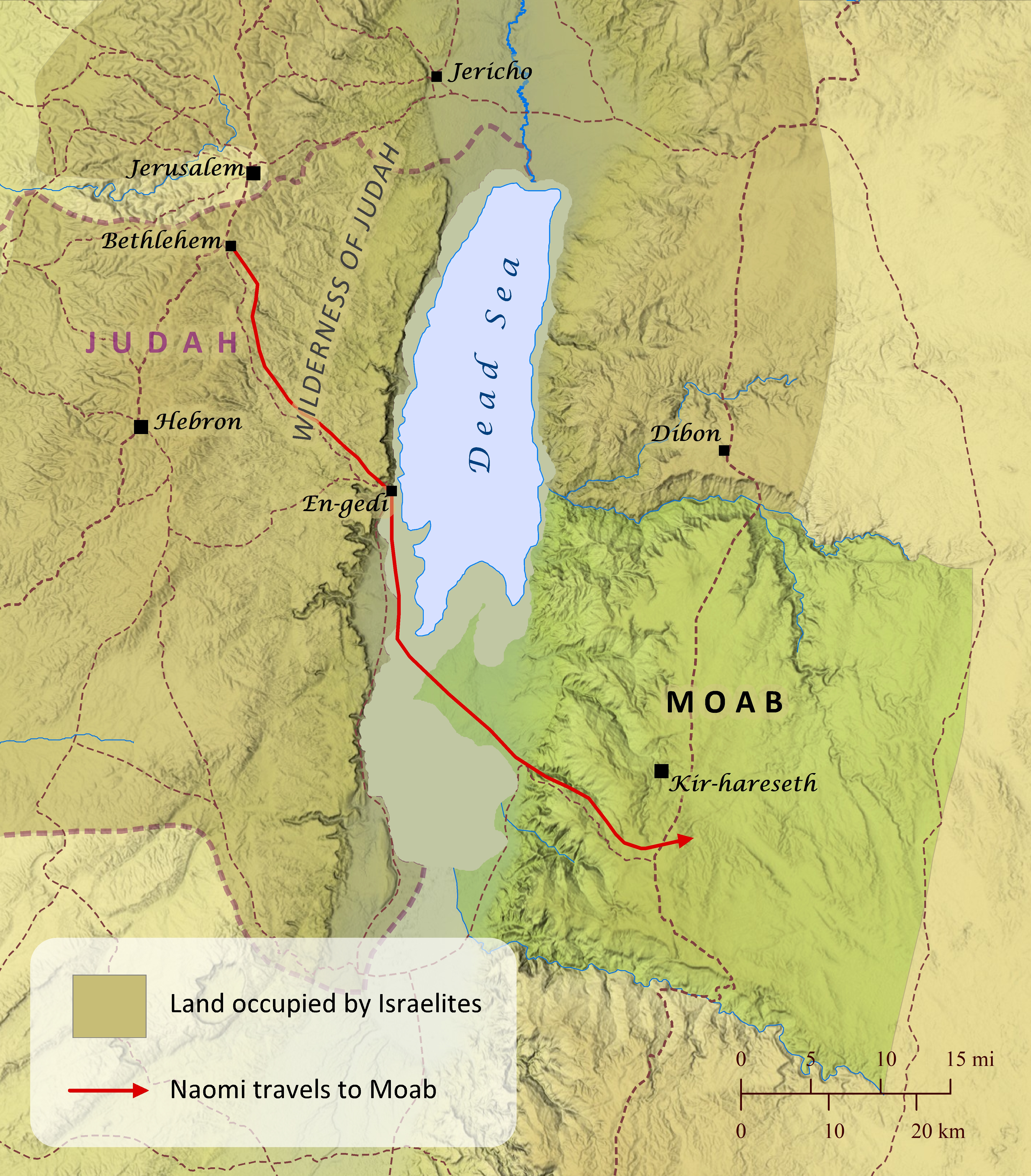
Ruth 1-4
The story of Ruth is set in the time of the Judges, a few generations before the birth of King David. While much animosity often existed between Israel and Moab (Judges 3:12-30; 10:6-12:7; 2 Samuel 8:2; 10; 2 Kings 3:4-27; 2 Chronicles 20; see also Nations across the Jordan River map), other times the two nations appear to have enjoyed a somewhat congenial relationship, as is demonstrated by Naomi’s willingness to relocate to Moab to seek relief from a famine. Later Naomi’s sons also marry Moabite women, and Ruth’s devotion to Naomi and her God no doubt speaks highly of the character of many Moabites. Many years later Ruth’s great-grandson David placed his parents in the care of the king of Moab while he was on the run from King Saul (1 Samuel 22:3-4).
Open Bible Data site copyright © 2023–2026 Freely-Given.org.
Python source code for creating these static pages is available on GitHub under an open licence.
For Bible data copyrights, see the details for each displayed Bible version.
The Open English Translation (OET) main site is at OpenEnglishTranslation.Bible or OET.Bible.