
OET OET-RV OET-LV GHT ULT UST BSB MSB BLB AICNT OEB WEBBE WMBB NET LSV FBV TCNT T4T LEB BBE Moff JPS Wymth ASV DRA YLT Drby RV SLT Wbstr KJB-1769 KJB-1611 Bshps Gnva Cvdl TNT Wycl SR-GNT UHB BrLXX BrTr Related Parallel Simple Interlinear Topics Reference Dictionary Search
ParallelVerse GEN EXO LEV NUM DEU JOB JOS JDG RUTH 1 SAM 2 SAM PSA AMOS HOS 1 KI 2 KI 1 CHR 2 CHR PROV ECC SNG JOEL MIC ISA ZEP HAB JER LAM YNA (JNA) NAH OBA DAN EZE EZRA EST NEH HAG ZEC MAL LAO GES LES ESG DNG 2 PS TOB JDT WIS SIR BAR LJE PAZ SUS BEL MAN 1 MAC 2 MAC 3 MAC 4 MAC YHN (JHN) MARK MAT LUKE ACTs YAC (JAM) GAL 1 TH 2 TH 1 COR 2 COR ROM COL PHM EPH PHP 1 TIM TIT 1 PET 2 PET 2 TIM HEB YUD (JUD) 1 YHN (1 JHN) 2 YHN (2 JHN) 3 YHN (3 JHN) REV
Ruth 1 V1 V2 V3 V4 V5 V6 V7 V8 V9 V10 V11 V12 V13 V15 V16 V17 V18 V19 V20 V21 V22
Note: This view shows ‘verses’ which are not necessarily natural language units and hence sometimes only part of a sentence will be visible—click on any Bible version abbreviation down the left-hand side to see the verse in more of its context. Normally the OET discourages the reading of individual ‘verses’, but this view is only designed as a tool for Bible-translators and others doing comparisons of different translations—the older translations are further down the page (so you can read up from the bottom to trace the English translation history). The OET segments on this page are still early looks into the drafted texts of the Open English Translation of the Bible—please double-check these texts in advance before using in public.
Text critical issues=small word differences Clarity of original=clear Importance to us=normal Speaker(s)=Narrator (All still tentative.)
OET (OET-RV) Then they wailed and cried again, and Orpah kissed her mother-in-law goodbye and left, but Ruth stayed and clung to Naomi.
OET-LV And_they_raised voice_of_their and_they_wept again and_ Orpah _she_kissed (to)_mother-in-law_of_her and_Rūt she_clung to_her.
UHB וַתִּשֶּׂ֣נָה קוֹלָ֔ן וַתִּבְכֶּ֖ינָה ע֑וֹד וַתִּשַּׁ֤ק עָרְפָּה֙ לַחֲמוֹתָ֔הּ וְר֖וּת דָּ֥בְקָה בָּֽהּ׃ ‡
(vattissenāh qōlān vattiⱱkeynāh ˊōd vattishshaq ˊārəpāh laḩₐmōtāh vərūt dāⱱəqāh bāh.)
Key: khaki:verbs.
Note: Automatic aligning of the OET-RV to the LV is done by some temporary software, hence the OET-RV alignments are incomplete (and may occasionally be wrong).
BrLXX Καὶ ἐπῇραν τὴν φωνὴν αὐτῶν, καὶ ἔκλαυσαν ἔτι· καὶ κατεφίλησεν Ὀρφὰ τὴν πενθερὰν αὐτῆς, καὶ ἐπέστρεψεν εἰς τὸν λαὸν αὐτῆς· Ῥοὺθ δὲ ἠκολούθησεν αὐτῇ.
(Kai epaʸran taʸn fōnaʸn autōn, kai eklausan eti; kai katefilaʸsen Orfa taʸn pentheran autaʸs, kai epestrepsen eis ton laon autaʸs; Ɽouth de aʸkolouthaʸsen autaʸ.)
BrTr And they lifted up their voice, and wept again; and Orpha kissed her mother-in-law and returned to her people; but Ruth followed her.
ULT Then they lifted up their voices and cried again. Then Orpah kissed her mother-in-law, but Ruth clung to her.
UST Then Ruth and Orpah cried loudly again. Orpah kissed her mother-in-law goodbye and left, but Ruth stayed with Naomi.
BSB & MSB Again they wept aloud, and Orpah kissed her mother-in-law {goodbye}, but Ruth clung to her.
OEB Then they again wept aloud, and Orpah kissed her mother-in-law goodbye, but Ruth stayed with her.
WEBBE & WMBB They lifted up their voices and wept again; then Orpah kissed her mother-in-law, but Ruth stayed with her.
NET Again they wept loudly. Then Orpah kissed her mother-in-law goodbye, but Ruth clung tightly to her.
LSV And they lift up their voice, and weep again, and Orpah kisses her mother-in-law, and Ruth has cleaved to her.
FBV They started crying loudly again. Then Orpah kissed her mother-in-law goodbye. But Ruth held on tightly to Naomi.
T4T Then Ruth and Orpah cried again because of what Naomi said. Then Orpah kissed her mother-in-law goodbye, and left, but Ruth clung to Naomi.
LEB And they lifted up their voices and cried again. And Orpah kissed her mother-in-law goodbye, but Ruth clung to her.
BBE Then again they were weeping; and Orpah gave her mother-in-law a kiss, but Ruth would not be parted from her.
Moff No Moff RUT 1:14 book available
JPS And they lifted up their voice, and wept again; and Orpah kissed her mother-in-law; but Ruth cleaved unto her.
ASV And they lifted up their voice, and wept again: and Orpah kissed her mother-in-law, but Ruth clave unto her.
DRA And they lifted up their voice, and began to weep again: Orpha kissed her mother in law and returned: Ruth stuck close to her mother in law.
YLT And they lift up their voice, and weep again, and Orpah kisseth her mother-in-law, and Ruth hath cleaved to her.
Drby And they lifted up their voice and wept again. And Orpah kissed her mother-in-law, but Ruth clave to her.
RV And they lifted up their voice, and wept again: and Orpah kissed her mother in law; but Ruth clave unto her.
(And they lifted up their voice, and wept again: and Orpah kissed her mother-in-law; but Ruth clave unto her.)
SLT And they will lift up their voice and weep yet. And Orpah will kiss to her mother-in-law; and Ruth adhered to her.
Wbstr And they lifted up their voice, and wept again. And Orpah kissed her mother-in-law; but Ruth cleaved to her.
KJB-1769 And they lifted up their voice, and wept again: and Orpah kissed her mother in law; but Ruth clave unto her.
(And they lifted up their voice, and wept again: and Orpah kissed her mother-in-law; but Ruth clave unto her.)
KJB-1611 And they lift vp their voyce, and wept againe: and Orpah kissed her mother in law, but Ruth claue vnto her.
(And they lift up their voice, and wept again: and Orpah kissed her mother-in-law, but Ruth clave unto her.)
Bshps And they lift vp their voyces, & wept againe: and Orpha kissed her mother in lawe, but Ruth abode still by her.
(And they lift up their voices, and wept again: and Orpha kissed her mother-in-law, but Ruth abode/stayed still by her.)
Gnva Then they lift vp their voyce and wept againe, and Orpah kissed her mother in lawe, but Ruth abode still with her.
(Then they lift up their voice and wept again, and Orpah kissed her mother-in-law, but Ruth abode/stayed still with her.)
Cvdl Then lifte they vp their voyce, and wepte yet more, and Arpa kyssed hir mother in lawe (and turned backe againe) but Ruth abode styll by her.
(Then lift they up their voice, and wept yet more, and Arpa kissed her mother-in-law (and turned back again) but Ruth abode/stayed still by her.)
Wycl Therfor, whanne the vois was reisid, eft thei bigunnen to wepe. Orpha kisside `the modir of hir hosebonde, and turnede ayen, and Ruth `cleuyde to `the modir of hir hosebonde.
(Therefore, when the voice was raised, after they began to weep. Orpha kissed the mother of her husband, and turned again, and Ruth cleaved/clung to the mother of her husband.)
Luth Da huben sie ihre Stimme auf und weineten noch mehr. Und Arpa küssete ihre Schwieger; Ruth aber blieb bei ihr.
(So lift/raise they/she/them their/her voice(n) on/in/to and cried still more. And Orpah kissed their/her mother-in-law; Ruth but stayed at/in you(pl)/their/her.)
ClVg Elevata igitur voce, rursum flere cœperunt: Orpha osculata est socrum, ac reversa est; Ruth adhæsit socrui suæ:[fn]
(Elevated therefore voice, again cry they_began: Orpah kissed it_is mother-in-law, and returned it_is; Ruth stuck mother-in-law his/her_own(pl):)
1.14 Elevata. Per has mulieres, quarum una dolens et lugens a socru recedit, altera obstinato animo adhæret, credentes significantur: quorum alii percepta gratia baptismi et societate fieri, ad errores pristinos relabuntur, quos significat Orpha: quæ ad Deos suos reversa est; alii vero definito consilio, perceptam gratiam consequuntur, quos significaRuth.
1.14 Elevated. Through has women, whose together painful and mourning from mother-in-law retreats, the_other stubbornly in_mind adhere, believers are_signified: whose others perceived grace baptism and society to_be_done, to errors former they_will_slip_back, which means Orpah: which to to_Gods his_own returned it_is; others indeed/however define by_design/by_the_advice, perceived grace they_follow, which significaRuth.
This section talks about the next main event of the story, which is Naomi’s return to Bethlehem, accompanied by her daughter-in-law, Ruth.
Many scholars agree that verses 1:7–21 describe this event in detail, and that verse 1:22 is the closing verse of this section, which summarizes the event.
However, scholars do not agree about the function of verse 1:6. Some scholars believe that verse 1:6 is a summary introduction. It says that Naomi arose (she and her daughters-in-law) and returned from the region of Moab. Thus, this section begins and ends with a summary description of the main event.NICOT (pages 99–100 ): The common Hebrew idiom qûm plus a verb of motion (šûḇ) also signals the start of the story’s main action: Then she…returned. Structurally, the idiom is a summary-introduction to the following events (vv. 7–21) and forms an inclusio with the chapter’s summary-conclusion (cf. wattāšāḇ, v. 22). Further, it sounds the chapter’s main theme, namely, the return of Naomi.
Some other scholars do not believe that verse 1:6 is a summary introduction. Rather 1:6 describes the first part of the action. It says that she arose (she and her daughters-in-law) and prepared to return from the region of Moab.
The majority of versions follow the second suggestion. However, the first suggestion follows a pattern that is also in some other Hebrew narratives. An event is introduced by a summary statement, and the verses after it describe that event in detail.For example: Genesis 1:1 introduces the creation account of 1:2–31. Genesis 6:7 introduces the flood account of Genesis 6–9. Ruth 1:1–2 introduces the first section in Ruth 1:3–5. See the Note on 1:6b for more information.
Here are some other examples of section headings:
Naomi and Ruth Return to Bethlehem (NIV)
Naomi and Ruth Return (NLT)
Departure from Moab (GW)
Again they wept aloud,
When Ruth and Orpah heard this they(dual/plur) began crying again.
Then Ruth and Orpah started crying again.
There is a Hebrew conjunction that introduces the next event in the story. Many English versions, including the BSB, do not translate this conjunction.
Again they wept aloud: The pronoun they refers to Ruth and Orpah.NICOT, WBC.
Here are some other ways to translate this verse part:
Again they started crying. (GNT)
Then Ruth and Orpah started crying again (T4T)
and Orpah kissed her mother-in-law goodbye,
Then Orpah said farewell to her mother-in-law.
Orpah kissed Naomi goodbye and left her,
Orpah kissed her mother-in-law goodbye: There is a textual issue in this verse part:
The Hebrew text says “And Orpah kissed her mother-in-law.” For example:
Orpah kissed her mother-in-law (NRSV)
Then Orpah kissed her mother-in-law and took her leave (REB) (BSB, ESV, NET, NIV, NASB, NABRE, NRSV, REB)
The Septuagint says “And Orpah kissed her mother-in-law and returned to her people.” For example:
Orpah then kissed her mother-in-law and went back to her people. (NJB) (GNT, NJB)
It is recommended that you follow option (1) along with most versions and commentaries.NICOT, WBC, ZECOT.
However, the information that Orpah returned home is clearly implied in 1:15a. You may wish to include this as implied information for clarity.
goodbye: The Hebrew text does not have the word goodbye. The BSB has added this word as implied information. Naomi’s statement in 1:15 makes it clear that Orpah is taking her leave.
Here is another way to translate this verse part:
Then Orpah kissed her mother-in-law Naomi good-bye (NCV)
Then Orpah said farewell/goodbye to her mother-in-law
but Ruth clung to her.
But Ruth held tightly to her.
but Ruth stayed with her. and did not leave her.
but Ruth clung to her: The Hebrew conjunction that the BSB translates as but introduces a contrast between what Orpah decided to do and what Ruth decided to do.
Ruth clung to her: The Hebrew word that the BSB translates as clung means “hold onto something tightly.” Ruth may have taken hold of Naomi’s arm or put her arms around her and held her close, indicating she wanted to stay with her.
Here are some other ways to translate this verse part:
but Ruth held onto her tightly (NCV)
But Ruth stayed with her. (NJB)
Note 1 topic: figures-of-speech / idiom
וַתִּשֶּׂ֣נָה קוֹלָ֔ן וַתִּבְכֶּ֖ינָה
(Some words not found in UHB: and,they_raised voice_of,their and,they_wept again/more and,she_kissed Orpah (to),mother-in-law_of,her and,Ruth clung to,her )
Here, they lifted up their voices is an idiom meaning that they expressed themselves loudly. If this phrase does not have that meaning in your language, use an idiom from your language that does have that meaning or state the meaning plainly. Alternate translation: [Then they wailed and wept loudly]
Note 2 topic: figures-of-speech / metaphor
וְר֖וּת דָּ֥בְקָה בָּֽהּ
and,Ruth (Some words not found in UHB: and,they_raised voice_of,their and,they_wept again/more and,she_kissed Orpah (to),mother-in-law_of,her and,Ruth clung to,her )
This could mean: (1) Ruth refused to leave Naomi. Alternate translation: [but Ruth would not leave her] or (2) Ruth physically held on to Naomi and would not let go of her. Alternate translation: [but Ruth held on to her]
Ruth 1-4
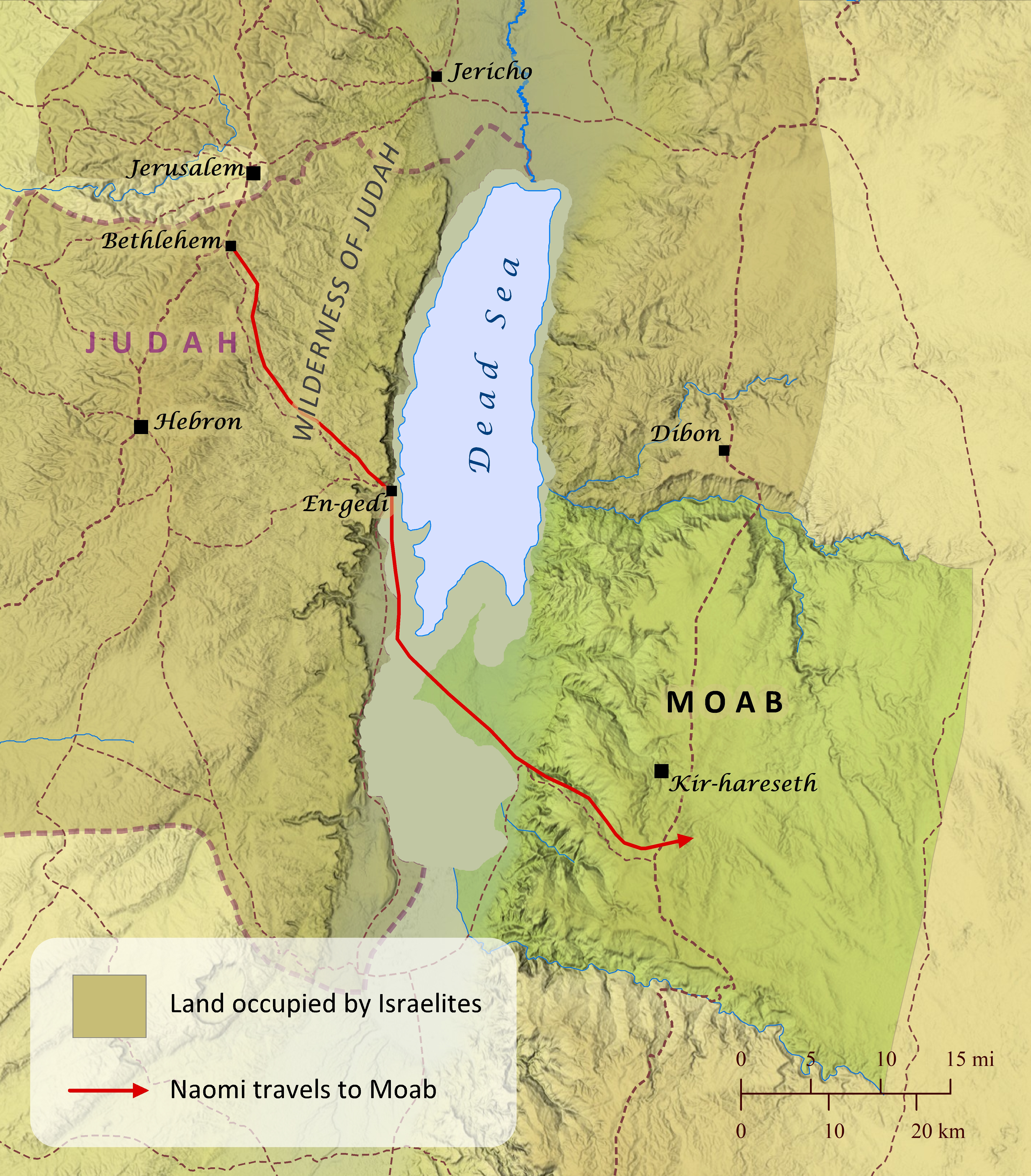
The story of Ruth is set in the time of the Judges, a few generations before the birth of King David. While much animosity often existed between Israel and Moab (Judges 3:12-30; 10:6-12:7; 2 Samuel 8:2; 10; 2 Kings 3:4-27; 2 Chronicles 20; see also Nations across the Jordan River map), other times the two nations appear to have enjoyed a somewhat congenial relationship, as is demonstrated by Naomi’s willingness to relocate to Moab to seek relief from a famine. Later Naomi’s sons also marry Moabite women, and Ruth’s devotion to Naomi and her God no doubt speaks highly of the character of many Moabites. Many years later Ruth’s great-grandson David placed his parents in the care of the king of Moab while he was on the run from King Saul (1 Samuel 22:3-4).
Open Bible Data site copyright © 2023–2026 Freely-Given.org.
Python source code for creating these static pages is available on GitHub under an open licence.
For Bible data copyrights, see the details for each displayed Bible version.
The Open English Translation (OET) main site is at OpenEnglishTranslation.Bible or OET.Bible.