
OET OET-RV OET-LV GHT ULT UST BSB MSB BLB AICNT OEB WEBBE WMBB NET LSV FBV TCNT T4T LEB BBE Moff JPS Wymth ASV DRA YLT Drby RV SLT Wbstr KJB-1769 KJB-1611 Bshps Gnva Cvdl TNT Wycl SR-GNT UHB BrLXX BrTr Related Parallel Simple Interlinear Topics Reference Dictionary Search
OET By Document By Section By Chapter Details
OET INT FRT GEN EXO LEV NUM DEU JOB JOS JDG RUTH 1 SAM 2 SAM PSA AMOS HOS 1 KI 2 KI 1 CHR 2 CHR PROV ECC SNG JOEL MIC ISA ZEP HAB JER LAM YNA (JNA) NAH OBA DAN EZE EZRA EST NEH HAG ZEC MAL GES LES ESG DNG 2 PS TOB JDT WIS SIR BAR MAN 1 MAC 2 MAC 3 MAC 4 MAC YHN (JHN) MARK MAT LUKE ACTs YAC (JAM) GAL 1 TH 2 TH 1 COR 2 COR ROM COL PHM EPH PHP 1 TIM TIT 1 PET 2 PET 2 TIM HEB YUD (JUD) 1 YHN (1 JHN) 2 YHN (2 JHN) 3 YHN (3 JHN) REV
MAT Intro C1 C2 C3 C4 C5 C6 C7 C8 C9 C10 C11 C12 C13 C14 C15 C16 C17 C18 C19 C20 C21 C22 C23 C24 C25 C26 C27 C28
This is still an early look into the drafted text of the Open English Translation of the Bible. Please double-check the text in advance before using in public.
27:62 Guards are assigned to the tomb
62 The next day was the day after the Passover preparation day and the chief priests and the Pharisees went together to Pilate 63 and told him, “Master, we were reminded that that deceiver when he was still alive said that he would come back to life after three days[ref] 64 so you should command that the tomb be secured until the third day in case someone steals his body and then tells the people that he has come alive again—that would be a worse deception than his initial teachings.”
65 “Well you all guard it,” answered Pilate, “and keep it secure as you say.”
66 So they went and secured the tomb by sealing it and placing guards there.

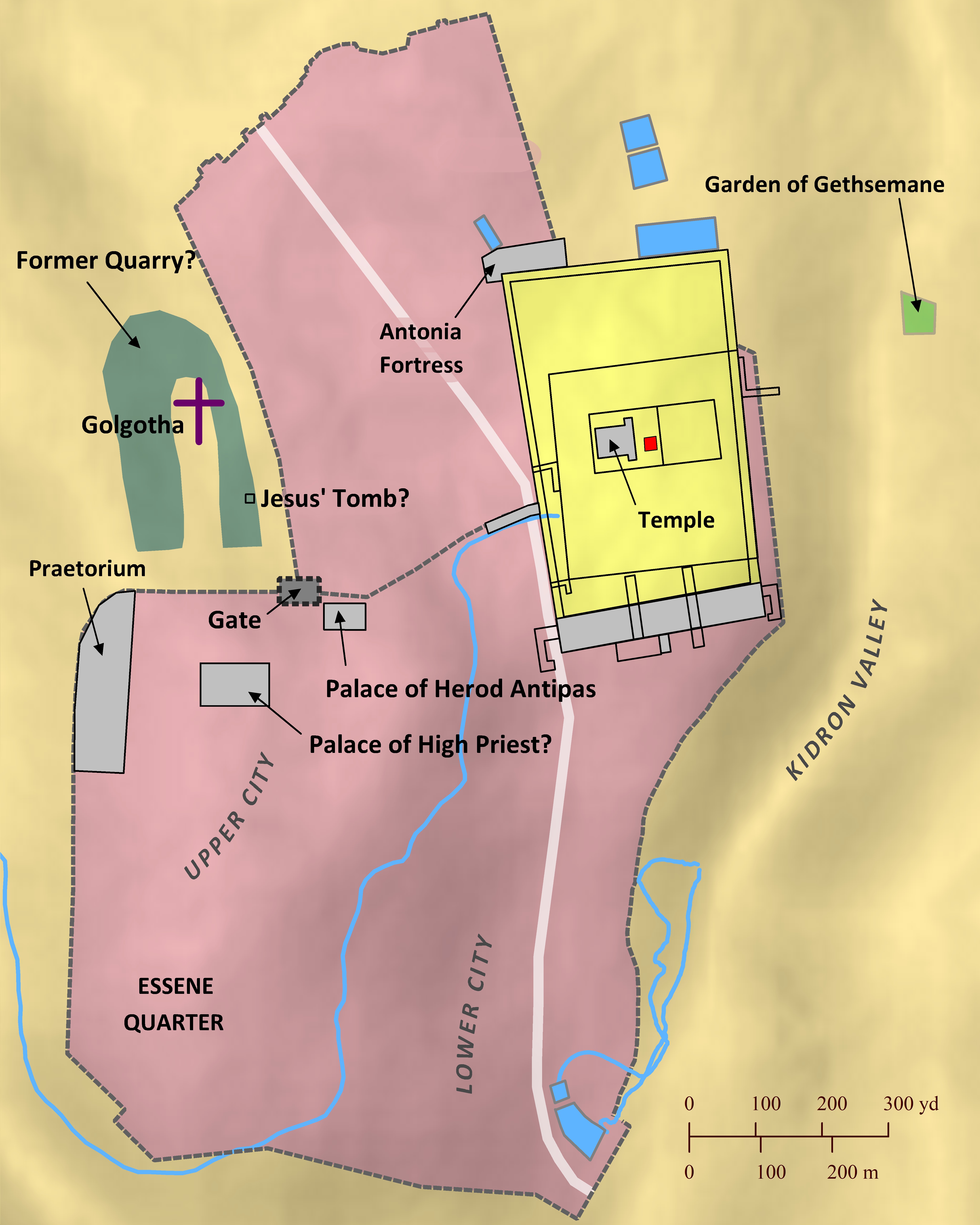
Matthew 26-27; Mark 14-15; Luke 22-23; John 13-19
On the Thursday before he was crucified, Jesus had arranged to share the Passover meal with his disciples in an upper room, traditionally thought to be located in the Essene Quarter of Jerusalem. After they finished the meal, they went to the Garden of Gethsemane, where Jesus often met with his disciples. There Judas Iscariot, one of Jesus’ own disciples, betrayed him to soldiers sent from the High Priest, and they took Jesus to the High Priest’s residence. In the morning the leading priests and teachers of the law put Jesus on trial and found him guilty of blasphemy. The council sent Jesus to stand trial for treason before the Roman governor Pontius Pilate, who resided at the Praetorium while in Jerusalem. The Praetorium was likely located at the former residence of Herod the Great, who had died over 30 years earlier. When Pilate learned that Jesus was from Galilee, he sent him to Herod Antipas, who had jurisdiction over Galilee. But when Jesus gave no answer to Herod’s many questions, Herod and his soldiers sent him back to Pilate, who conceded to the people’s demands that Jesus be crucified. Jesus was forced to carry his cross out of the city gate to Golgotha, meaning Skull Hill, referring to what may have been a small unquarried hill in the middle of an old quarry just outside the gate. After Jesus was unable to carry his cross any further, a man named Simon from Cyrene was forced to carry it for him. There at Golgotha they crucified Jesus. After Jesus died, his body was hurriedly taken down before nightfall and placed in a newly cut, rock tomb owned by Joseph of Arimathea, a member of the Jewish high council. This tomb was likely located at the perimeter of the old quarry.
MAT Intro C1 C2 C3 C4 C5 C6 C7 C8 C9 C10 C11 C12 C13 C14 C15 C16 C17 C18 C19 C20 C21 C22 C23 C24 C25 C26 C27 C28